Get Full Government Meeting Transcripts, Videos, & Alerts Forever!
Get email alerts on the Parking topic
No spam. Unsubscribe anytime.
Woonsocket council debates tighter rules for overnight parking and towing thresholds
Summary
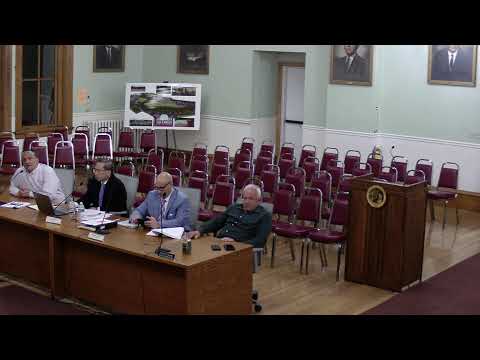
The Woonsocket City Council on June 9 reviewed a draft ordinance that would tighten rules for overnight parking on city streets and in municipal parking lots and change the number of days a vehicle must remain before it may be tagged and towed.
The Woonsocket City Council on June 9 reviewed a draft ordinance that would tighten rules for overnight parking on city streets and in municipal parking lots and change the number of days a vehicle must remain before it may be tagged and towed.
Council President Gendron opened discussion of the draft ordinance and said he was concerned with language that would shorten the period a vehicle may remain before becoming an enforceable violation. "I was on vacation, I left a vehicle parked in front of my house on a quiet cul de sac for 8 days," Gendron said. "If the draft changed 10 days to 5 days, my car could have been towed before I got home from my cruise."
The draft, prepared by City Solicitor Alan Fung, separates parking rules for on-street spaces from municipal lots and proposes changing the consecutive-days trigger and the number of days used to determine a violation. Fung told the council the change was prompted by practical enforcement problems the police were encountering. Under the previous wording, the police said they effectively needed five separate offenses — in practice requiring repeated checks over many weeks — before they could tag and tow a vehicle. "Before, because it required 5 offenses, the police had to stay out on the street for basically 50 consecutive days in order to be tagged and towed from that location," Fung said. He said the current draft scales that back to two consecutive violations of five days so a vehicle would not be towed until after about day 11 under the proposed text. Fung said keeping a 10-day threshold would instead push a tow to roughly day 21 under the new consecutive-offense language.
Council members raised a number of concerns. Councilwoman Gonzales asked whether residents who plan to be away could register a short-term exception at City Hall; she proposed a process by which a resident could provide notice and receive an accommodating log or temporary allowance. Director Steve D'Agostino and police staff said the department already makes case-by-case accommodations when contacted and that officers often note temporary exceptions in dispatch records. "If you called up and said, 'I'm having my driveway repaved,' the police would accommodate and note it in dispatch," D'Agostino said.
The draft also proposes making the Monument Square lots a single lot with uniform overnight hours and keeping a subset of permit spaces reserved for Church Street residents. Fung said the ordinance would set Monument Square no-parking hours at 2:30 a.m. to 6 a.m., consolidating two subsections that formerly used different end times.
Council members discussed enforcement priorities and scope. Police representatives said enforcement is aimed at repeated, stationary violations, not ordinary nightly parking in front of a homeowner's house. Captain Pickard said officers are not looking to conduct broad sweeps; they respond to complaints and use objective indicators — leaves under a vehicle, accumulated debris, repeated calls — to identify vehicles that appear to be stationary for an extended period.
Members also raised nonparking concerns that the ordinance would touch on, including camping in vehicles and vehicles doing mechanical work in lots. Gonzales asked whether the ordinance could add a prohibition on using municipal lots for repair or storage; Fung said adding that language is straightforward, but crafting objective criteria for environmental nuisance such as oil leaks is harder to prove. "It's difficult to come up with objective criteria to show that that stain was caused by a particular vehicle unless it's a repeat pattern," Fung said. Council members suggested exploring environmental or property-damage language that would allow the director or police to act when lots are being damaged.
Council feedback at the workshop included: keeping the 10-day allowance in section 1, creating a short-term notification process for residents who will be away, consolidating Monument Square hours while protecting existing Church Street permit spaces, and adding language to address grease or repair activity in municipal lots. The solicitor said he will revise the draft to reflect the council's input and return with a revised ordinance.
No formal vote on the ordinance was taken at the workshop; the item will return to a future meeting for formal consideration and possible adoption.