
Encinitas council votes to begin withdrawal from cooperative fire management agreement
Get AI-powered insights, summaries, and transcripts
Sign Up Free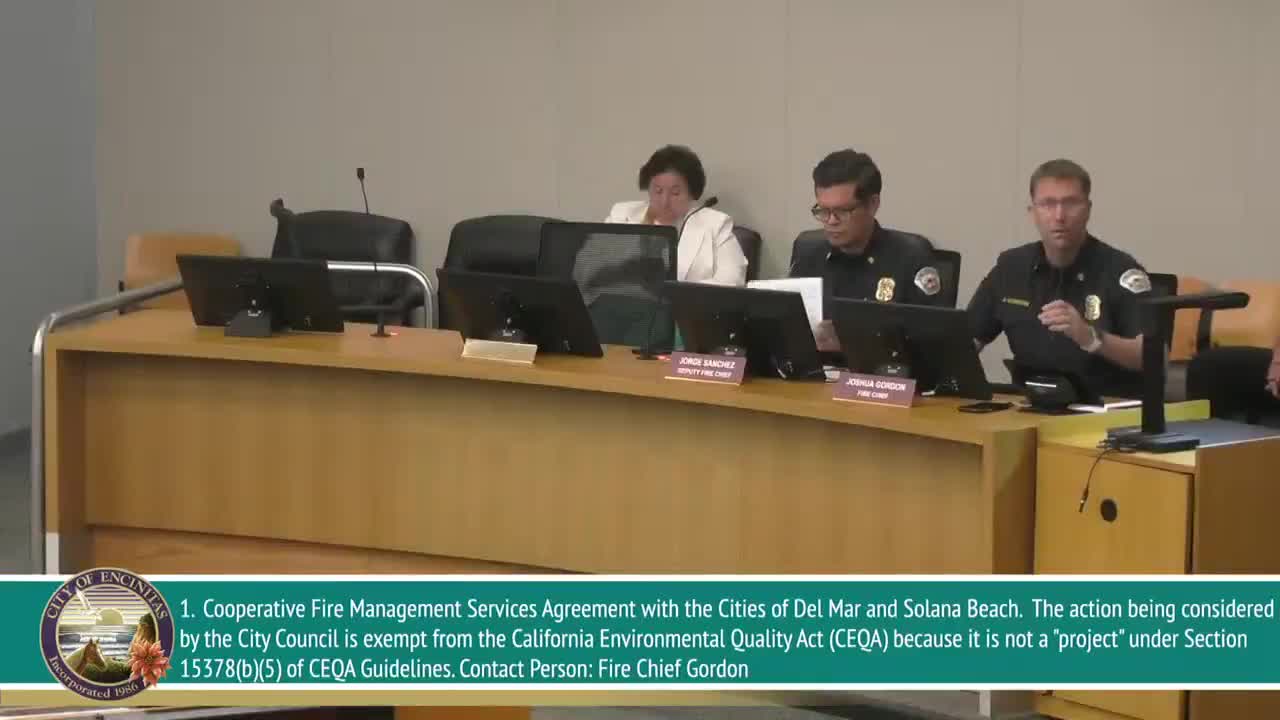
Summary
The Encinitas City Council unanimously directed staff to begin formal notice and a transition timeline to exit the cooperative fire management services agreement with Del Mar and Solana Beach, targeting a March 31, 2026 end date and an August public transition update.
ENCINITAS, Calif. — The Encinitas City Council unanimously approved a motion June 17 to initiate withdrawal from the Cooperative Fire Management Services agreement with Del Mar and Solana Beach, directing staff to give formal notice, develop a transition timeline and return with a public status update in August. Council set a target completion date of March 31, 2026.
Council members said the move is intended to let the city focus fire-management leadership and resources on local priorities including wildfire resilience, prevention work, training and efforts to raise the department’s ISO rating. Fire Chief Josh Gordon told the council that Encinitas currently funds roughly 69.25% of the cooperative management budget and that the city’s proposed cooperative-related revenue for fiscal year 2025–26 is about $850,000.
The cooperative management agreement began in late 2009 among Encinitas, Del Mar and Solana Beach (originally including Rancho Santa Fe Fire Protection District). Gordon summarized the management structure as 10 shared executive positions — a fire chief, deputy chief, fire marshal, administrative services manager, four battalion chiefs, a senior deputy fire marshal and an administrative captain — whose duties covered the three jurisdictions. The agreement’s cost-allocation formula, he said, is 10% equally shared, 20% by population, 20% by geographic area, 20% by call volume and 30% by suppression personnel.
Gordon told council the cooperative’s consolidation of executive management reduced administrative redundancies, but that Encinitas has grown substantially over the last 15 years — the city now serves more than 61,000 residents across about 19.4 square miles and ran 7,919 calls in 2024. He said that increased local hazards, shifting fire-hazard maps and recent incidents such as the Palisades fire convinced department leaders and the Public Health and Safety Commission the city needs more locally focused prevention and community engagement.
Public commenters asked for more financial specifics before finalizing withdrawal. Resident Sheila Cameron pressed the council for detailed numbers on staff, equipment and projected savings, asking whether positions added under the cooperative (training officer, senior deputy fire marshal, administrative captain) would still be needed and whether the roughly $1.8 million figure cited for Encinitas’s share of the cooperative represents annual costs or savings. Rachel Graves, who served on the public health and safety process, thanked Chief Gordon and urged clarity on whether losing the $850,000 will affect priorities identified in the city’s gap analysis, listing Station 6 minimum staffing, a deputy fire marshal, a community engagement specialist and four-person truck staffing among top needs.
City Manager (unnamed) and Finance Director Gallup described options to mitigate the budget impact: pursuing grants (including SAFER and Assistance to Firefighters/AFG grants and USDA prevention grants), expanding mitigation fees, adjusting development fees, and using dedicated emergency-service accounts. Gallup reported the city has about $500,000 in a CSA emergency-services account; staff said a nine-month transition would leave a prorated budget gap of a few hundred thousand dollars that would be covered in the coming year while staff develops longer-term funding options.
Council members debated timing and oversight of the transition. Deputy Mayor Lyons and others said they support the policy direction but want iterative public updates. The motion approved by the council instructed staff to (1) provide formal written notice to Del Mar and Solana Beach in accordance with the agreement, (2) establish a transition timeline aligned with the city’s fiscal planning, (3) conduct a comprehensive assessment of budgetary impacts of operating an independent fire department (personnel, equipment, administrative needs), and (4) coordinate closely with the partner cities to minimize service disruption. Staff will return with a public update on transition status and the change in departmental framework in August.
The council vote was unanimous. Mayor Ehlers moved the motion; Councilmember Schaeffer seconded. The council’s action initiates the formal process required by the contract and directs staff to report back publicly as the city develops its operating and budget plan.
The council did not make final determinations about which positions would remain Encinitas employees, exact budget offsets, or detailed program start dates. Chief Gordon and staff repeatedly said shared operational practices — automatic/closest-unit aid, joint training and joint purchasing — will continue regionally even if the management agreement ends. Gordon said, “The closest engine or the closest ambulance is the one who responds to that call no matter what,” and emphasized that the change is intended to restore local focus while maintaining regional operational partnerships.
What’s next: staff will send formal notice to partner cities, prepare the transition timeline and deliver an August public update on the transition’s status and the specific changes to the department’s organizational framework and service delivery. The council targeted March 31, 2026 as the transition completion date.