Get Full Government Meeting Transcripts, Videos, & Alerts Forever!
Get email alerts on the School Physical Education topic
No spam. Unsubscribe anytime.
Elyria City sports-performance class reports measurable strength and power gains in year one
Summary
Presenter Jay Banyas told the Elyria City Board of Education that 137 students who completed the district's sports-performance class posted improvements in three core performance measures; the program will expand next year with more class periods, summer sessions and a nutrition component.
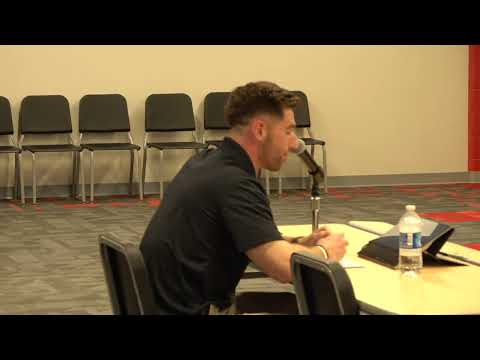
Jay Banyas, the district's sports-performance coach and presenter, told the Elyria City Board of Education on June 4 that 137 student-athletes who completed the first year of the sports-performance class improved on three core performance metrics.
Banyas said the program tracked bench press (upper-body max), squat (lower-body max) and vertical jump (explosiveness). "All 137 student athletes improved in all three aspects in our KPI," he said.
The district launched the class to provide year-round, in-school strength and conditioning that also counts for academic credit. "It's a free and equitable resource that all our kids have the opportunity to do now," Banyas said, describing the class as a daytime course that supports attendance and eligibility while letting students work or help at home.
Why it matters: Board members heard data intended to show the district's investment produced measurable athletic development and growing student demand, which administrators said supports expanding capacity.
Key numbers Banyas reported: at the start of the year five students could jump 30 inches or more; at the end of the year 28 students reached that benchmark (he characterized this as a 460% increase). Thirty-one students could bench 135 pounds at the start and 83 could at the end (about a 167% increase). Thirty-three could squat 185 pounds at the start and 79 at the end (about a 139% increase). Banyas said those figures came from the 137 student-athletes who participated for the full year and were used for the program's summative assessment.
Banyas also reported increased interest: initial program requests numbered about 147; for the 2024-25 school year requests rose to 221 (roughly 50% growth). He said retention for freshmen, sophomores and juniors returning the following year was about 95 percent.
Board members asked for gender and sport breakouts. Banyas said he did not have exact counts at the meeting but estimated the initial January requests were about 75% male and that the later (February) requests showed more female participation. He said the district will add class periods "to accommodate" rising demand and aim to run seven classes next year.
Plans for year two include summer training programs for each sport, more emphasis on speed and agility, development of a nutrition component (meal plans and grocery lists made available to families), and a longer-term goal to introduce dedicated middle-school offerings. Banyas said middle-school programs currently run in late-afternoon slots and the goal is to move them closer to the school day.
Board members and administrators who spoke during the discussion included Colleen Abel, the district treasurer, and Sam Slush, the superintendent, who both thanked coaches and staff. Banyas credited Heather Beck (program coordinator), Coach Hamilton (classroom and weight-room support) and Mr. Zwicker for program assistance.
Banyas closed by saying the district's approach allows the program to "stack" gains year over year because each incoming cohort will start from a higher baseline.
The board did not take formal action on the presentation; no budget or contract vote was recorded during the presentation.