Get Full Government Meeting Transcripts, Videos, & Alerts Forever!
Get email alerts on the Process Improvement topic
No spam. Unsubscribe anytime.
Council debates rubric, Q&A process and financial summaries in debrief; items added to retreat
Summary
After approving allocations, council members urged more opportunities to clarify applications, questioned how financial summaries and red/yellow/green flags are used, and recommended discussing changes to the rubric — especially for GOS — at the retreat and chairs liaison meeting.
Following the council's approval of funding recommendations, members devoted an extended portion of the meeting to a post‑allocation debrief focused on process improvements and topics for the upcoming retreat.
Council members raised three recurring themes: (1) a desire for more opportunities to ask applicants clarifying questions during or before study sessions, (2) concern about how SCFD financial summaries are color‑flagged and whether those flags introduce bias, and (3) requests to revisit rubric treatment of general operating support (GOS) versus project awards.
Council member Jim Toll emphasized the responsibility to “ask questions,” saying the council is “handing out other people's money” and should ensure applicants supply clear answers. Several members, including Aaron Vega, said brief Q&A interviews or a structured set of questions during study sessions could help reviewers better assess applications without adding excessive time. Zoe and Dana noted constraints in accepting new material after the grant deadline: Dana said, “you certainly can request, or you can ask questions of the organizations during the study sessions... we have the q and a repository that is in the Flux portal, and that contains questions... and the responses.” Dana clarified that organizations cannot submit new, unsolicited information after the deadline; any exchange must be a formal question posted to the repository for all reviewers to see.
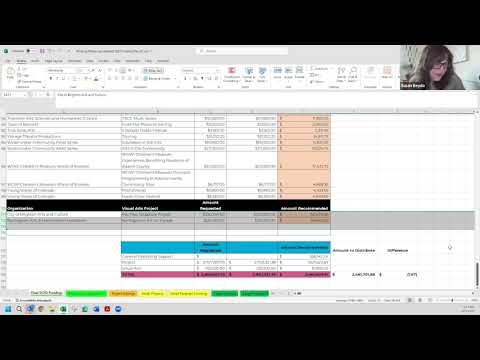
Members also debated the SCFD financial summaries that flag items green, yellow or red. Some councilors said the visual flags are a useful prompt to review attachments more closely. Others worried such flags could bias scoring. Dana said the color designations reflect staff review of financial statements and are intended as a tool, not a recommendation: “When SCFD... does the financial summaries, that is to assist you all... it has no indication whatsoever as to whether it's a good, bad, or okay grant.” She offered to brief the council at the retreat or the chairs‑liaison meeting on how the flags are determined.
A distinct discussion concerned whether GOS should be scored with the same rubric as project requests. Chair Joyce Downing said, “I really think we need a different rubric for the GOS. I don't think you should be using the... project rubric,” and asked for the council to prepare arguments and specific suggestions to present to the regional chairs if they want a change that would apply across all seven participating counties.
Zoe summarized potential retreat topics to be discussed in depth: clarifying eligibility for GOS (including office location and programming requirements), how schools and school‑based programming should count toward eligibility, the Q&A process and repository use, financial‑summary methodology, rubric calibration and study‑session formats (for example, order of review by organization size). Members agreed to add these items to the retreat agenda and to bring detailed proposals where appropriate.
Ending
Council members agreed the items merit fuller discussion at the retreat and potentially at the chairs‑liaison meeting; staff offered to prepare explanatory materials on the Flux Q&A repository, financial‑summary flags and rubric mechanics in advance of those sessions.