Get Full Government Meeting Transcripts, Videos, & Alerts Forever!
Get email alerts on the Transportation topic
No spam. Unsubscribe anytime.
Board and residents debate Rhinecliff parking plan, enforcement and safety standards
Summary
Town and Rhinecliff residents spent more than an hour debating a revised hamlet parking plan that would add on-street spaces, formalize 3-hour daytime parking in a town lot, and use enforcement tools including signage and a parking app.
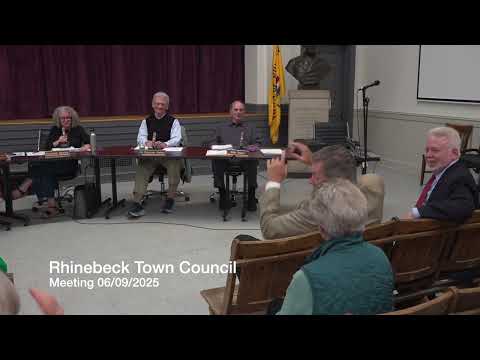
Rhinecliff residents, town board members and consultants held an extended public discussion on June 9 about a revised parking plan for the Rhinecliff hamlet that would add roughly two dozen on-street spaces, formalize 3-hour daytime parking in a town-owned lot, allow overnight resident parking, and use targeted signage or a parking app for enforcement.
Town Board member Chad Klitsch introduced the updated plan and said it removed most one-way street concepts except for one block (Kelly Street), clarified parking legends on the draft map, and proposed making the short 15-minute post-office spaces available for up to three hours after 5 p.m. to support evening visitors to the library and restaurants.
Consultant feedback and town legal guidance shaped parts of the debate. Board members said consultants (LaBella) advised that narrow street widths limit safe allowance of on-street parking unless streets are made one-way or meet state guidance; the board and residents questioned whether New York State guidance on "yield" roads applies in Rhinecliff and asked the town attorney and consultants to clarify the law. The board said it will go back to the consultant LaBella to seek additional guidance about whether parking can be permitted on one side of certain streets without converting them to one-way.
Residents and business owners described competing goals: they want enough short-term parking for library patrons, diners and events, but they also want to prevent long-term Amtrak commuter parking that blocks spaces for local visitors. Several residents urged clearer signage and enforcement so permitted parking is usable for locals. The board said it plans to codify parking rules in local law (which would allow posting signs) and to explore enforcement options, including periodic patrols by village police, contracted peace/officers or sheriff support.
Key operational proposals and clarifications discussed at the meeting included: - A 3-hour daytime limit for the town-owned municipal lot (16 spaces) with overnight resident parking available by permit or app; day and evening hours were discussed as roughly 8 a.m. to 10 p.m. for daytime use and a 10 p.m. overnight start for residents with permits. - Changing the existing 15-minute post-office parking to allow three-hour parking after 5 p.m. (and potentially on Sundays) so that library and evening patrons can use those spaces without risking tickets. - Moving or correcting map legend items (for example, the riverside ramp parking label) to reflect the desired on-ramp parking location for recreational users. - Consideration of making Orchard Street parking allowed on one side only or converting a one-block segment to one-way to gain additional parking near the firehouse; residents and board members debated safety and traffic-calming implications of one-way conversions.
Residents raised enforcement and liability concerns: consultants reportedly advised the town that certain roadway-width and state-guidance constraints could create liability if the town authorizes parking that does not meet state standards; residents countered this with local experience that the streets have functioned without past incidents. The board asked the consultant and town attorney to provide a clear legal opinion and to re-examine whether the "yield" road approach is applicable in a rural hamlet.
Board members said the town will: (1) return to LaBella for follow-up and clarification; (2) pursue consistent signage and possibly an app-based system to reduce sign clutter while enabling enforcement; (3) open the municipal lot as proposed for 3-hour daytime parking and permit overnight resident parking; and (4) consider permit, fee and towing procedures to reduce long-term Amtrak commuter parking.
No formal vote to adopt the Rhinecliff parking plan was taken at the meeting; the board said it will reconvene the item with consultant follow-up and legal clarification. Residents were encouraged to provide additional feedback to the board and to use posted channels once the town returns with clarifications.