Get Full Government Meeting Transcripts, Videos, & Alerts Forever!
Get email alerts on the Climate topic
No spam. Unsubscribe anytime.
Consultants present Rhinebeck climate action plan and municipal greenhouse-gas inventory
Summary
The town received a two-year Climate Action Plan and 2019 municipal GHG inventory from the Center for Economic and Environmental Partnership (SEAT); strategies include landfill mitigation, solar feasibility, heat-pump conversions, fleet electrification, green infrastructure and targeted culvert repairs.
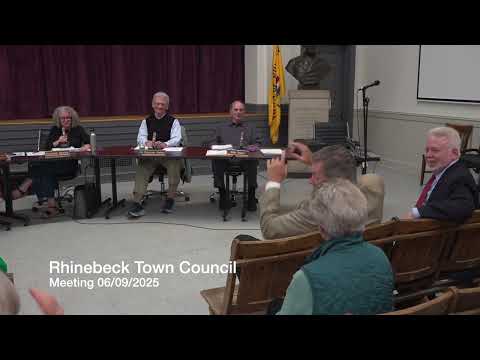
Town officials and consultants presented a Climate Action Plan (CAP), municipal greenhouse-gas (GHG) inventory and a vulnerability/adaptation assessment to the Rhinebeck Town Board on June 9, summarizing about two years of work that focused on municipal operations rather than community-wide emissions.
The Center for Economic and Environmental Partnership (SEAT) team (presenters: Janelle Kazarek, executive director, and Kim Easley, sustainability coordinator) said the inventory used 2019 as a baseline year and that they separated emissions from the town's capped Stone Church Road landfill from municipal-only emissions to better target mitigation actions.
SEAT identified municipal buildings and the vehicle fleet as the largest municipal emission sources once landfill emissions were removed. Recommended mitigation measures included: pursuing a solar array on the capped landfill (a feasibility study has been funded but is currently paused), installing a biofilter on the landfill cap to reduce methane emissions (presenters estimated about a 40% reduction at some times of year), adopting an environmentally preferable purchasing policy for municipal operations, converting large municipal buildings from oil/kerosene heating to heat pumps (the highway garage, town hall and maintenance shed were called out), an anti-idling policy, and a fleet-efficiency plan to phase in electric vehicles where operationally possible.
On adaptation and vulnerability the CAP team combined a 2020 vulnerability assessment with a 2024 focus group. The vulnerability/adaptation recommendations highlighted three categories: infrastructure, environment and social response. Infrastructure items flagged in the presentation included three culvert repairs (a concrete culvert on Lands Mill/Landsman Kill mainstream bed, an upsized culvert on Mill Road and another identified site) identified to improve stormwater management. The team recommended watershed-scale, targeted green infrastructure measures to address flooding of public roads and private property.
Presenters said residents in focus groups raised the need for micro-transit or ride-sharing options to help elderly residents, residents with disabilities and those without private vehicles, especially for evacuations and daily travel. The plan also recommends continued tree monitoring and maintenance to protect canopy cover, and mapping high social-vulnerability areas (floodplains, low-income and elderly neighborhoods, proximity to reporting facilities) to prioritize adaptation and outreach.
SEAT asked the board to accept feedback from the public and the board, make edits, and then adopt the plans. The CAP documents and a feedback form were posted on the town website; presenters invited residents to use the online feedback form and a QR code shared at the meeting.
Board members and staff asked about grant opportunities and next steps. Presenters noted that the solar feasibility funding is paused but that NYSERDA and other state programs may have opportunities; the presenters offered continued technical support and grant-writing assistance if funding resumes.
No formal vote on adoption occurred at the meeting; the board directed staff to review materials and invited public comment through the online form.