
Subcommittee weighs removing preapproval, easing attendance proofs and clarifying payment sponsors for volunteer EIP
Get AI-powered insights, summaries, and transcripts
Subscribe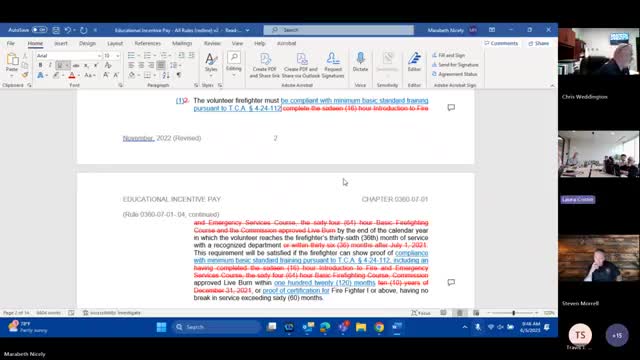
Summary
Members discussed scrapping preapproval for training programs, accepting electronic proof of completion, limiting mandatory tests, and clarifying who may request/receive EIP payments (departments, approved organizations, or individuals).
The rules subcommittee on June 5 also spent substantial time on administrative changes tied to the educational incentive pay (EIP) program: whether to remove preapproval of training programs, how departments should keep attendance and proof‑of‑completion records, what auditing is practicable for online courses, and who can request payment on a volunteer''s behalf.
Key administrative topics and outcomes discussed:
- Preapproval and substitution forms: Members discussed eliminating the longstanding preapproval/substitution program that required trainers to submit course packages in advance. The effect would be to move to an audit‑based system where departments submit attendance records and completion proof after the fact rather than seeking prior Commission approval. Several training officers welcomed the simplification; others warned the change could produce uneven training quality unless departments and AHJs take responsibility for quality control.
- Attendance records and electronic proof: The committee agreed that proof of completion (a certificate, course roster, or a verifiable platform report such as from Target Solutions) should be acceptable. Staff suggested replacing language that required a specific, Commission‑prescribed attendance form with a requirement to maintain a verifiable record and make it available on audit. One staff auditor said "proof of completion" is the practical standard used during audits.
- Online training and testing: Members debated whether every class must include a test. Many argued testing is impractical for ad hoc or conference CEUs and for live practical sessions that have no standardized test. The subcommittee moved away from requiring a test in every case; instead the committee said programs that have tests should retain them and departments should keep the associated test instruments/rosters for audit purposes. Members also discussed reasonable limits (for example, caps on how many online hours count toward EIP) but did not adopt final limits in this meeting.
- Audit procedures and anti‑fraud: Training officers asked how the Commission would audit online learning completed off‑duty and whether departments can detect "pencil‑whipping." Staff replied that auditing compliance with required hours is feasible, but verifying the identity of a remote course taker is primarily a department responsibility; departments should maintain internal procedures to limit misuse.
- Payment sponsors and attestation forms: The subcommittee discussed who may request EIP payments: the fire department, an approved sponsoring organization (for example, a chiefs or firefighters association), or in some cases the individual volunteer. Staff explained current practice: when a department accepts funds, a county/city administrative official signs the acknowledgement; when the department refuses funds, the individual may be paid directly, but the attestation form still must be completed in either the department or the individual's packet. Association representative David described past practice of his organization signing attestation forms on behalf of volunteers and said some volunteer groups prefer the association or a sponsoring organization handle payment distribution rather than the county government. Members suggested adding language to permit Commission‑approved organizations to act as sponsors so long as they meet financial controls.
What the subcommittee directed: Staff was asked to redraft rule text removing the prescribed attendance form language, to accept electronic proof of completion (certificate or verifiable platform report), to retain audit authority while clarifying that departments are responsible for preventing misuse of online CEUs, and to provide options for authorized sponsoring organizations or AHJ attestations where departments will not accept funds. No formal vote occurred.
Ending: The subcommittee emphasized administrative simplicity and auditability. Members asked staff to return with revised language that preserves financial safeguards while reducing paperwork burden on small departments.