Rules subcommittee debates training-hour, live‑burn rules that affect volunteer firefighter pay
June 07, 2025 | Commerce & Insurance, Deparments in Office of the Governor, Organizations, Executive, Tennessee
This article was created by AI summarizing key points discussed. AI makes mistakes, so for full details and context, please refer to the video of the full meeting. Please report any errors so we can fix them. Report an error »
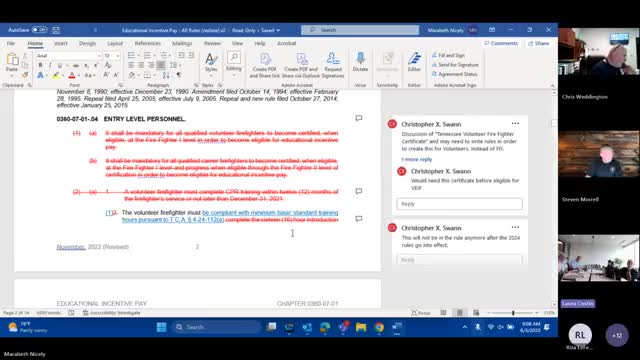
The debate centered on two competing aims: give the Commission office a clear, auditable standard for approving EIP while avoiding language that would exclude volunteers who trained under other regimes or in other states. Commissioner Solomon said a narrowly written statutory reference could reintroduce exemptions the committee had tried to avoid, warning that "If you leave that 1 12 a in there, they're gonna have to hit the 16 hours" (Commissioner Solomon). Staff and attendees repeatedly raised the practical problem that certificates from older courses or from other states often lack the discrete "16‑hour" or "64‑hour" labels currently used by the office for verification.
Among the points discussed:
- Hours vs. named courses: Some members argued the rules should specify a minimum number of verifiable hours (members discussed 90–96 hours as an approximate benchmark derived from a 16‑hour and 64‑hour construct). Others recommended removing the word "hours" from the rule and instead require completion of the "minimum basic training standard" or an equivalent course that the approving authority can verify. Staff said their processing this year has often required them to "take into account" older or differently labeled certificates rather than rely on a single hour figure.
- Live‑burn exemptions and AHJ attestation: The group noted Tennessee law already contains exemptions from the live firefighting portion for firefighters determined by medical certification or by a chief to be non‑interior/support personnel. A staff member summarized that the statute allows a chief to certify that a person "will not operate within an environment determined to be immediately dangerous to life and health" and thus be exempted from the live‑burn portion. The subcommittee discussed creating a standard attestation form the department chief would complete so the Commission office would not require a live‑burn certificate in those cases.
- Support personnel: Members pressed to include a distinct category for support personnel (drivers, engineers, logistics) who perform essential duties but who by policy or physical limitation do not enter Immediately Dangerous to Life and Health (IDLH) environments. The proposal under discussion would allow an attestation by the authority having jurisdiction (AHJ) to replace the live‑burn requirement for support roles so those personnel can qualify for EIP if they meet other minimum training standards.
- Investigators and inspectors: The subcommittee discussed explicitly including fire investigators and inspectors in eligibility language. Members noted the statute uses different time frames for inspectors versus other classifications (12 months for some inspector certifications, 24 months for certain public‑safety educator tracks), and they proposed harmonizing the rule language so newly hired inspectors/investigators must complete required certification within a consistent period (discussion focused on 12 months for inspectors and investigators).
- Reciprocity and out‑of‑state training: Several members raised examples of firefighters with substantial out‑of‑state training packages (one participant described a 124‑hour college program) that exceed Tennessee minimums but lack the Tennessee course labels. Staff said the AHJ should be able to provide documentation correlating such certificates to Tennessee minimums rather than forcing the firefighter to retake courses.
Why it matters: The committee's choices will determine which volunteers remain eligible for EIP payments and how burdensome documentation and verification will be for the Commission office and small departments. Members repeatedly emphasized avoiding language that would unintentionally exclude otherwise qualified volunteers, while also creating auditable standards for payment.
What the subcommittee directed: Members asked staff to draft rule language that (a) references the statutory minimums but allows AHJ attestation for live‑burn exemptions and support personnel; (b) clarifies timelines for inspectors/investigators; and (c) removes ambiguous one‑line hour statements in favor of verifiable course or certificate requirements. No formal vote or final rule adoption occurred at the meeting.
Ending note: Several members urged the subcommittee to keep the verification process administratively simple (an attestation form and clear checklist for staff) so smaller departments are not priced out of compliance or excluded from the EIP program.
Don't Miss a Word: See the Full Meeting!
Go beyond summaries. Unlock every video, transcript, and key insight with a Founder Membership.
30-day money-back guarantee
Sponsors
Proudly supported by sponsors who keep Tennessee articles free in 2025

