Get Full Government Meeting Transcripts, Videos, & Alerts Forever!
Get email alerts on the Historic Preservation topic
No spam. Unsubscribe anytime.
Downtown Austin historic resources survey documents nearly 2,000 resources, highlights underrepresented histories
Summary
City staff presented the 2024 Downtown Austin historic resources survey to the Housing and Planning Committee. The survey documented about 1,964 resources across roughly 1,553 parcels, identified clusters for potential historic districts, and noted archaeological research and equity-based preservation as priorities.
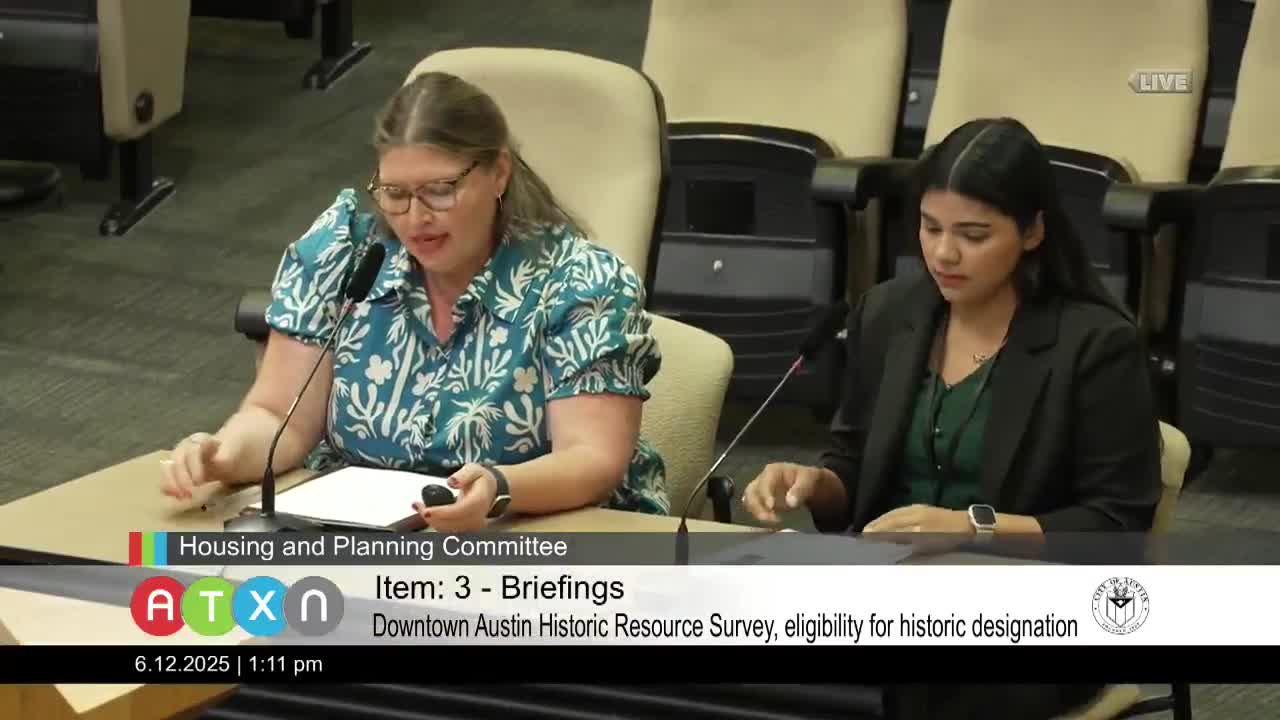
Kim McKnight, division manager for historic preservation in the City of Austin Planning Department, and Sofia Wagner, the city’s historic resource survey coordinator, presented the Downtown Austin historic resources survey to the Housing and Planning Committee on July 12.
The survey documented approximately 1,964 resources across about 1,553 parcels and evaluated properties built before 1975 for architectural character, historic association and potential designation eligibility. The survey area is bounded by Enfield Road and MLK Jr. Boulevard to the north, I-35 to the east, Lady Bird Lake to the south and Mopac to the west. Survey work included field documentation, historic research (including occupancy histories) and integration of data into the city’s GIS tools.
Sofia Wagner told the committee the team documented buildings and related features and photographed each resource; staff assessed integrity and possible eligibility for local landmark designation, local historic district zoning, and National Register listing. Kim McKnight said the survey identifies areas where groupings of historic buildings may qualify as new historic districts and noted the survey helps inform permit reviews, designation applications and public education.
McKnight emphasized that a survey is advisory research and does not automatically change zoning or taxes. She said local designation can alter zoning where a property receives historic overlay zoning and may make properties eligible for property tax reductions if owners comply with design standards; National Register listing does not change zoning but can make properties eligible for federal rehabilitation tax credits. McKnight also said involuntary designation against an owner’s wishes is possible under city law but rare: "Since 2014 only 2 buildings have been designated against an owner's wishes," she said.
Council members asked about archaeology and equity-focused preservation. McKnight said archaeology is a component of the city’s equity-based preservation plan and that the city is discussing resources and staffing to expand archaeological work, noting the Texas Archaeological Research Laboratory at UT Austin maintains classified records accessible to professional archaeologists. She also described coordination with multiple city departments on an implementation plan and a public dashboard tracking progress.
Examples cited during the briefing included properties evaluated as eligible for landmark status or historic-district listing; McKnight described the McFarland McBee House as an example where community action and nonprofit involvement supported preservation after designation was initiated. She said the final survey will be delivered to staff next week and the Historic Landmark Commission will receive a briefing in July, with the city planning to update surveys roughly every 10 years.
Funding for many surveys has come from the city’s historic preservation fund, supported by hotel occupancy tax allocations.
The survey and associated materials are available on the Historic Preservation Office website; McKnight and Wagner encouraged preservation and neighborhood stakeholders to review the full report.