Get Full Government Meeting Transcripts, Videos, & Alerts Forever!
Get email alerts on the Pavement Projects District3 topic
No spam. Unsubscribe anytime.
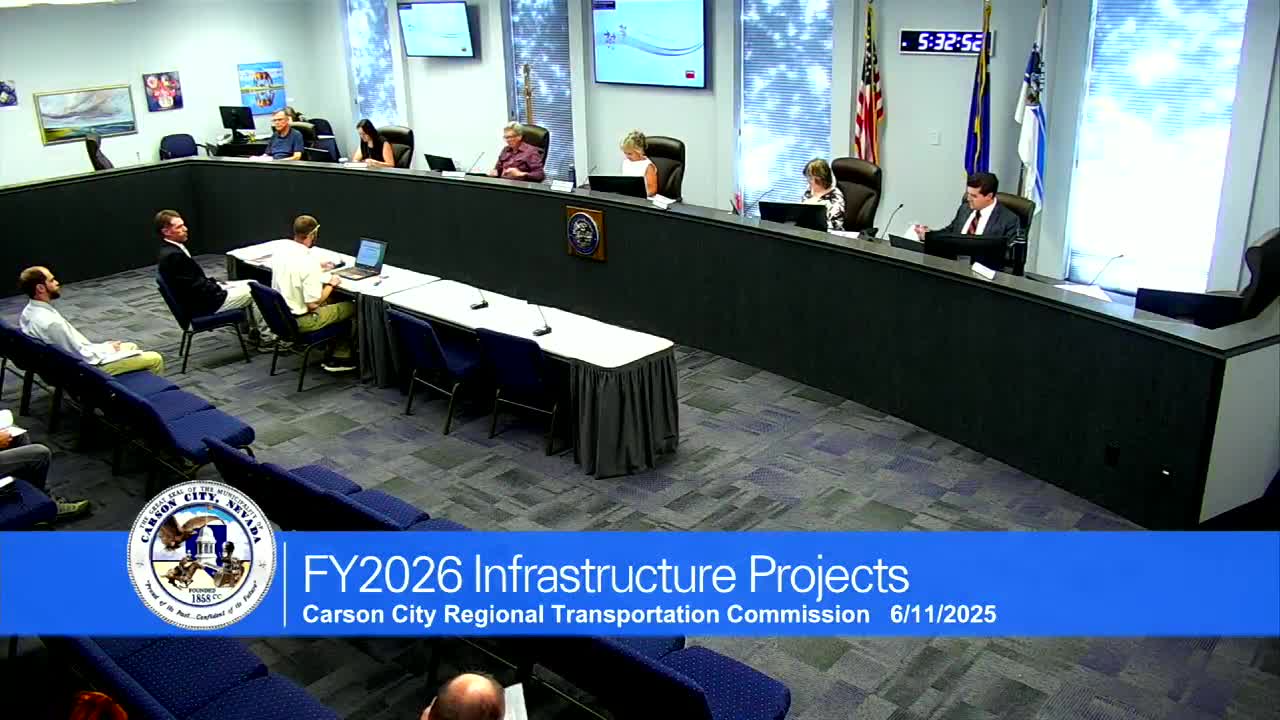
RTC staff recommend District 3 FY26 pavement projects; commissioners debate swaps and funding priorities
Summary
Staff proposed a slate of District 3 preservation and rehabilitation projects totalling roughly $4.56 million and recommended funding allocations; commissioners and members of the public questioned prioritization, costs for reconstruction (notably Desatoya Drive) and whether to swap Clear Creek for Empire Ranch.
Carson City staff presented recommended pavement projects for Fiscal Year 2026 in District 3 and described a prioritized package intended to allocate available RTC funds to preservation and rehabilitation work.
Casey Sylvester, presenting staff’s evaluation and selection, described a multi-step data-driven process that used the 2024–2028 Pavement Preservation Plan, PCI field data, traffic volumes (where available), road classification (regional vs. local), proximity and cost estimates to rank and group roadway segments into projects. Using those steps, staff produced eight regional and seven local candidate projects and recommended packaging four regional projects and two local projects for FY26.
Chris Martinovich summarized the proposed slate and funding: staff recommended four regional projects (Fairview Drive North from the Fifth Street roundabout to U.S. 50; Bud Eye Way including a segment of Airport Road; Clear Creek Avenue (Frontage Road/US 395 frontage to Snyder); and South Edmonds Drive rehabilitation) with an estimated combined cost of $3,602,000. For local roads staff recommended two projects (Hell’s Bells–Marsh preservation and a Racetrack Road neighborhood preservation package) with a combined estimated cost of $954,000. Staff said the FY26 project budget available to the RTC was approximately $4.6 million after roll-forward funds; the recommended regional-plus-local package totaled roughly $4.56 million, leaving an estimated $77,000 in available funding. Staff cautioned that construction cost volatility remains a risk and said they had built contingencies into estimates.
Commissioners pressed staff on several topics. Commissioner Lucia Maloney asked whether private developers were using polymer-modified mixes on new subdivisions; staff said they believed private developers are using polymer-modified oil mixes. Mayor/Chair Bagwell and others asked why very low-PCI local segments such as Empire Ranch Road and Desatoya Drive did not rise to the top of the recommended list. Staff explained the prioritization gives higher weight to regional roads (collectors/arterials), routes with transit service and projects that preserve investments (the “keep good roads good” approach); it also factors cost and constructability. Staff noted Desatoya Drive’s full reconstruction cost estimate was high (about $3,500,000 for the whole segment) and that some very low-PCI local roads are expensive to reconstruct, which reduces the number of miles the budget can cover.
Commissioners discussed possible swaps. Commissioner Maloney suggested staff discuss Clear Creek with the local tribe to explore potential partnership or federal tribal funding for that segment; staff said they would raise the idea with tribal staff. Several commissioners and members of the public urged considering replacing Clear Creek in the FY26 package with an Empire Ranch project because Empire Ranch repair would cover more miles for the dollar and addresses immediate neighborhood need. Commissioner Maloney and at least one other commissioner expressed support for substituting Empire Ranch for Clear Creek, but no formal motion or vote to change the recommended package was recorded in the transcript.
Public comment: Mark Costa, a resident, urged greater transparency in scoring and warned that the city may not have funds to fully repair the worst roads; he suggested, for some severely deteriorated segments, that converting to lower standards (e.g., gravel) might be a candid option if reconstruction dollars are not available.
Staff outlined next steps: finalize scopes of work, coordinate with utilities and other agencies, begin design in fall and schedule construction for summer 2026, and pursue additional federal funding where eligible. Commissioners asked staff to produce additional scenario analyses showing what different funding levels (for example a dedicated sales-tax scenario) would do to projected pavement conditions and the list of projects.