Get Full Government Meeting Transcripts, Videos, & Alerts Forever!
Get email alerts on the Workers Bill Of Rights topic
No spam. Unsubscribe anytime.
Council hears public comment urging unbiased research on proposed Workers’ Bill of Rights; staff says RFQ imminent
Summary
A resident urged the council to proceed with unbiased research on a proposed Workers’ Bill of Rights. Assistant Manager Stacy Ray said the city is finalizing an RFQ and will seek consultants and academic partners to conduct the work, with updates coming at the midyear retreat.
A member of the public urged Olympia city leaders to move forward with “unbiased research” on a proposed Workers’ Bill of Rights and warned the policy could have far-reaching effects on employees, employers and the local economy.
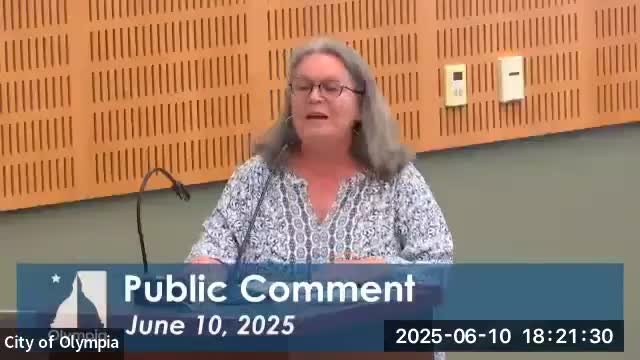
Suzanne Beatty, identified as an Olympia resident, told the council she attended the council’s planning day in January and understands the bill is in the finance committee with budgeted funds to research baseline conditions and potential impacts. She urged the council to hire researchers experienced in objective analyses so that implementation decisions would be grounded in reliable data.
In response to requests for an update, Assistant Manager Stacy Ray, who said she is the project staff lead for the workers’ bill of rights research scope, told the council staff had established a scope of work with the finance committee and were finalizing a request for qualifications (RFQ) to find a consulting firm. Ray said staff will also reach out to academic institutions to identify existing data and research and that the work will be reported on at the council’s midyear retreat.
Ray described the process as moving forward: "I'm working with our director of economic development, Jennica Machado, to put together an RFQ…to find a consulting firm that can work with us to do the kind of unbiased research that we've talked about," she said. No timeline for consultant selection or final report was provided in the meeting.
Beatty urged a one-year deadline for the research and emphasized the importance of reliable baseline data to understand potential effects on wages, scheduling, safety and staffing needs if the council moves forward with implementation.