Get Full Government Meeting Transcripts, Videos, & Alerts Forever!
Get email alerts on the Infrastructure Materials topic
No spam. Unsubscribe anytime.
Committee advances bill requiring local agencies to explain when they reject recycled asphalt
Summary
AB 978 would encourage use of recycled asphalt pavement (RAP) in local road projects by requiring local agencies, upon bidder request, to provide reasoning if they determine RAP use is not feasible; the Transportation Committee passed the bill and moved it to Appropriations.
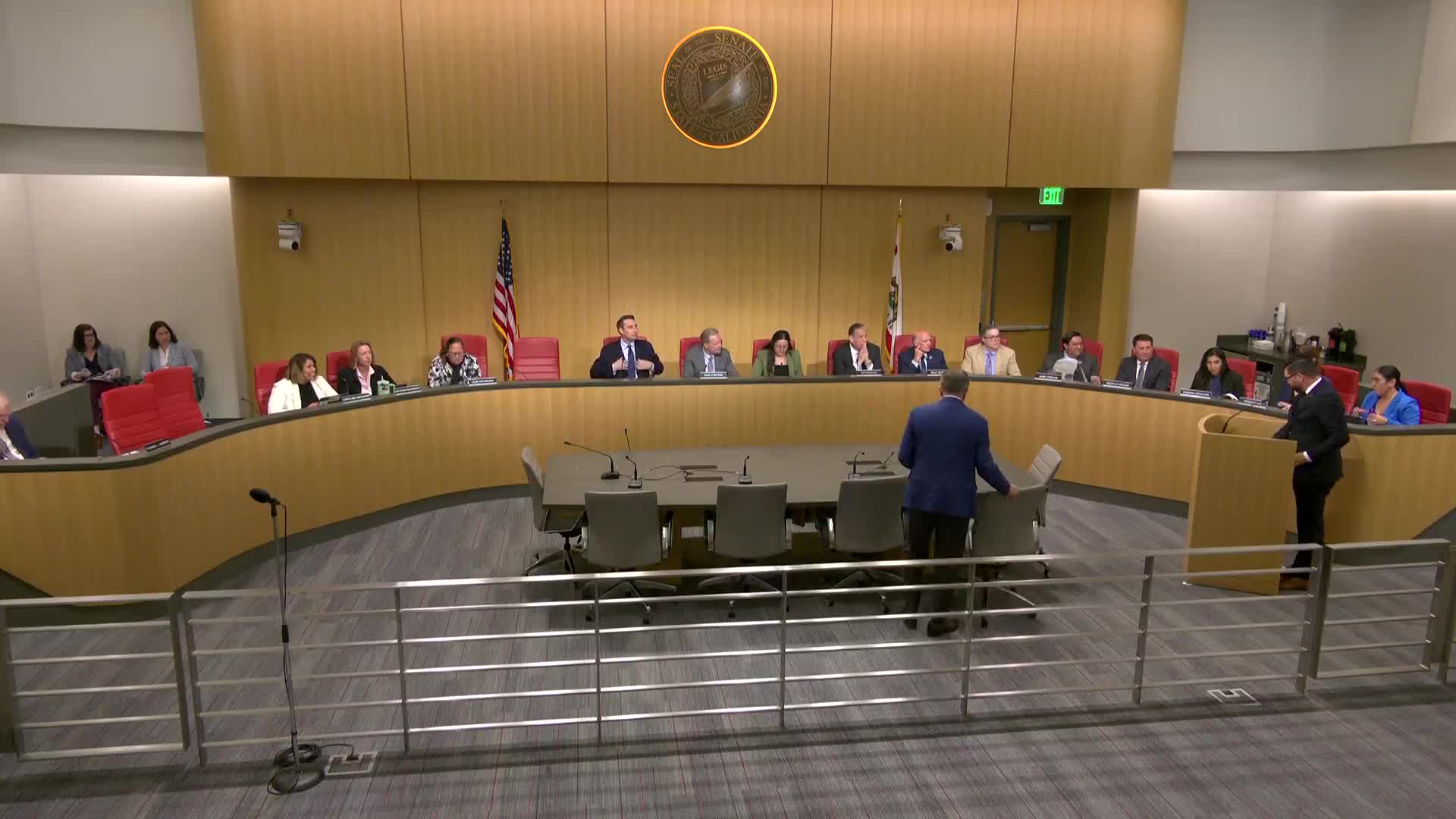
Assemblymember Kevin Hoover presented AB 978 to the Senate Transportation Committee as a measure to promote sustainable, cost‑reducing use of recycled materials — specifically recycled asphalt pavement or RAP — in local road projects.
Hoover said the bill would maintain the existing requirement that local agencies allow the use of recycled materials "to the extent feasible and cost effective," and would add a requirement that agencies provide reasoning upon request when they determine RAP cannot be used. "AB 978 would continue to require a local agency to allow for the use of recycled materials in their paving projects to the extent feasible and cost effective. But it would also require local agencies upon request to provide reasoning if they determine that it is not feasible," Hoover said.
Industry supporters described environmental and cost benefits. Don Roland, vice president of government affairs for Granite Construction, told the committee that RAP reuses rock, sand and oil from milled asphalt, reduces demand for virgin materials, lowers truck trips and greenhouse‑gas emissions, and that Caltrans currently allows up to 25 percent RAP in new asphalt production. "There is no waste," Roland said. He emphasized the bill does not mandate RAP use; it seeks transparency when agencies decline it.
Contractors and trade representatives voiced support. Todd Blumstein, representing the Southern California Contractors Association, spoke in favor of the bill.
Committee questions and cost: Senator Richardson asked whether RAP is cheaper than new asphalt. Witness testimony said price can vary by market and location; in many areas recycled material costs less and can moderate volatility in oil markets. When pressed for a direct answer, a witness responded that recycled asphalt "would overall, would cost less than new."
Vote and procedure: Vice Chair Strickland moved the bill. The committee vote was recorded and the chair announced the bill "out" following roll call; the hearing record shows the committee moved AB 978 forward (committee notation indicated the bill was out of committee). The chair said, "13. The bill's out." That roll call was completed and the measure was placed on the committee record for referral to the Committee on Appropriations.
Why it matters: Supporters said the bill encourages wider adoption of a recycling practice already permitted at the state level (Caltrans) and increases transparency when local agencies decline recycled materials, which proponents say can reduce environmental impacts and project costs.
What the bill does not do: Supporters and the sponsor emphasized AB 978 would not mandate RAP nor set a statewide quota; it would preserve local agency discretion while requiring written reasoning upon request when RAP is not used.
Next steps: AB 978 was advanced from the Transportation Committee and referred to the Committee on Appropriations for further consideration.