Get Full Government Meeting Transcripts, Videos, & Alerts Forever!
Get email alerts on the Emergency Management topic
No spam. Unsubscribe anytime.
Committee advances bill letting local emergency offices seek 'code 3' vehicle permits
Summary
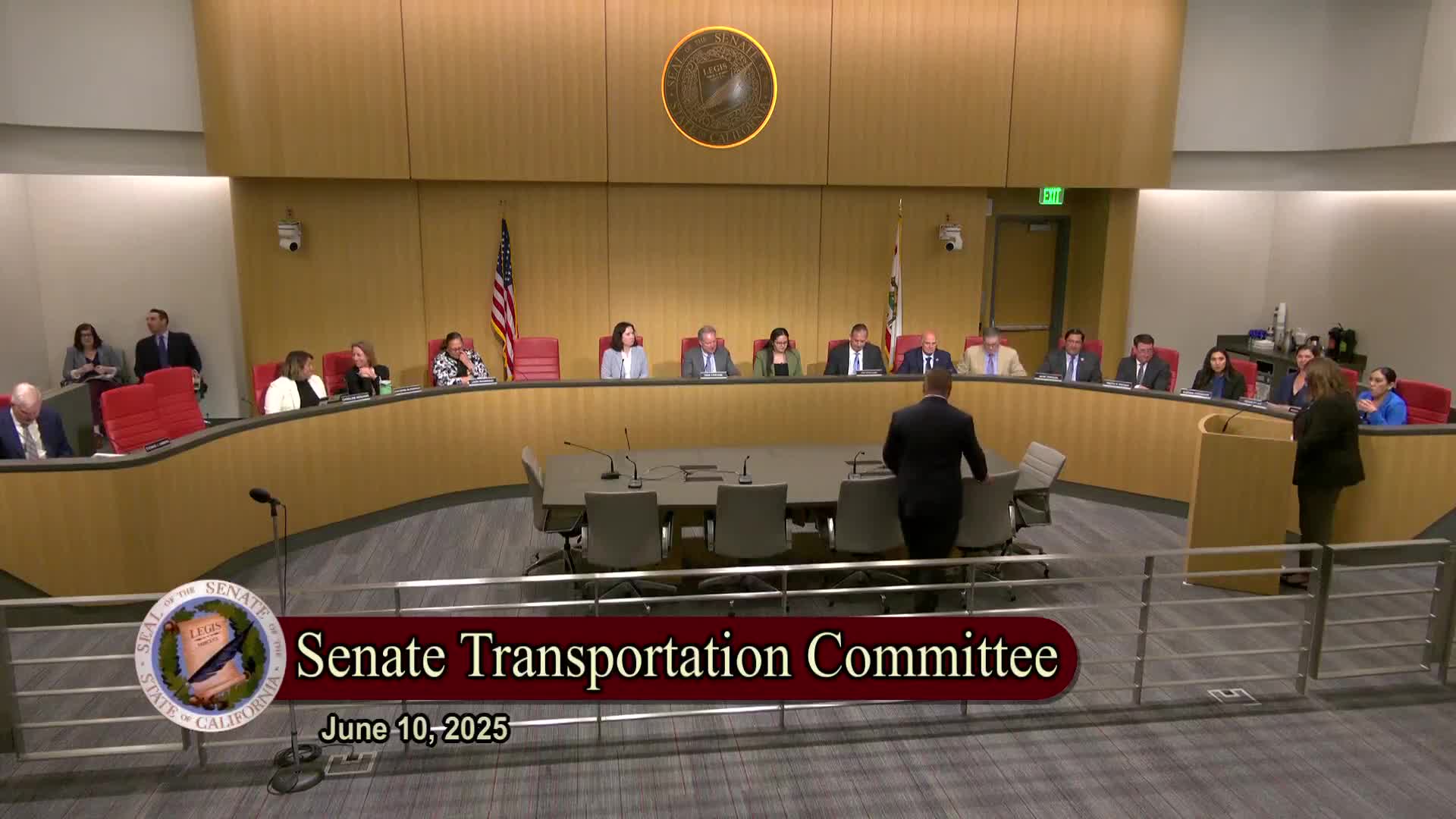
The Senate Transportation Committee advanced AB 438, which would let city and county offices of emergency services apply to the California Highway Patrol for authorized emergency vehicle permits to use lights and sirens when circumstances warrant; the measure passed the committee on a 12-0 vote and moves to the Committee on Appropriations.
Assemblymember Christy Haslund Hadwick on behalf of Assemblymember Hadwick (author) told the California State Senate Transportation Committee that AB 438 would let city and county offices of emergency services apply to the California Highway Patrol for an authorized emergency vehicle permit to use lights and sirens in time‑sensitive life‑safety situations.
The bill, Hadwick said, aims to close a gap that leaves local emergency managers without the statutory vehicle authority of police, firefighters and some state agencies. "Under current law, police, firefighters, and state office of emergency services vehicles are considered authorized emergency vehicles. ... Local offices of emergency services do not have this authorization," Hadwick said. She described the change as important for rural and fire‑threatened communities and asked the committee for an aye vote.
The bill’s sponsor and a local emergency manager told the committee why the change matters in practice. "This bill provides local government the option if they choose to authorize their office of emergency services to use code 3 driving when the situation warrants it," said Zachary Hamill, emergency operations manager for the Sutter County Office of Emergency Management. Hamill said timely evacuation notices during fast‑moving wildfires can be critical and gave one example where OES personnel drove with lights and siren out of a cellular dead zone to reach internet access and issue an evacuation order.
Eric Will, speaking on behalf of Rural County Representatives of California, voiced support for the measure, describing it as beneficial to rural counties.
Committee procedure and vote: Vice Chair Strickland moved the bill. The committee recorded a 12‑0 vote to pass AB 438 to the Committee on Appropriations. The motion was recorded as "pass with committee on appropriations." The committee chair noted two members were excused from the hearing; the roll call reflected the committee's recorded aye votes.
Why it matters: AB 438 would create an opt‑in process for local governments; it does not compel any jurisdiction to authorize code‑3 driving for OES vehicles. Supporters said the option would let trained emergency management staff respond more quickly during evacuations, hazardous material incidents and other time‑sensitive public‑safety events, particularly where communities are remote and dispersed.
What the bill does not do: The measure does not require jurisdictions to add sirens to every county vehicle or to create new routine code‑3 operations. Hadwick and Hamill emphasized the bill simply permits an application process with the California Highway Patrol and leaves adoption to local authorities.
Next steps: With committee passage, AB 438 was referred to the Committee on Appropriations.