Get Full Government Meeting Transcripts, Videos, & Alerts Forever!
Get email alerts on the Land Use Zoning topic
No spam. Unsubscribe anytime.
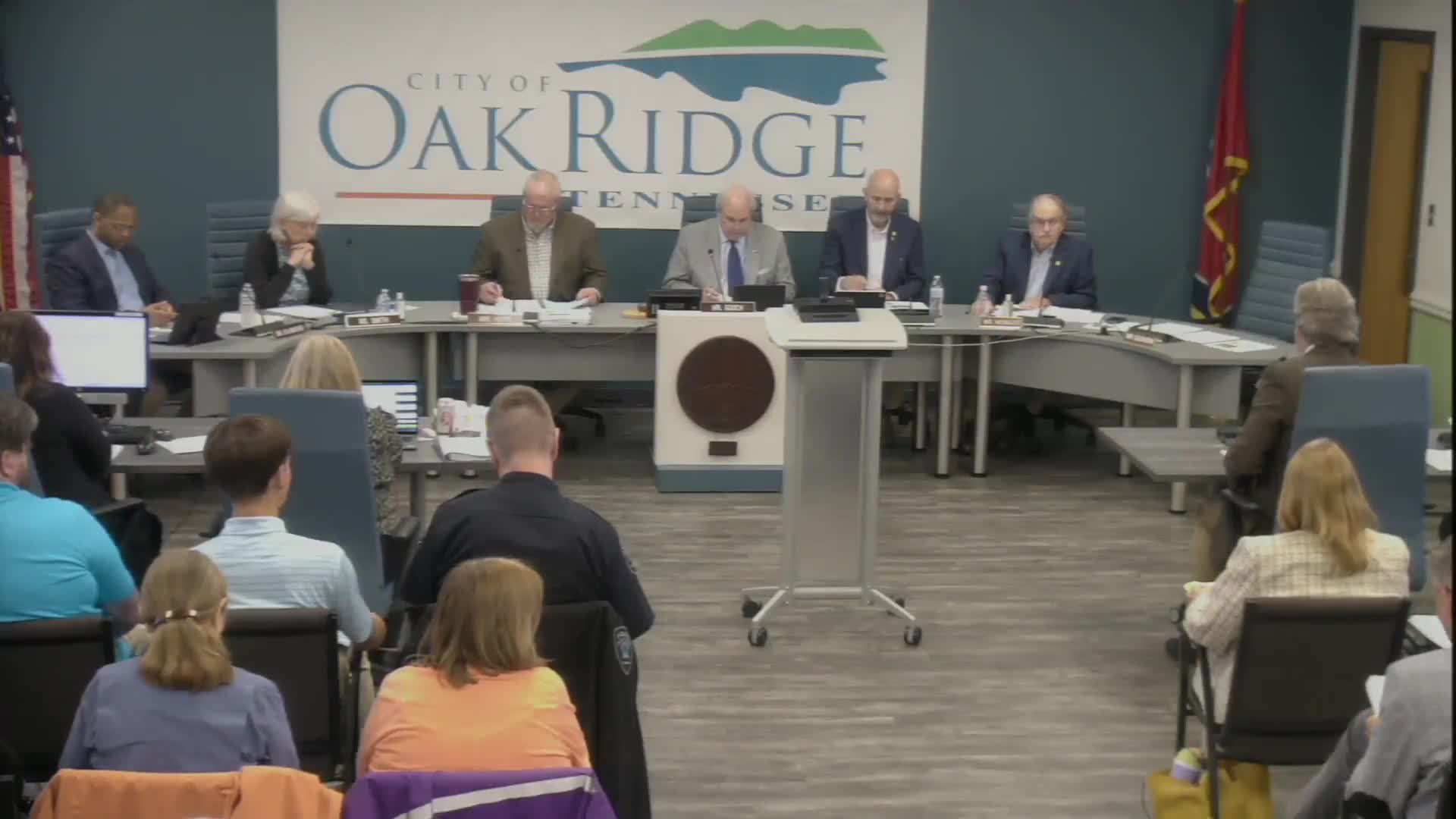
Council approves IND3 zoning for Development Area 5 at Horizon Center amid questions about radioactive materials and surrounding greenways
Summary
Oak Ridge City Council approved on first reading a rezoning that changes roughly 96.5 acres in Horizon Center from IND2 to IND3, a higher‑hazard industrial classification, prompting council questions about proximity to greenways and conservation easements.
Oak Ridge City Council voted to approve the first reading of an ordinance to rezone Development Area 5 in Horizon Center Industrial Park (approximately 96.5 acres) from IND2 to IND3 industrial zoning. Council considered a staff presentation, public comment and questions about whether the IND3 designation was appropriate for the site, which borders greenway trails and conservation easements.
Planning staff and the planning commission recommended approval. City staff representative Wayne Blasius told council the applicant—represented in the meeting by a company speaker—requested IND3 because of planned future phases the applicant said would not be allowed under IND2.
Council member Smith (identified in the transcript as Miss Smith) raised substantive objections. She said the IND3 district is intended for operations that can create nuisances such as excessive noise, odors and significant hazards; she questioned whether placing another IND3 zone next to greenways, the Black Oak Ridge Conservation Easement and nearby subdivisions was appropriate. She noted that the presence of radioactive materials alone did not, in her view, justify IND3 and emphasized concern about “significant external radiation” or accident consequences.
A company representative, who identified himself in the meeting as Mike Tessa (program director) and said his company had purchased the land, told council the planned activities are “related to a nuclear work” and would be licensed by the U.S. Nuclear Regulatory Commission. When asked why IND3 was necessary, he said he did not know the technical differences between IND2 and IND3 and asked for time to provide details by the final reading.
A nearby resident, Doug Cole, told council he had observed heavy day‑use on the Greenway near the site and disputed the applicant’s description of the area as “isolated.” He said he encountered children and multiple parked cars on the Greenway within 30 feet of the property boundary.
Council discussion also noted that TRISO‑X, an adjacent facility, already occupies IND3 property and that the city has begun work on a specialized zoning district for nuclear uses; the city manager mentioned a state grant to hire an expert consultant to help create that zoning category.
Outcome: The council approved the ordinance on first reading. Staff and council asked the applicant to provide more detail before final reading so council could assess whether IND3 was the correct classification or whether other zoning tools should be applied.
Why it matters: The rezoning places a high‑hazard industrial classification adjacent to conservation land and neighborhood greenways and prompted council and residents to request more technical documentation from the applicant and to accelerate work on a possible new nuclear zoning district.