Get Full Government Meeting Transcripts, Videos, & Alerts Forever!
Get email alerts on the Water Rates topic
No spam. Unsubscribe anytime.
Elsinore Valley Water board outlines drivers of proposed Proposition 218 rate increases; public hearing set June 26
Summary
Elsinore Valley Municipal Water District officials told the Lake Elsinore City Council that rising imported water and new drinking-water regulations are the primary drivers behind proposed Proposition 218 rate adjustments and that a public hearing is set for June 26 at 4 p.m.
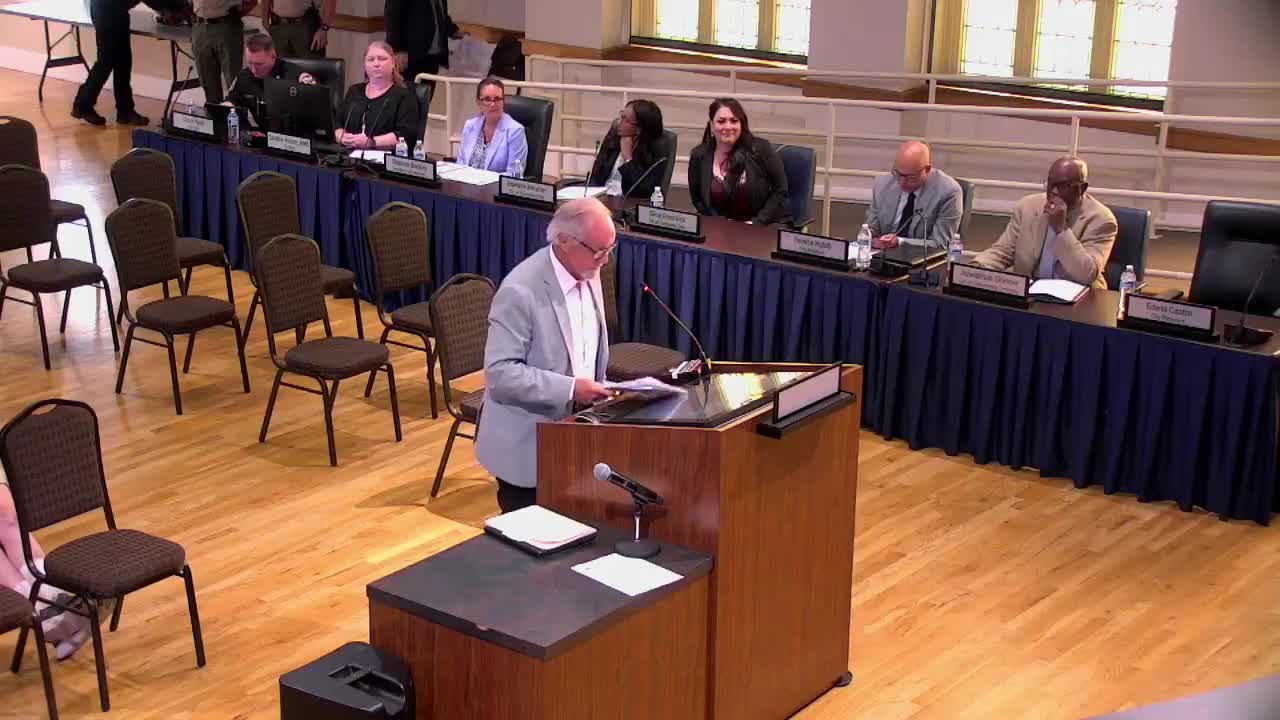
Elsinore Valley Municipal Water District board member Harvey Ryan told the Lake Elsinore City Council that proposed rate adjustments under Proposition 218 respond to sharply higher supply and treatment costs and that the district will hold a Proposition 218 hearing on June 26 at 4 p.m.
“We don’t take raising rates lightly,” Ryan said. He told the council the district imports roughly 75% of its water from the Metropolitan Water District, which has announced multi-year increases that will push local costs higher. He also flagged electricity cost projections — “Edison is projecting double digit 17% increases in the next 6 months” — and the district’s continuing need to treat regulated contaminants.
The presentation described the most immediate technical and regulatory drivers: state limits on PFAS and related compounds forced the Canyon Lake treatment plant offline, Ryan said, and reauthorizing that source will require a new treatment facility he estimated at more than $100 million. The district also reported some wells out of service because of similar regulation. Those compliance and supply pressures, he said, contribute substantially to the proposed rate adjustments.
Ryan outlined how the district plans to spread costs and soften near-term impacts: a five-year capital program of about $600 million, funded in part by capital facility fees charged to new development; use of reserves; and roughly $15.1 million in non-ratepayer revenue over the next four years to offset increases. He said the district had considered smaller, phased-in increases of about 3% per year but that approach could force much steeper, double-digit hikes later. To support customers with low incomes, Ryan said the district operates a rate assistance program called RARE that can reduce water and sewer bills by about $40 a month for qualifying households.
Why it matters: the district’s service area includes large portions of Lake Elsinore and adjacent communities. The district’s cost projections and the proposed rate adjustments will affect household and commercial water bills if adopted after the Proposition 218 process.
Council members did not pose substantive questions during the presentation. Ryan invited residents to the June 26 Proposition 218 hearing to review the full analysis and ask questions. He also said the district will meet with council members to discuss recently adopted capital facility fees and stressed that many growth-related infrastructure costs are paid by developers through those fees rather than by existing customers.
Clarifying details from the presentation include: imported water supplies of roughly 75% of the district’s portfolio; the district’s five‑year capital improvement program estimated near $600,000,000; an estimated more-than-$100,000,000 treatment plant needed to address PFAS at Canyon Lake; and a non-ratepayer revenue offset of approximately $15,100,000 over four years. Ryan identified a Proposition 218 hearing on June 26 at 4 p.m. and described the RARE rate assistance program as providing about $40 per month in bill credits for qualifying customers.
The district’s staff provided no firm percentage for the proposed overall rate change during this council presentation; Ryan said detailed rate schedules and the full independent rate study will be presented during the June 26 public hearing.