Get Full Government Meeting Transcripts, Videos, & Alerts Forever!
Get email alerts on the Zoning Ag Element topic
No spam. Unsubscribe anytime.
Board denies proposed Title 25 zoning changes, asks stakeholder group to continue work
Summary
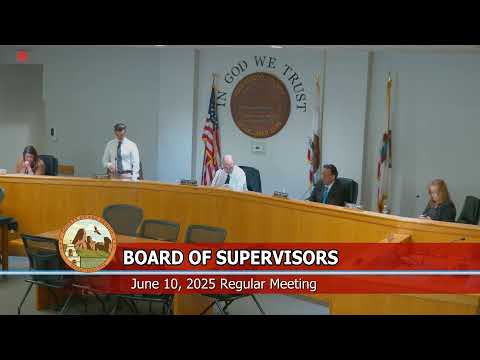
After more than two hours of public comment, the San Benito County Board of Supervisors voted 5-0 on June 10 to deny proposed amendments to Title 25 that would have raised minimum lot sizes for certain agricultural zoning categories and to return the issue to stakeholder review and a focused committee for further work.
The San Benito County Board of Supervisors voted 5-0 Tuesday to deny proposed ordinance changes to Title 25 that would have increased minimum parcel sizes for subdivisions in several agricultural zoning categories and to direct staff to bring back a public committee process tied to the county’s ag-element stakeholder group.
Supporters of the denial said the measure needed more study and more input from farmers, lenders and the county’s Ag Element stakeholder planning group; opponents said the change would sharply reduce land values, harm family farms and shrink borrowing power for agricultural operations.
The board’s action follows a lengthy presentation by county planning staff and multiple hours of public comment from landowners, farming groups, realtors and lenders. Planning staff presented a draft that would have raised the minimum acreage “for subdivision only” in certain categories: agricultural productive (AP) from 5 to 40 acres, agricultural rangeland (AR) from 40 to 160 acres, and rural transitional (RT) from 2.5 to 5 acres, with additional clarifying language intended to show how the changes would apply to “each new lot or parcel.” The planning commission recommended moving a version of the amendments to the board with a higher AP threshold; the ag-element stakeholder planning group voted unanimously on June 3 to request that the board remove the item from the agenda and continue the work.
During Tuesday’s session, Principal Planner Bridal Goodspeed reviewed maps and explained that the proposed text would affect subdivision eligibility even where parcels already appear large on GIS maps, and that the assessor’s office had told staff it could not produce an accurate estimate of overall assessed-value loss because market reactions vary. County Assessor Tom Slavich told the board that owners could request reassessments if subdivision rights were restricted; he said changes in highest-and-best-use can reduce assessed value, but the office could not calculate a single countywide dollar figure.
More than a dozen people representing farms, the San Benito County Farm Bureau, the San Benito County Cattlemen’s Association, realtors and lenders urged the board to pause and seek more analysis. Lenders and mortgage experts warned that changing zoning would complicate appraisals and lending on parcels, particularly for borrowers who rely on land equity. Several landowners testified that they had purchased land or taken on long-term indebtedness based on existing zoning and would see future borrowing power reduced.
Supporters of tighter limits said the county does need tools to keep agricultural land productive and to address situations where 5‑acre subdivisions are adjacent to working farmland, creating conflicts. Supervisor Zenger suggested “cluster development” as a possible compromise in which residential density could be concentrated while leaving larger blocks of farmland in agricultural easement. Several supervisors said the item had not been adequately resolved in the stakeholder group and that the broader ag-element work should continue before adopting zoning text changes.
The board first voted to deny the ordinance changes. After that vote, supervisors agreed there was public will to keep working, and they asked staff to return an agenda item to create a publicly noticed, Brown‑Act committee that would draw a small subcommittee from the Ag Element stakeholder group plus a cross-section of stakeholders — including the Farm Bureau, Cattlemen’s representatives, land trust, a realtor and two supervisors — to develop options and report back. Supervisors also emphasized they expect the full stakeholder group to complete its general-plan work and the definition and mapping of “prime farmland” before any final ordinance changes.
Supervisor Sotelo said she opposed the draft as written and asked that the stakeholder group be allowed to finish its assignments before any zoning is adopted. Supervisor Velasquez said she had expected a different route but supported preserving farmland and the need for a careful, community-led solution. Supervisor Currow also urged patience, saying the general-plan amendment process should inform any zoning text change.
The denial vote and the direction to return with a formal committee item were both recorded as 5-0 on roll call.
The board also asked staff to codify, in a future agenda item, how the county will administer election costs for any future voter-required general-plan amendments that might arise from ag-land redesignations, a topic raised during discussion of Measure A earlier in the meeting.