Get Full Government Meeting Transcripts, Videos, & Alerts Forever!
Get email alerts on the Myanmar Humanitarian Crisis topic
No spam. Unsubscribe anytime.
U.N. special envoy: Myanmar conflict has deepened since earthquake as humanitarian appeals remain underfunded
Summary
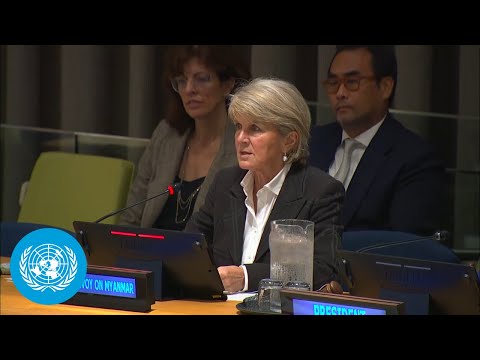
Julie Bishop, the U.N. secretary-general's special envoy on Myanmar, told U.N. delegates that fighting and a recent 7.7-magnitude earthquake have deepened the country’s humanitarian crisis while U.N. appeals are only a fraction funded.
Julie Bishop, the U.N. secretary-general's special envoy on Myanmar, told delegates at a U.N. briefing that fighting in Myanmar has continued and escalated since the military takeover in February 2021 and that a recent 7.7-magnitude earthquake has compounded an already severe humanitarian emergency.
"There has been no end to the violence," Bishop said, noting that thousands have been killed or injured and that civilians — including in schools, hospitals and places of worship — have been directly affected. She said towns, villages, markets and infrastructure have been bombed and that the health system is collapsing while foreign direct investment is evaporating and the economy is floundering.
Bishop said the scale of humanitarian need is vast: more than 20,000,000 people face humanitarian needs, and the U.N. Humanitarian Needs and Response Plan was, she said, less than 8% funded midway into 2025. For a Flash Addendum covering earthquake-affected areas she said only 22% of requested funds had been received. Bishop warned that without urgent funding recovery efforts risk stalling as monsoon rains and floods heighten disease risk and vaccine coverage falls.
She described ceasefires announced by some parties as largely unobserved and said the flow of weapons into the country is "fuelling the expectations that a military solution is within reach." Bishop said some ethnic armed organisations, including the Arakan Army and the National Unity Government, do not regard the State Administration Council's ceasefires as genuine. She quoted the NUG that the military "continues to conduct air strikes, artillery attacks, and excessive use of force against civilians," and said the SAC describes its ceasefires as temporary and reserves the right to respond to attacks across contested areas.
Bishop said she has detected "some openness to political dialogue with some regional support" but that there is not yet broader agreement on how to move forward. She said the Commander in Chief of the military cites the 2015 Nationwide Ceasefire Agreement as a framework while excluding nonparticipants and labelling some groups terrorists. Bishop warned that planned elections would be "deeply contested" and said she has repeatedly warned that without an end to the violence and an inclusive, transparent process, elections risk fueling greater resistance and instability.
The envoy said key national leaders remain detained, describing "more than 22,000 political prisoners still in detention," and reiterated a U.N. Security Council call for the immediate release of arbitrarily detained prisoners, including Win Myint and Aung San Suu Kyi (as cited in her briefing). She said she continues to build trust with a diverse range of Myanmar stakeholders and to coordinate with regional and global partners toward an inclusive political solution.
Bishop described close coordination with ASEAN, saying she had extensive discussions with ASEAN's Special Envoy "Ofman Hashim" in Kuala Lumpur and that the two special envoys had agreed to pursue joint initiatives, including a joint visit to Myanmar and coordinated stakeholder engagement. She said they had jointly briefed a private Security Council meeting and that a joint initiative to address the disproportionate impact of the crisis on women and girls is underway. "Women, Peace and Security will remain at the centre of my efforts," she said.
On the Rohingya and Rakhine situation, Bishop said conditions remain dire, with up to 80% of Rohingya described as living in poverty. She said civilians in Rakhine face forced recruitment and other abuses and that dangerous attempts to flee by boat have produced further tragedies. Bishop said she met online with Rohingya representatives from Myanmar and Bangladesh and called for Rohingya voices to be represented at a high-level conference on Rohingya and other minorities scheduled for Sept. 30, which she said should draw international attention and support for host communities such as Bangladesh. She said the 2025 Rohingya joint response plan in Bangladesh was, in her account, about 20% funded, and that funding shortfalls have led to cuts in food rations and educational opportunities in camps.
Bishop closed by urging the United Nations and member states to act to prevent further deterioration and to support a future for Myanmar that ensures safety, accountability and opportunity for all communities, including the Rohingya. "A viable future for Myanmar must ensure safety, accountability and opportunity for all its communities," she said.
The briefing recorded coordination steps and advocacy efforts but did not record new formal U.N. decisions or votes during Bishop's statement.