Get Full Government Meeting Transcripts, Videos, & Alerts Forever!
Get email alerts on the Open Meetings Law topic
No spam. Unsubscribe anytime.
Trainer reiterates Open Public Meetings Act rules, warns against email/text serial meetings and improper executive-session decisions
Summary
A legal trainer reviewed Washington open-meeting rules with the Camas School District board, emphasizing limits on serial communications, public records for emails/texts, and narrow grounds for executive sessions, and warned that decisions reached in private can trigger legal challenges.
Sean, the meeting's legal presenter, told the Camas School District Board of Directors that Washington's Open Public Meetings Act establishes a broad presumption that board meetings must be open and that elected officials must complete required training.
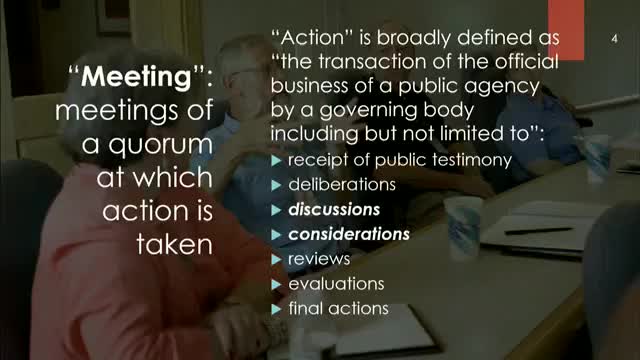
He said the law treats a “meeting” broadly — any gathering of a quorum involving deliberation or action — and warned that emails, texts and other exchanges can form a de facto meeting if they show collective intent to decide. "If you piece it together...it looks like this body had a meeting," Sean said, summarizing recent court rulings that have treated serial communications as a meeting when a quorum's views are exchanged through multiple channels.
The nut graf: The trainer framed the guidance as both legal requirement and risk-management: public records requests can reach personal devices when messages discuss district business, and misused executive sessions or private decision-making can expose the district to litigation or require later corrective action.
In the discussion, Sean described common problem scenarios: passive distribution of informational materials to the full board can be permissible, but adding advocacy or follow-up “reply all” threads risks creating an unlawful serial meeting. He referenced recent Washington cases, including litigation over executive-session conduct and the Port of Vancouver decision, as examples of how courts have analyzed the totality of communications.
On executive sessions, Sean outlined permitted topics the board may address outside public view — for example, narrow discussions about price in property disposition, evaluation of candidate qualifications, potential litigation with counsel present, and labor negotiations — and stressed strict limits. He warned that executives sessions used to reach or announce decisions in public can trigger Open Public Meetings Act challenges: "If you're in executive session, you're not taking straw polls, you're not making any determinations," he said.
Board members asked clarifying questions about one-on-one discussions among members, replies-all email practices, and whether passive information sharing (for example, a conference summary) violates law. Sean repeatedly advised caution: keep advocacy out of shared materials, avoid reply-all, label informational shares as passive, and limit executive-session discussions to the statutory subject matter.
Ending: The board's conversation closed with general agreement to apply restraint in email and text exchanges and to follow established protocols for executive sessions and public comment. Sean summarized sanctions and remedies available for violations, including potential nullification of actions and attorney-fee exposure, and noted that later open reconsideration can sometimes cure procedural errors.