Get Full Government Meeting Transcripts, Videos, & Alerts Forever!
Get email alerts on the City Budget topic
No spam. Unsubscribe anytime.
Belmont audit committee reviews proposed $94.3 million city budget, flags state VLF uncertainty
Summary
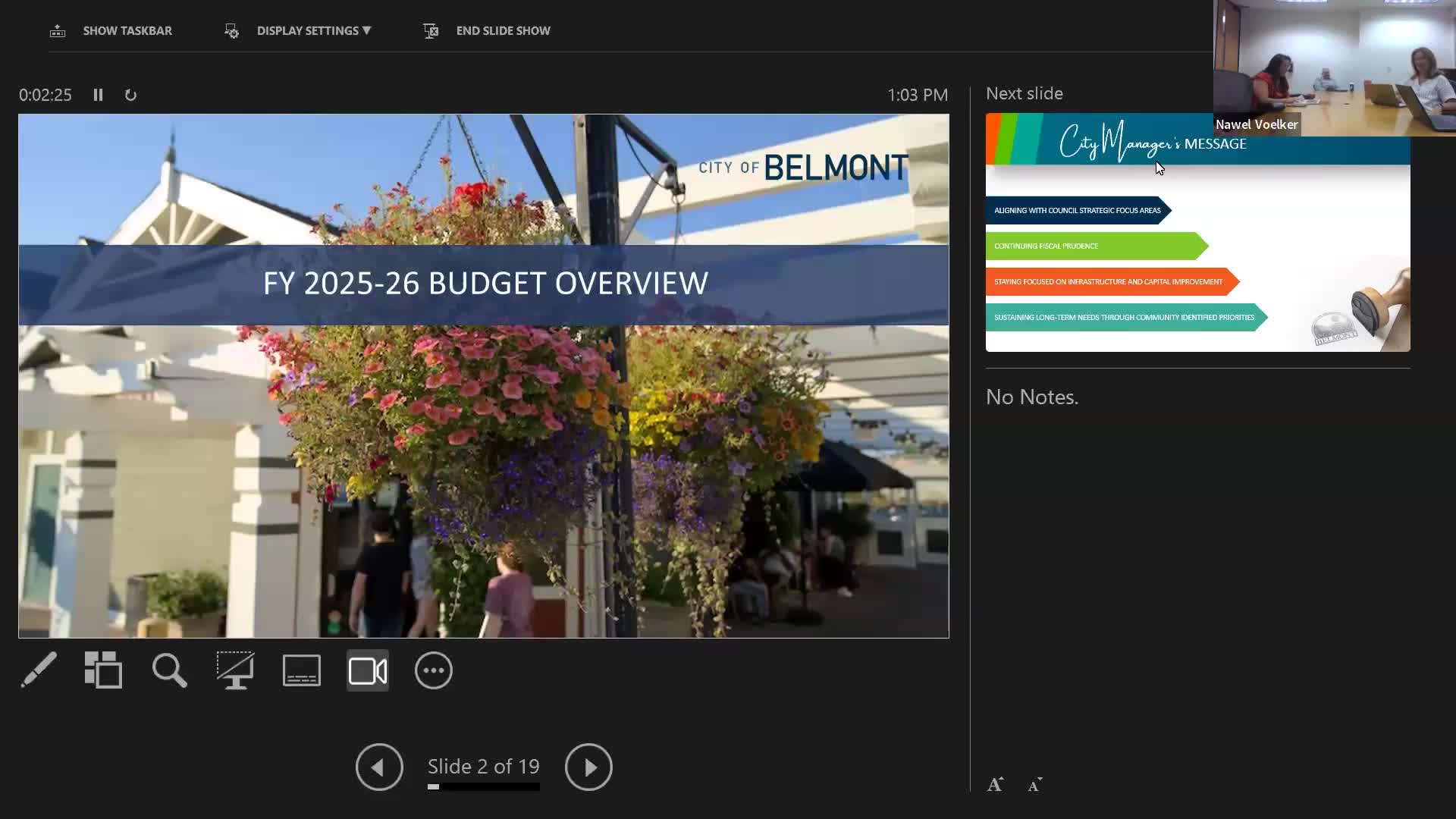
Belmont City’s audit committee heard a presentation on the proposed fiscal 2025–26 budget, including a $94.3 million citywide plan, a $13.5 million capital improvement program and concerns about an unbudgeted Vehicle License Fee shortfall that could widen a long-term gap.
Belmont City’s Audit Committee reviewed a proposed fiscal year 2025–26 budget that totals about $94.3 million citywide, including an $80.8 million operating budget (including fire) and a $13.5 million capital improvement program, Budget Manager Joanne told the committee.
The presentation said the general fund is budgeted at about $32.9 million while total staffing remains unchanged at 144.75 full-time equivalent positions. Joanne said the budget does not include a shortfall in Vehicle License Fee (VLF) reimbursements the state currently owes the city and that if the state repaid that amount the general fund would balance without drawing on reserves.
Why it matters: Committee members pressed the magnitude and reliability of state-held revenue streams that make up a substantial portion of Belmont’s tax base. The presentation projected that if VLF reimbursements are not restored, Belmont could face widening annual shortfalls and draw on reserves over the next decade.
Joanne walked the committee through revenue and spending composition, showing that personnel costs make up roughly 59% of general fund requirements. On the revenue side, property tax accounts for about 40% of general fund resources, followed by sales tax, transient occupancy tax and service charges.
Joanne said most secured property tax (about 96% of the property tax bucket) comes from residential properties in Belmont and that VLF and a related swap make up a significant portion of property-tax-derived revenue. She told the committee that the presentation does not include the state’s VLF shortfall and that a repayment would materially change the city’s reserve position.
The committee also heard details on the capital improvement program. The proposal for the next fiscal year budgets $13.5 million in CIP money, with roughly 90% earmarked for streets and storm projects; three projects were listed with budgets over $1 million. One storm-related project was identified in the presentation as “Sanghuang Palm Station.” The presentation projected a five-year CIP of about $62 million.
Committee members discussed county-level revenue mechanisms that affect Belmont’s receipts, including the Educational Revenue Augmentation Fund (ERAF) and the Local Control Funding Formula (LCFF). Joanne explained ERAF’s role as a county-level reallocation of property tax used to satisfy school funding formulas and described how any excess ERAF can return to cities, noting the relationship is not one-to-one with changes in VLF receipts.
Long-term outlook: The committee was shown two scenarios in a 10-year forecast. A “fully funded VLF” scenario keeps the city on a steadier path while a “no payback” scenario shows the gap widening, with cumulative projected losses of about $30 million over 10 years under the worst-case orange-line projection presented to the committee. The presentation noted that Belmont’s reserve level could fall below the city’s target if the state does not restore VLF funding and if revenue growth lags inflation.
Next steps: The presentation concluded with a staff recommendation that the committee forward the proposed fiscal 2025–26 budget to the City Council for consideration; Joanne said staff will incorporate committee feedback and present the budget to council on June 10. The presentation also noted that the fire district budget and a multi-year capital reserve for fire station replacement are included in planning; committee members asked for and were told a decision on site selection for a replacement Fire Station 15 would occur within roughly a year if the project moves forward.
Quotes: “If the state paid us back the $1,700,000 we will have a balanced budget without the need of using general fund reserve,” Joanne said during the presentation. She also summarized the revenue mix: “Property tax at 40%...sales tax, hotel tax or TOT, and service charges at 13 to 14% each.”
The committee did not provide a detailed roll-call vote on the record in the transcript excerpt; staff said the action requested is that the committee recommend the budget to City Council for approval.
Taper: Staff said they will present final audit results for the fiscal year ending June 30, 2025, later in the fall and return to the committee with the budget recommendation at the City Council meeting on June 10.