Get Full Government Meeting Transcripts, Videos, & Alerts Forever!
Get email alerts on the Civil Jurisdiction topic
No spam. Unsubscribe anytime.
Assembly passes bill to confirm New York courts’ general jurisdiction over businesses that register here
Summary
Assemblymember Lunsford sponsored and the Assembly passed A.8303, an amendment to New York’s Civil Practice Law and Rules, clarifying that corporations, limited liability companies and other entities that register with the New York Secretary of State to do business in New York “consent” to general jurisdiction in New York courts.
Assemblymember Lunsford sponsored and the Assembly passed A.8303, an amendment to New York’s Civil Practice Law and Rules, clarifying that corporations, limited liability companies and other entities that register with the New York Secretary of State to do business in New York “consent” to general jurisdiction in New York courts. The Assembly recorded 99 ayes and 46 noes; the bill passed and "This act shall take effect January 1," the clerk read, with no year specified in the floor text.
Supporters said the bill restores the state’s longstanding practice before federal cases narrowed general jurisdiction. "This bill is actually relatively simple," Lunsford told the Assembly, saying the change returns New York law to its pre‑Daimler approach and reflects recent U.S. Supreme Court guidance such as Mallory v. Norfolk Southern Railway. Lunsford said the statute limits potential plaintiffs to those with a nexus to New York — residents, New York‑domiciled businesses, or foreign businesses registered here — and, she said, that approach had governed New York for more than a century.
Opponents raised concerns that the change could encourage forum shopping and discourage companies from registering in New York. One Assembly member arguing against the bill said it "encourages forum shopping" and warned it could "drive opportunities to neighboring states with more predictable jurisdictional rules." He argued the change may increase litigation and impose further burdens on the State court system, which he and others said already report backlogs and resource constraints during budget hearings.
During floor exchanges, Lunsford and questioning members discussed precedent and constitutional limits. The sponsor cited Mallory v. Norfolk (Supreme Court) and other precedent, and referenced International Shoe and Daimler in explaining how New York courts previously exercised general jurisdiction. Questioners asked whether the bill would allow New York residents to sue businesses for claims wholly unrelated to New York conduct and whether businesses could avoid jurisdiction simply by declining to register; Lunsford confirmed the bill would permit suits brought by residents or New York‑domiciled businesses against companies that have registered to do business here, even when the alleged injuries occurred outside New York, and noted the law expressly allows withdrawal of consent by deregistration.
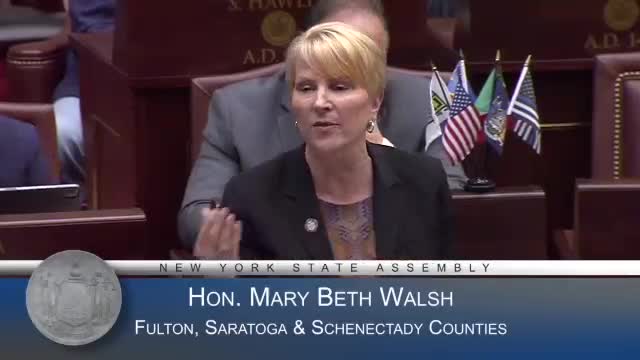
Supporters argued the bill clarifies the State’s intent after the Daimler decision and said New York courts and litigants benefit from clear statutory direction. Opponents — including members who called for a party vote — pointed to prior gubernatorial vetoes of similar measures and warned the bill could chill business formation and registration in New York. Assemblymember Walsh announced the conference would vote in the negative citing prior votes in 2021 and 2023 and two previous gubernatorial vetoes; Assemblymember People Stokes said the Democratic conference would support the bill overall.
The clerk announced the vote totals: "Ayes, 99; No's, 46." The bill was declared passed on the floor.
Key procedural notes and context recorded on the floor: sponsors and questioners repeatedly referenced federal cases (Mallory v. Norfolk Southern, Daimler, International Shoe) and a prior state practice; sponsors and opponents cited concerns about court workload and the business climate. The bill sponsor said the change would reestablish jurisdiction for roughly 400 companies that are registered to do business in New York according to the sponsor’s memo. The Assembly also noted that the bill had been vetoed previously and had substantial opposition in prior years.
The floor text supplied no statutory citation number beyond amending the Civil Practice Law and Rules. The clerk read the bill's effective provision saying it "shall take effect January 1," without specifying the year in the on‑floor reading.
Votes at a glance and related procedural votes for this bill were recorded on the Assembly floor during the same session.