Get Full Government Meeting Transcripts, Videos, & Alerts Forever!
Get email alerts on the Minimum Wage topic
No spam. Unsubscribe anytime.
Tipped‑wage fight intensifies at council hearing as workers, owners clash over Initiative 82 and paid‑leave cuts
Summary
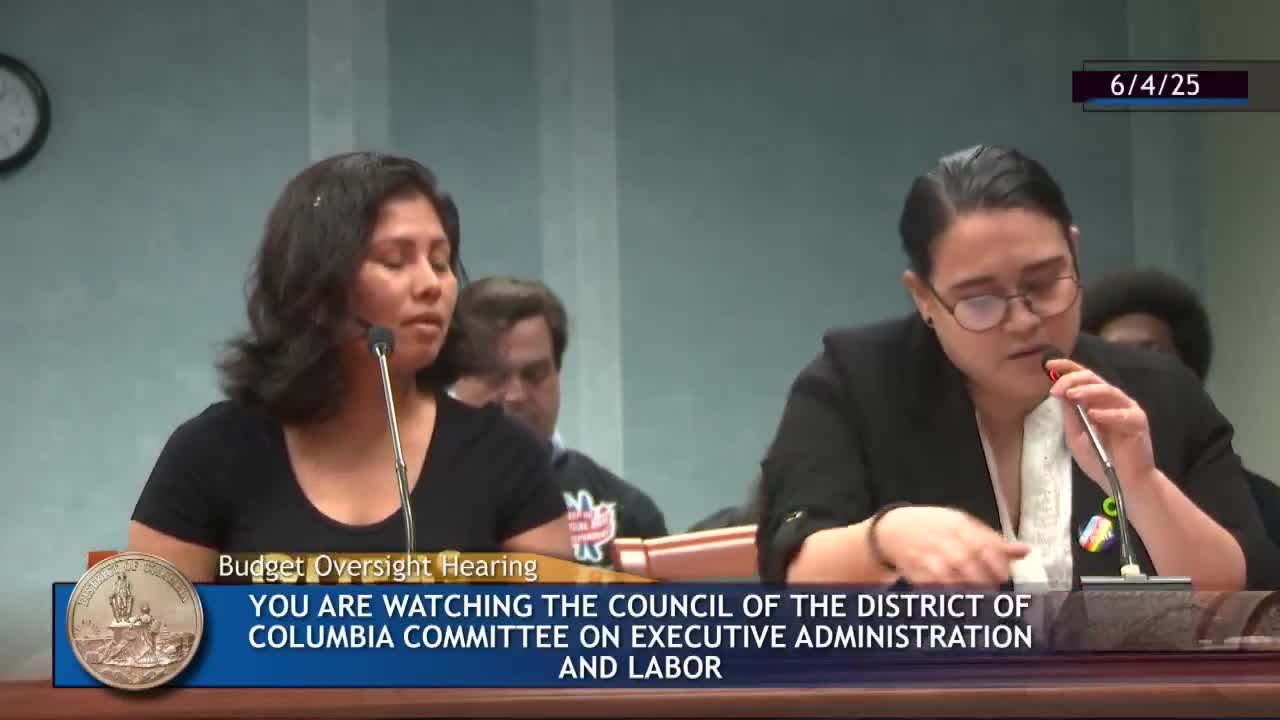
WASHINGTON — Testimony lasting into the evening on June 4 made clear the District’s debate over tipped wages and paid family leave has become the city’s largest, immediate fiscal and political issue.
WASHINGTON — Testimony lasting into the evening on June 4 made clear the District’s debate over tipped wages and paid family leave has become the city’s largest, immediate fiscal and political issue.
The hearing drew long lines of workers and owners to the Committee on Executive Administration and Labor. Many tipped workers and union organizers urged the Council to leave Initiative 82 — the voter‑approved phase‑out of the tipped subminimum wage — intact and to reject any effort to cut paid family leave benefits. Several restaurant owners and the Restaurant Association of Metropolitan Washington said initiative 82’s phased wage increases have driven a jump in payroll costs, pushed some businesses to adopt service charges and, they say, contributed to closures and job‑losses.
'I voted yes on Initiative 82 and I still support its implementation,' said bartender Matt Holla, speaking as a voter and hospitality worker. 'This is about dignity. Don't cut our wages.' Several dozen workers made similar statements, many noting little or no drop in tips at their workplaces since the policy took effect and pointing to service charges as the cause of confusion and reduced take‑home pay for some staff.
Union leaders and community advocates described the issue in equity terms. 'Tipped workers are disproportionately women and workers of color,' said Paul Schwab, executive secretary treasurer of Unite Here Local 25. 'Initiative 82 addresses a long‑standing pay gap. Pausing or repealing it would undercut stability and the will of the voters.' Unite Here and other labor groups called on the council to restore proposed cuts to the paid family leave program set out in the mayor’s FY26 budget.
By contrast the Restaurant Association’s president, Sean Townsend, argued that Initiative 82 has imposed 'an unprecedented wage restructuring' that has been especially painful for small, independent restaurants that operate on thin margins. 'The crisis touches everyone in our ecosystem but falls hardest on small independently owned businesses,' Townsend said, urging repeal.
Economists and several independent researchers offered competing interpretations of the data. Rebecca Paxton, who described herself as an economist following restaurant employment, said U.S. Bureau of Labor Statistics payroll data show a net employment decline in full‑service restaurant and bar jobs since May 2023 that exceeds neighboring jurisdictions and historical trends; she said median earnings for lower‑paid tipped workers fell in the period compared with prior years. On the other hand, advocates for implementation pointed to local survey work and Bureau of Labor Statistics estimates that find wage growth for many tipped workers and more restaurants open than closed in the interval.
Beyond wage politics, witnesses pressed the committee on the mayor’s FY26 proposals to reduce the paid family leave benefits and to lower the dedicated payroll tax that funds the program. Labor advocates said the mayor’s proposal would cut the maximum weekly benefit by roughly 15% and reduce the number of weeks available for medical and family caregiving leave — changes they argued would deny critically ill people and caregivers needed income. 'Paid family leave is a lifeline,' said Rebecca Abu Raqia Einhorn, a Ward 5 resident who described taking months of DC leave after surgery. 'It must be protected.'
The hearing also surfaced enforcement issues. Several witnesses said wage theft persists in the restaurant sector and that DOES and other city bodies receive fewer formal complaints than the problem’s scope warrants. At least one witness submitted FOIA‑obtained data showing low reporting rates into a DOES wage portal; advocates said better enforcement and clearer, simpler reporting would make compliance more visible.
Vote at a glance - Council action (referenced in testimony): pause on additional Initiative 82 wage increases — outcome: paused; vote details not specified in the hearing transcript. (The committee and public witnesses repeatedly referenced a council vote taken the day before to pause increases.) - Mayor's FY26 budget: proposal included repeal of Initiative 82 (administration proposal). Outcome in June committee hearing: the proposal remained in the FY26 mayoral budget; the council’s final action was pending. - Mayor's FY26 budget: proposed reductions to Paid Family Leave (lower weekly maximum and fewer weeks); outcome: proposed in mayor’s budget, subject to council action.
What proponents say Workers and labor advocates argued that Initiative 82 reduces dependence on tips and improves stability for low‑income workers. Witnesses noted that many tipped workers — buffet servers, front‑line hospitality staff and kitchen support — are low paid and disproportionately women of color.
What opponents say Restaurateurs, the Restaurant Association and some economists said the law has driven up labor costs, forced service charges and price increases, and contributed to staffing cuts and closures at small independent restaurants. They urged the council to repeal the initiative or to adopt a different path that addresses rising commercial rents, insurance and other non‑labor cost drivers.
Committee takeaways Chairperson Anita Bonds repeatedly emphasized the difference between public comment and formal action and asked witnesses for documentation as the budget process continued. Multiple witnesses — from worker groups, nonprofits and restaurant owners — promised written submissions to the committee record.
Ending: The hearing produced no final council decision on repeal or on paid‑leave cuts; the mayor’s proposals remain pending as council members weigh enforcement, small‑business relief options and the will of voters. The committee left the record open for written follow‑up through June 18 and asked several agencies and witnesses for additional documentation.