Get Full Government Meeting Transcripts, Videos, & Alerts Forever!
Get email alerts on the Workforce Development topic
No spam. Unsubscribe anytime.
Workforce Investment Council urges sustained investment in apprenticeships, frontline training amid FY26 cuts
Summary
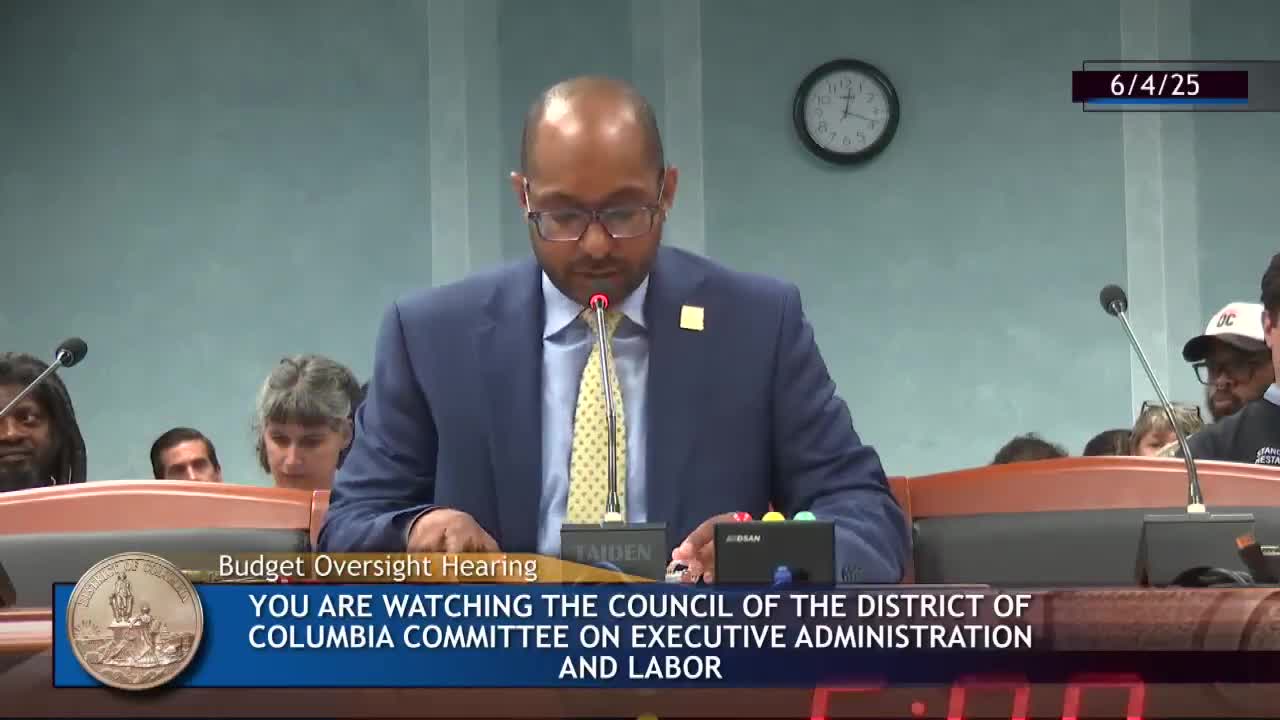
DC Workforce Investment Council executive director Drew Hubbard told the Council’s Committee on Executive Administration and Labor that the WIC needs continued funding to sustain sector partnerships, apprenticeship pipelines and frontline staff training while navigating reduced federal dollars and a hiring freeze.
Good afternoon, Chairperson Anita Bonds and members of the Committee on Executive Administration and Labor. My name is Drew Hubbard. I have the privilege of serving as the executive director of the DC Workforce Investment Council.
Hubbard told committee members on June 4 that the WIC’s requested FY26 budget totals about $33 million and is “a mix of federal grants and local dollars,” but that the agency faces a smaller operating base than in recent years as one‑time federal appropriations have expired. He said the council role for WIC is statutory: to “guide, align and hold accountable the district's workforce development system” and to oversee and coordinate WIOA‑funded programs.
Hubbard framed the WIC’s recent work around sector partnerships and apprenticeships, citing the Healthcare Intermediary Partnership as a model. “The partnership funded originally at $250,800 beginning in FY ’23 and then later at $658,000 in FY ’24 is a sector‑based collaboration,” he said, describing the DC Hospital Association–led partnership as having grown to more than 50 members and having produced healthcare occupations reports used for planning and employer engagement.
The WIC director said the FY26 request aims to fund a next sector partnership that will build on the healthcare pilot’s “earn‑while‑you‑learn” apprenticeships and pre‑apprenticeship models. Hubbard emphasized also that the WIC trains the workforce professionals who deliver services: “Last year, the WIC trained nearly 200 frontline workers,” he said, and the FY26 funds would continue that support so that job‑center and community‑based staff can advise jobseekers on career pathways.
Operational details that Hubbard provided included staff size and vacancies: the WIC is authorized for 13 full‑time positions, with 9 currently filled and four vacancies held “strategically” in response to a districtwide hiring freeze. Hubbard said some positions were paused mid‑recruitment when the hiring posture shifted and that some roles were later filled by internal promotion. He told the chair the WIC will seek waivers if any vacancy proves mission‑critical.
Hubbard also described WIC’s oversight responsibilities under federal law and the WIOA state plan, which the WIC completed and the U.S. Department of Labor approved earlier in the year. That plan, he said, “serves as a blueprint on leveraging federal dollars to push how our local initiatives operate” and identifies priority populations and geographic focus areas, including East of the River, justice‑involved individuals and Black women.
Committee Chairperson Anita Bonds asked for examples and for measurable outcomes; Hubbard pointed to the registered apprenticeship pipeline in health care, a cybersecurity apprenticeship partnership with the University of the District of Columbia and Accenture, and the WIC’s technical assistance to more than 150 frontline staff and 20 community‑based organizations. He said the WIC is “central” to the mayor’s Grow DC initiative and that its work is intended to make federal, local and philanthropic dollars stretch further through coordination.
The WIC director closed by asking the committee to preserve funding that sustains the WIC’s convening, employer engagement, apprenticeship and frontline training work and to note that “now is not the time to pause” those investments.
Ending: Chairperson Bonds pressed for written follow‑up on the WIC’s staffing needs and asked for documentation about the partners and the apprenticeship programs. Hubbard agreed to provide additional detail by the committee’s requested deadline.