Get Full Government Meeting Transcripts, Videos, & Alerts Forever!
Get email alerts on the City Budget topic
No spam. Unsubscribe anytime.
Birmingham holds public hearing on 2025–26 budget as residents press for street, stormwater and trash fixes
Summary
At a June 4 public hearing on the proposed fiscal 2025–26 Birmingham City budget, residents urged the council to prioritize street repairs, emergency stormwater fixes, equitable trash service and to direct transit funds to city routes; council members and staff described implementation timelines for ARPA money and a new state school-zone mandate.
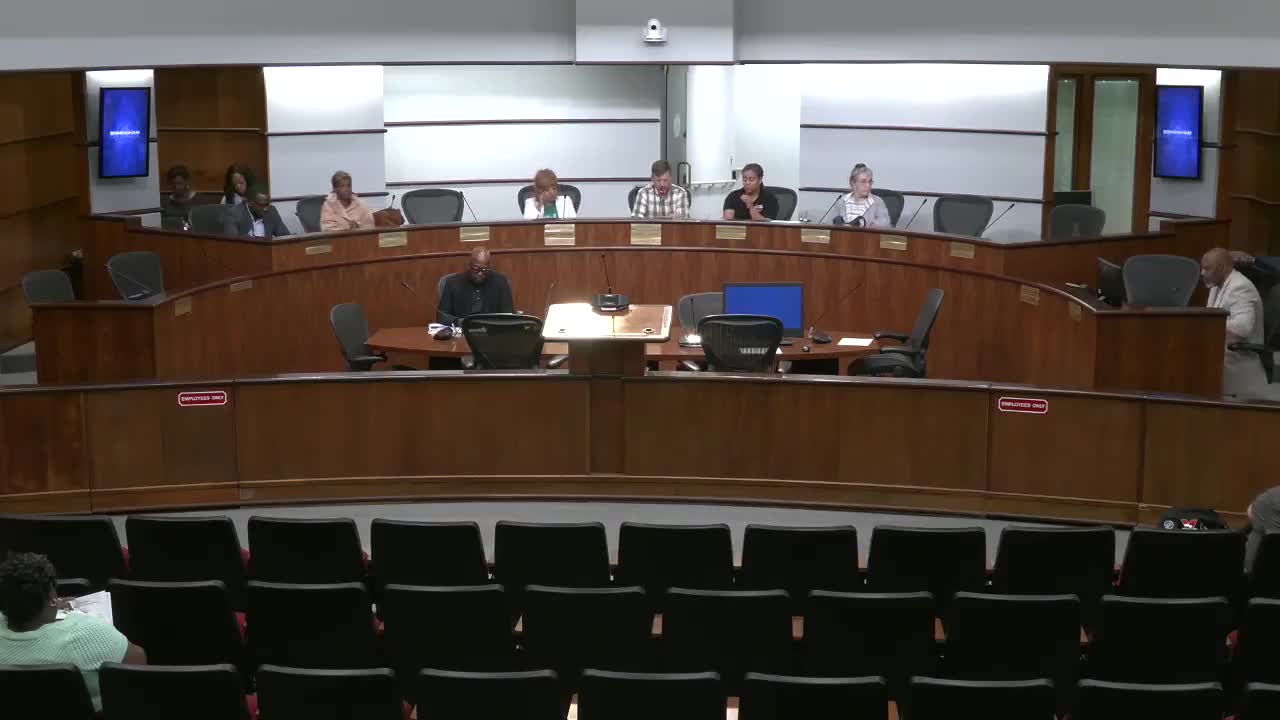
Council member Crystal Smitherman, chair of the Budget and Finance Committee, opened a public hearing June 4 on the City of Birmingham’s proposed fiscal 2025–26 general and capital budgets and invited oral and written comments.
The hearing drew two in-person residents who urged the city to redirect budget attention to street and stormwater repairs, to address inequities in trash collection, and to target transit funding within city limits.
Daniel Christiansen, a resident of 2412 Second Avenue North, commended the city’s recently installed protected bike lane on Rugby Avenue and urged expansion of similar projects. He raised concerns about the city’s allocation for maintaining private property while public infrastructure remains in disrepair, and said the city’s two-tier trash collection system — in which some residents must pay private haulers while others receive city-subsidized pickup — has left “about a $10,000,000 hole in our Department of Public Works budget.” He also noted the proposed $16,000,000 for public transit and said he hoped Birmingham-Jefferson County Transit Authority funds would be concentrated inside the city.
Susan Palmer, speaking for Central Park and other District 8 neighborhoods, asked the council to prioritize street repairs and emergency stormwater work in Central Park. She identified a recurring drainage collapse on 50 Second Street near houses she gave as 1769 and 1772 and said the concrete grid has caved in and remains marked by cones, calling for “an emergency repair as of today at that location.” Palmer also described repeated neighborhood flooding, requested school crossing flashers for Central Park Elementary School on Terrace Q, and urged expedited paving and flood mitigation along Bessemer Superhighway and South Park Drive where 18-wheelers and recent apartment development have worsened conditions.
Smitherman responded that American Rescue Plan Act (ARPA) funds were subject to an implementation deadline and that “all of the ARPA funding was 12/31/2024, so it's been allocated. So now it's actually in the process of being implemented, and we have, a couple of years to implement it.” She advised residents to raise school flashing-light requests with the Birmingham Board of Education and said she would follow up with Council member Clark on specific ARPA-funded neighborhood projects.
During the hearing the council noted a 2024 state law requiring municipalities to implement school zones around all public and private schools; Smitherman characterized that as an “unfunded mandate,” saying the state requires the zones but does not provide additional state funding for them. Councilor Tate suggested residents contact Birmingham Department of Transportation director James Fowler about truck-route signage and no-truck restrictions, saying some communities have used signage to reduce heavy-truck traffic through neighborhoods.
Council staff and members also addressed questions submitted online about park and recreation funding. The council indicated park work is part of the capital budget and noted an ongoing parks master-plan assessment intended to inventory system needs and governance as a step toward larger capital investments.
There were no formal votes on the proposed budget itself during the public hearing. The meeting concluded after the public-hearing comments and a motion to adjourn was seconded and approved by voice vote; the clerk recorded the meeting adjourned.
The record of the hearing and the capital and operating budget proposals will remain available to the council as it moves toward formal budget adoption in subsequent meetings.