Get Full Government Meeting Transcripts, Videos, & Alerts Forever!
Get email alerts on the Economy topic
No spam. Unsubscribe anytime.
Consultant: Helene’s economic damage concentrated in Buncombe County, recovery uneven
Summary
Raleigh consultant Dan Gerlach told the Buncombe County Board of Commissioners on June 3 that the economic damage from Tropical Storm Helene was far more concentrated in western North Carolina than state estimates suggest and that recovery, especially in leisure and hospitality, remains stubborn.
Dan Gerlach, a Raleigh-based economic consultant and former state budget and economic development adviser, told the Buncombe County Board of Commissioners on June 3 that Tropical Storm Helene caused a concentrated economic shock in western North Carolina, with Buncombe County bearing a disproportionate share.
Gerlach said state Office of State Budget Management estimates placed about 53% of the storm’s statewide economic damage in a hatched 15-county area that includes Buncombe County. “I believe that estimate is closer to 95% of any kind of economic development damage that you could imagine,” Gerlach said, speaking by video to the commissioners.
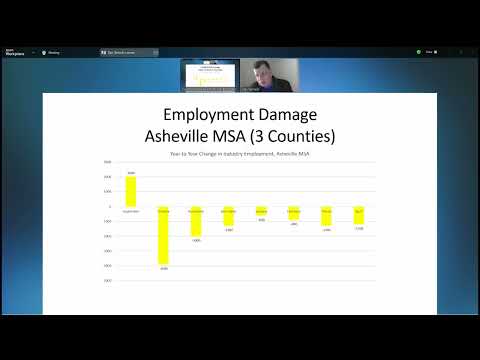
Gerlach told commissioners he measured business losses three ways: physical capital losses (damaged buildings, inventory and equipment), lost revenue, and human-capital effects such as workers leaving the area. He said county-level measures show a sharp employment decline beginning in October and that Buncombe County still had roughly 3,000 fewer jobs — about 2.5% fewer — than a year earlier.
The consultant said losses were concentrated in leisure and hospitality, which he said was down about 2,400 payroll jobs year to year (about an 8% decline), while retail trade and manufacturing showed smaller changes. “If leisure and hospitality had held ground, you would be up employment,” he said.
Gerlach reviewed unemployment-insurance and disaster-unemployment-insurance (DUI) claims, saying regular UI claims rose from roughly 262 people in September to about 5,200 in November and that nearly 1,000 additional people were on disaster UI at one point. He noted the DMA-funded temporary sheltering and reconstruction work may have stabilized the situation but cautioned the recovery is incomplete.
Commissioners asked about comparable recovery examples and pitfalls elected leaders make. Gerlach pointed to Hurricane Matthew in eastern North Carolina and to federal and state recovery work but said no prior example matches Buncombe County’s situation. He advised officials to push agencies that received recovery funds to expedite funds to the West, to focus on housing and get “hammers swinging” in rebuilding, and to avoid presenting the community as a helpless victim when asking for aid.
Commissioner Lael Whitesides asked how to get grants (not loans) for small businesses; Gerlach said some legislative measures have included grants and that matching programs and targeted forgiveness tied to remaining open were possible mechanisms. Commissioner Sloan asked about analogs and lessons; Gerlach cited prior foundation and recovery work and emphasized the need to focus on housing and diversify the county economy. The chair thanked Gerlach for the briefing and commissioners followed with additional questions.
The consultant repeatedly cautioned that numbers and sector mixes could shift as markets change and that his analysis used survey-based labor-force measures and payroll reports as available. He recommended continuing demand-side measures to bring visitors and customers back to support hospitality employers and suggested workforce matching and promotion of summer and fall tourism.
The commissioners did not take a formal vote on policy during the briefing; Gerlach concluded by saying he would be available to answer further questions and that state and federal partners should be pressed to ensure recovery funds reach the west of the state.