Get Full Government Meeting Transcripts, Videos, & Alerts Forever!
Get email alerts on the Land Use Development topic
No spam. Unsubscribe anytime.
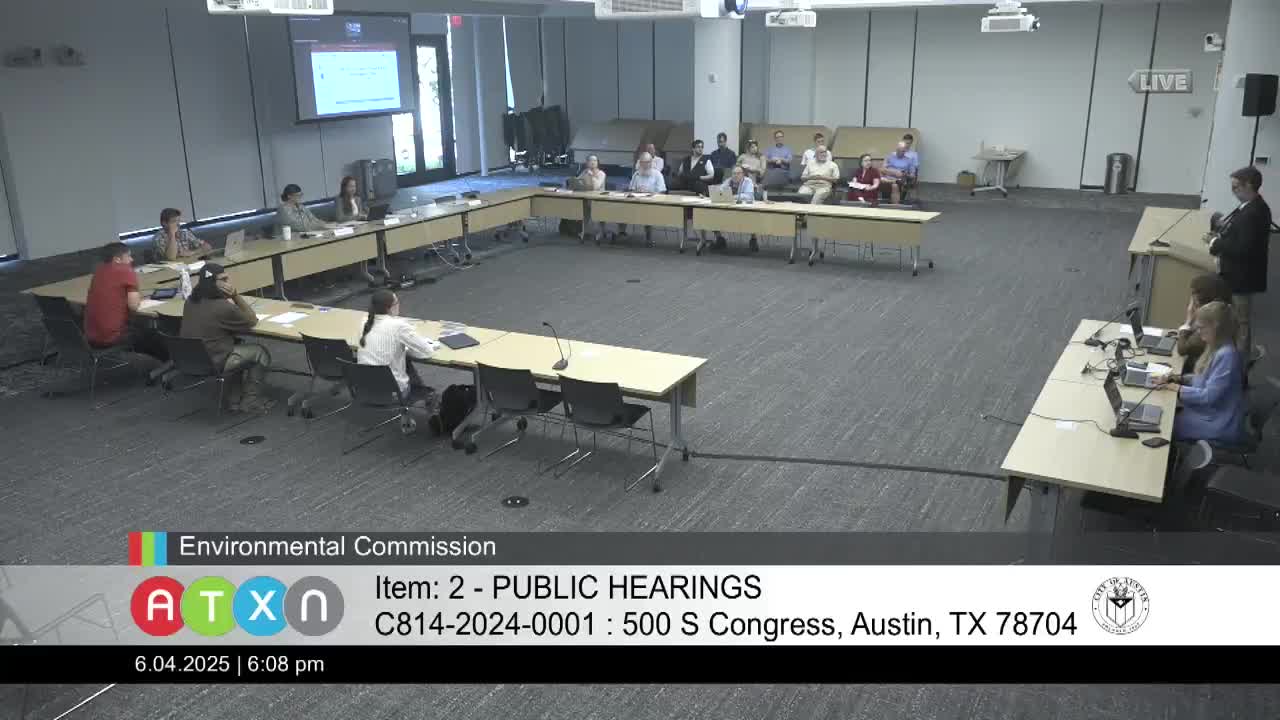
Environmental Commission recommends approval of 500 South Congress PUD with riparian restoration and environmental conditions
Summary
The Austin Environmental Commission voted to recommend approval of a planned unit development (PUD) for 500 South Congress on June 4, 2025, subject to conditions including riparian restoration, reduced impervious cover, and requirements for tree preservation and future EV charging capability.
The Austin Environmental Commission recommended approval on June 4 of a Planned Unit Development for 500 South Congress, a 6.48-acre mixed-use project in the South Central Waterfront area, with conditions to limit environmental impacts and restore riparian habitat.
The commission’s recommendation follows a Watershed Protection Department presentation and a developer briefing on a plan the applicant describes as 950 residential units, a 225-key hotel, 600,000 square feet of office, and about 155,000 square feet of retail and restaurant space including a grocery store. Shawn Watson, environmental program coordinator with the Watershed Protection Department, said, "Staff recommends approval of 500 Planned Unit Development with the following conditions," and then read a set of environmental conditions and code modifications the department supports.
Why it matters: The site sits partly inside the 100-year floodplain and the critical water quality zone of East Bouldin Creek and Lady Bird Lake watersheds. The PUD seeks exemptions to some code standards in exchange for environmental "superiority" measures the applicant proposes, including reducing impervious cover in the critical area, restoring riparian habitat, and increasing floodplain storage volume.
Key project details and proposed environmental measures: The applicant presented the following principal elements: the site is 6.48 acres in Austin full-purpose jurisdiction (Council District 9); existing impervious cover in the critical area is 48.2 percent and the proposal would reduce that to about 20.7 percent; the project would remove approximately 8,000 square feet of concrete embankment and restore roughly 23,000 square feet of riparian habitat; the proposal also states a 25,000 cubic-foot increase in 100-year floodplain volume, tree relocation and preservation plans (including relocation of heritage trees on site), rainwater harvesting to irrigate more than 50 percent of landscape areas, a target of 20 native pollinator plant species, and LEED/sustainable site certification goals for buildings.
Presenters and applicants: Shawn Watson (Watershed Protection Department) presented the staff recommendation and technical exhibits. Related Texas representatives including Mike Iannacon (president) and David Rubin (vice president) described the developer’s approach to affordable housing and site planning. Iannacon said, "On-site affordability is absolutely something that we welcome," and described the applicant’s preference to give the city flexibility (fee-in-lieu or on-site units) to maximize affordable housing outcomes over time. Consultants on ecology and design included Jonathan Ogren of Siglo Group and Matt Yeager of TBG Partners; civil engineering support came from Jonathan McKee (Garza EMC).
Public and stakeholder comments: Local conservation groups and residents questioned the use of a PUD on a parcel smaller than 10 acres, the amount and location of proposed programming inside the critical water quality zone, affordable housing commitments, and above-ground parking. Roy Whaley, conservation chair for the local Sierra Club, asked why a PUD was being used for a site smaller than the code’s typical 10-acre threshold. Bobby Levinsky of Save Our Springs Alliance said, "I don't see a compelling reason for this PUD," and argued the project could undermine the South Central Waterfront vision plan if similar exceptions continue. Developer representatives and staff said code modifications for sub-10-acre PUDs have precedent in the area and that the PUD contains trade-offs intended to provide environmental and public benefits (trail connectivity, restored creek edge, tree preservation, habitat plantings).
Commission discussion and conditions: Commissioners questioned affordable-housing commitments, tree transplant survival, maintenance responsibilities for restored habitat, whether underground parking would count toward impervious cover, and how the proposed creek-edge trail and access would be managed and protected. The commission added or confirmed multiple conditions in its recommendation. Those conditions read into the record include: implementing on-site recycling and reuse of demolition materials to the extent feasible; use of shielded, low-intensity dark-sky-compliant lighting along riparian corridors; committing to certify the riparian restoration area as a wildlife habitat (Texas Wildscape or National Wildlife Federation equivalent); and requiring provision in building electrical capacity to support conversion of an additional 5 percent of parking spaces to EV charging in the future (provisioning for electrical capacity beyond an initial 5 percent of active chargers). Staff also recommended and the applicant accepted or discussed commitments on reduced impervious cover, removal of concrete embankment, native plantings, and monitoring and long-term natural area management plans.
Votes and outcome: The Environmental Commission voted to recommend approval of the PUD with the conditions described above. The roll-call list recorded in the hearing transcript identified nine commissioners voting in favor and one opposed. The motion as read in the record begins "Environmental Commission motion 2025-6042, June 4, 2025, subject 500 South Congress (C814-2024-001)" and concludes with the commission’s recommendation to approve the mixed-use PUD with the staff-provided conditions and the additional conditions the commission inserted during the meeting.
Next steps: The PUD will proceed through the city review sequence noted in the presentation: South Central Waterfront Advisory Board, Planning Commission, and ultimately City Council. The applicant listed dates in the staff slide set (Parks Board: May 19, 2025 — recommended; South Central Waterfront Advisory Board: June 16; Planning Commission and Council dates were under review at the time of the presentation). The commission’s recommendation is advisory; final zoning and any adopted code modifications require City Council action.
What remains unresolved: Affordable-housing outcomes (on-site units versus fee-in-lieu), final detailed design of the creek trail and public access, precise counts and locations for parking and active EV stations, and final tree relocation and long-term maintenance arrangements will be determined during site-plan review or future agreements. The commission requested more detail on several of those items during subsequent site-plan review and building-permit phases.