Get Full Government Meeting Transcripts, Videos, & Alerts Forever!
Get email alerts on the Right Of Way Fees topic
No spam. Unsubscribe anytime.
Staff outlines methodology behind proposed right-of-way occupancy fee increase for utility occupants
Summary
Public Works presented an updated calculation that raised the per-linear-foot charge for utilities occupying city right-of-way, driven primarily by higher five-year average capital costs. Occupants were notified; few formal objections were reported. Final council action is not recorded in the transcript.
City Public Works staff presented the city’s methodology and rationale for revising the right-of-way occupancy fee assessed to utilities and other occupants that operate in the public right-of-way. The fee is set by an ordinance in Title 11 (originally enacted Feb. 2001) and can be paid either by reported linear footage or as 2% of gross revenue, at the occupant’s election.
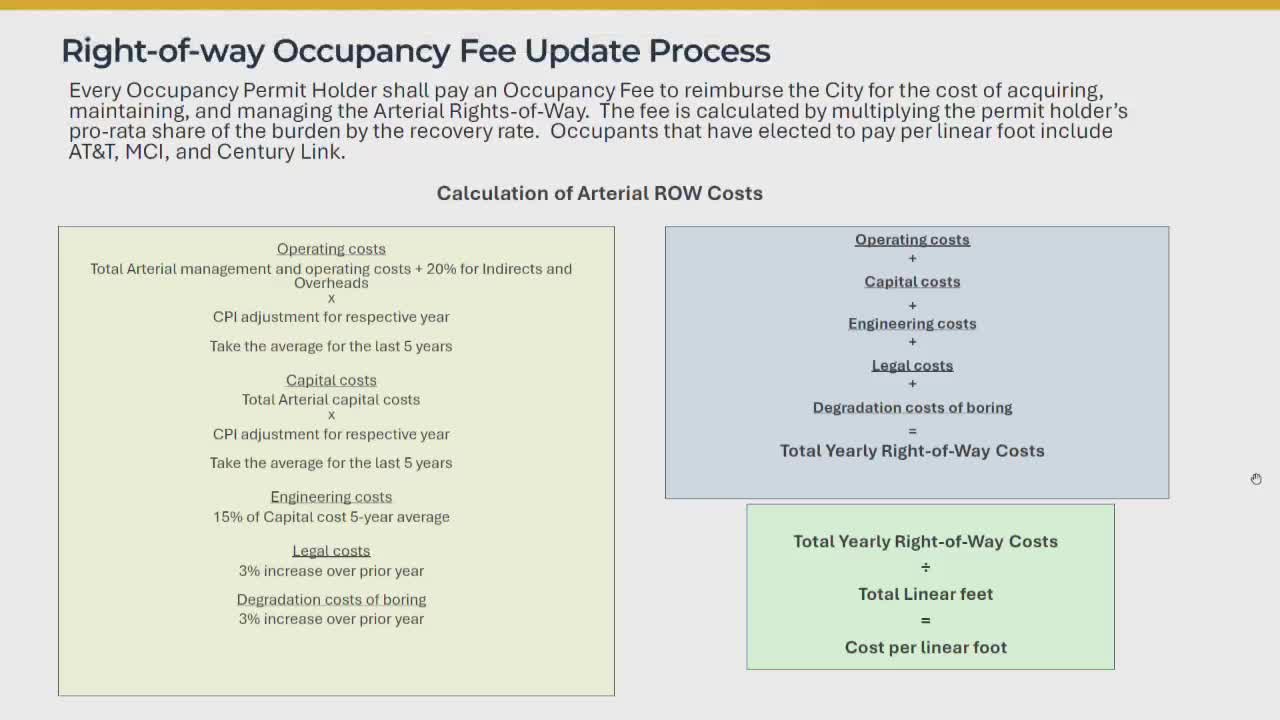
Public Works explained the fee calculation: operating costs for arterial management plus 20% indirects, CPI adjustment and a five-year average; capital costs averaged over five years; engineering, legal and degradation/boring factors applied; then divide total by reported linear footage to produce a per-linear-foot rate. Staff said the primary driver of the proposed fee increase is a jump in average capital costs (from about $12.6M to $34.7M in the figures used), tied to increased sales-tax and bond-funded arterial street improvement projects.
Staff said occupants were notified by email and first-class mail in May and that only one response sought clarification. Council discussion noted the impact on large corporate occupants (AT&T, MCI, CenturyLink were listed in the packet as existing per-linear-foot payers) and raised concern for nonprofits and smaller organizations that use rights-of-way for events or infrastructure work. No formal appeal or waiver outcomes were recorded in the transcript.
The presentation closed with councilors and staff discussing communications and the option of appeals or waivers on a case-by-case basis; no final recorded council vote on the fee change is included in the provided transcript.