Get Full Government Meeting Transcripts, Videos, & Alerts Forever!
Get email alerts on the Budget topic
No spam. Unsubscribe anytime.
Kodiak Island Borough staff reviews 2023 budget process and property-tax cap formula
Summary
Staff explained the borough's budget timeline, fund accounting and the legal formula that caps property-tax revenue; some assembly members urged revisiting the cap's treatment of debt-service and the borough's coupling of severance tax to the mill rate.
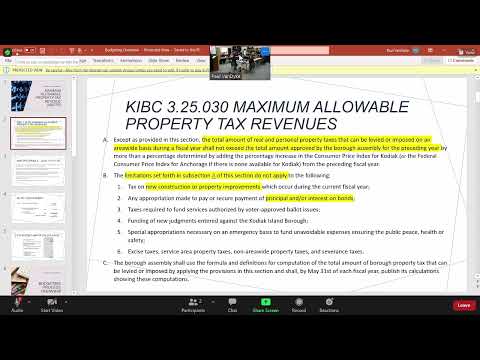
First up on the agenda was a presentation on the process for the borough's 2023 fiscal-year budget, including a detailed explanation of the borough's maximum-allowable property-tax revenues formula.
Staff member Dora said the cap is set in Kodiak Island Borough Code 3.2503 and summarized the mechanics: the prior-year approved levy creates the baseline, the cap can increase for new construction, voter-approved service areas, new judgments and declared emergencies, and the calculation applies a consumer price index (Dora said the Anchorage CPI is used in the formula). "The maximum allowable property tax revenues is in KIBC code 3.2503," she told the assembly. Dora also said the borough will bring an ordinance next month to clarify that debt-service principal and interest should be excluded from the cap calculation because the borough accounts for debt service in a separate fund.
Assembly members raised several concerns about how the cap operates in practice. Assemblymember Scott Smiley warned that rapid increases in assessed values and difficulty for assessors to fully keep pace with market changes could create fiscal stress under the cap, including reductions in state school funding tied to assessed value. He said the assembly needs to consider whether the cap, as written and applied, constrains the borough's ability to maintain infrastructure and basic services.
Other members noted interactions between the mill rate and severance-tax revenues. One assemblymember observed that the borough's severance-tax revenue is tied to the mill rate and said that steep assessment increases followed by a lower mill rate could also reduce severance-tax receipts. Several members discussed whether to decouple severance tax from the mill rate as a way to reduce that risk; an assemblymember noted a prior attempt to decouple the two had failed twice in earlier years.
Dora walked the assembly through fund accounting fundamentals (general fund, special revenue funds, debt service, enterprise funds and capital projects), the typical budget timeline (staff budgeting beginning in December, manager's budget due to the assembly April 1, school district requests due April 30 and a legal deadline to adopt a budget by June 10), and budget-level controls (department-level controls within the general fund, fund-level controls for enterprise and special funds). She confirmed personnel costs are the largest recurring expense and explained that individual department directors do not control fixed personnel costs such as step increases and benefits.
On technical points Dora provided figures used in the presentation: a one-time adjustment of about $134,000 was added to the FY22 cap calculation because last year levies were below the cap; the value of new improvements she cited was about $10,900,000 for the roll used in the example. Dora also said that because the borough keeps debt-service in a separate fund, the staff will present an ordinance to exclude debt-service principal and interest from the revenue-cap calculation.
Why it matters: the cap determines how much property-tax revenue the borough may levy year to year. Assembly members said that without clear public explanation of rising cost drivers (special-education increases, IT, facilities maintenance) the cap can create confusion when some taxpayers pay more or less year to year because of exemptions or changing tax rolls. Several members urged clearer public outreach and asked staff to return with recommended ordinance language and further analysis.
The manager and staff also flagged timing items that will affect the 2023 budget: service-area budgets due to finance by March 31, the manager's proposed budget due April 1, and a known uncertainty over the state's school-debt reimbursement percentage (the state typically posts its figure after the borough adopts a budget). Dora noted the borough had submitted bond-payment reimbursement estimates in October and that refunding activity may increase the state reimbursement this year, but she cautioned that the assembly should not assume that level of funding in later years.
Ending: The assembly directed staff to draft the ordinance to remove debt service from the maximum-allowable property-tax revenue calculation and return next month with proposed language and any fiscal analysis. Staff also committed to providing clearer written explanations and figures to support public outreach in advance of the regular budget process.