Get Full Government Meeting Transcripts, Videos, & Alerts Forever!
Get email alerts on the Transportation Mobility Fees topic
No spam. Unsubscribe anytime.
Cape Coral staff previews mobility-fee plan to replace 20-year-old road impact fee
Summary
City transportation planner Laura Dodd presented a plan-based "mobility fee" to the Planning and Zoning Commission June 4 that would repeal the existing road impact fee, expand what development-generated transportation fees can fund and tie fees more directly to local projects and trip generation rates.
Laura Dodd, the City of Cape Coral’s principal transportation planner, told the Planning and Zoning Commission on June 4 that the city is preparing to replace its 20-year-old road impact fee with a plan-based “mobility fee.” The change would move Cape Coral from a capacity-focused, level-of-service approach toward a 20-to-25-year multimodal funding plan that can pay for sidewalks, bike lanes, streetscaping and other improvements in addition to traditional road capacity projects.
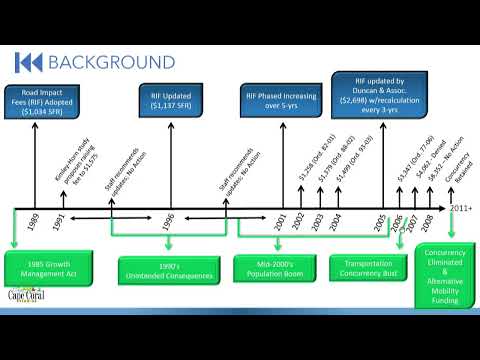
The proposal matters because Cape Coral’s current road impact fee has not been updated since 2006 and remains at roughly $3,347 for a standard single-family home, Dodd said. She described the mobility-fee approach as a more transparent, assessment-area driven system in which fees are tied to a publicly published project list for specific areas and to land-use trip-generation characteristics.
"It repeals and replaces the road impact fee," Dodd said, adding that the mobility-fee system is "a plan-based vision that focuses on moving all forms of transportation." She told commissioners the mobility plan would pair land use with transportation so that "you're putting the right development on the right road improvement."
Dodd said mobility fees can fund a wider range of projects than traditional road impact fees, including sidewalks, greenways, bike lanes, quick-build projects, parking structures and intersection improvements, while preserving the ability to fund roadway capacity when needed. She described the technical calculation process: create assessment areas, list planned improvements and apportion costs to produce an assessment-area fee ratio tied to trip generation rates.
Commissioners asked detailed questions about how the fee would vary by land use. Commissioner Senator asked whether a Dunkin’ Donuts and a law office would pay the same fee; Dodd answered they would not. "This is much more technically based than the road impact fee calculation. It's tied to the ITE trip generation manual's rate," she said, explaining that higher trip-generation uses pay higher fees.
Commissioner Botana voiced concern that the broader mobility-fee list could complicate addressing the city's near-term road capacity problems and add bureaucracy; Dodd responded that capacity projects — turn lanes, signals, roundabouts — remain eligible and that the mobility plan gives the city the programming tools to prioritize projects by time frame and assessment area.
Dodd said the city has begun calculating fees and expects additional public and committee briefings. She gave a tentative schedule: Transportation Advisory Commission (CTAC) in July, P&Z briefing on Aug. 6, Committee of the Whole and then two readings at City Council once the fee schedule is developed.
Dodd offered one-on-one briefings for commissioners as the draft schedule and technical calculations are finalized.
Ending: The presentation was informational; no formal action was taken at the June 4 meeting. Staff said a fee schedule is under development and further hearings are planned for summer 2025.