Get Full Government Meeting Transcripts, Videos, & Alerts Forever!
Get email alerts on the Plan Development Districts topic
No spam. Unsubscribe anytime.
Timnath tightens standards for plan-development (PDO) approvals and raises bar for public benefits
Summary
The Planning Commission approved amendments to how plan-development (PDO) overlays are evaluated, raising review standards for new PDOs, adding a neighborhood‑meeting expectation for new PDOs, and creating streamlined tiers for minor PDO amendments; commissioners also asked staff to add an explicit economic‑development criterion.
The Timnath Planning Commission on May 20 revised the town’s approach to plan‑development overlays (PDOs), tightening the review criteria for new PDOs and establishing a tiered pathway for amendments to existing PDOs so that minor changes can be handled administratively or at the commission level while major modifications still require council action.
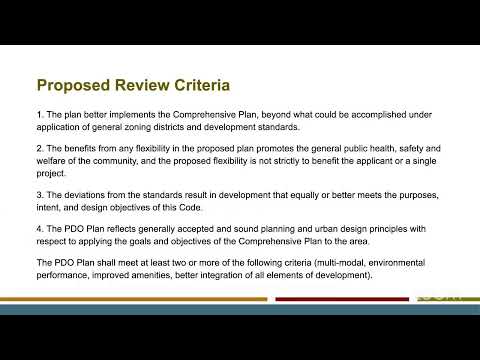
Why it matters: PDOs are the town’s negotiated-zoning tool used widely across Timnath. Staff said many prior PDOs had functioned like broad variance packages—reducing landscaping, open space and façade requirements without clear, measurable public benefits. The new rules aim to preserve the PDO tool for projects that deliver verifiable public benefits (multimodal connections, environmental performance, enhanced amenities) instead of being used primarily to relax standards.
Key changes: Staff proposed a menu of evaluation criteria and asked that qualifying PDO proposals demonstrate two or more public benefits; during discussion commissioners asked that economic-development benefit (sales‑tax generation, job creation or similar measurable outcomes) be added to the criteria and a motion was adopted directing staff to draft final wording and require “three or more” criteria be met (staff to draft the specific language). The draft also sets a 5‑acre threshold under which PDOs would generally not be used, requires a neighborhood meeting for new PDOs, and creates a three-tier amendment path so small corrections or state-law updates can be handled administratively while more substantive changes come to the commission and council.
Developer comments: Ladera representatives and other developers urged caution and asked that past public benefits (off-site improvements and infrastructure provided by previous developers) be recognized if they return for modest amendments; staff said the draft includes an improved mechanism for limited amendments and clarified that minor corrections and state-law updates would not trigger the full PDO hearing route.
Action: The commission approved the PDO amendment package with a direction that staff add a clear economic-development criterion and that staff propose final wording that will require a petitioner to demonstrate three or more qualifying benefits. The commission voted 5–0 in favor of the amended language.
Quotes “Logan (staff): ‘these [PDOs] allow communities to achieve specific planning goals that might not be feasible under our base code.’”
Ending: Staff will prepare final language incorporating an economic-development criterion and return the package to town council. Commissioners suggested adding PDO amendment items to planning‑commission consent agendas when the changes are strictly administrative so the commission sees them even when staff approves them administratively.