Get Full Government Meeting Transcripts, Videos, & Alerts Forever!
Get email alerts on the State Budget Transit Funding topic
No spam. Unsubscribe anytime.
SFMTA staff warns state budget shifts and SB 63 timetable could put capital and fare‑subsidy funds at risk
Summary
Agency staff told the SFMTA board that proposed state budget changes and the governor’s cap-and-invest proposal could reduce funding tied to transit, putting MuniForward capital projects and discount-fare programs at risk; regional SB 63 (Connect Bay Area Act) advanced in the Senate and remains on a tight timeline.
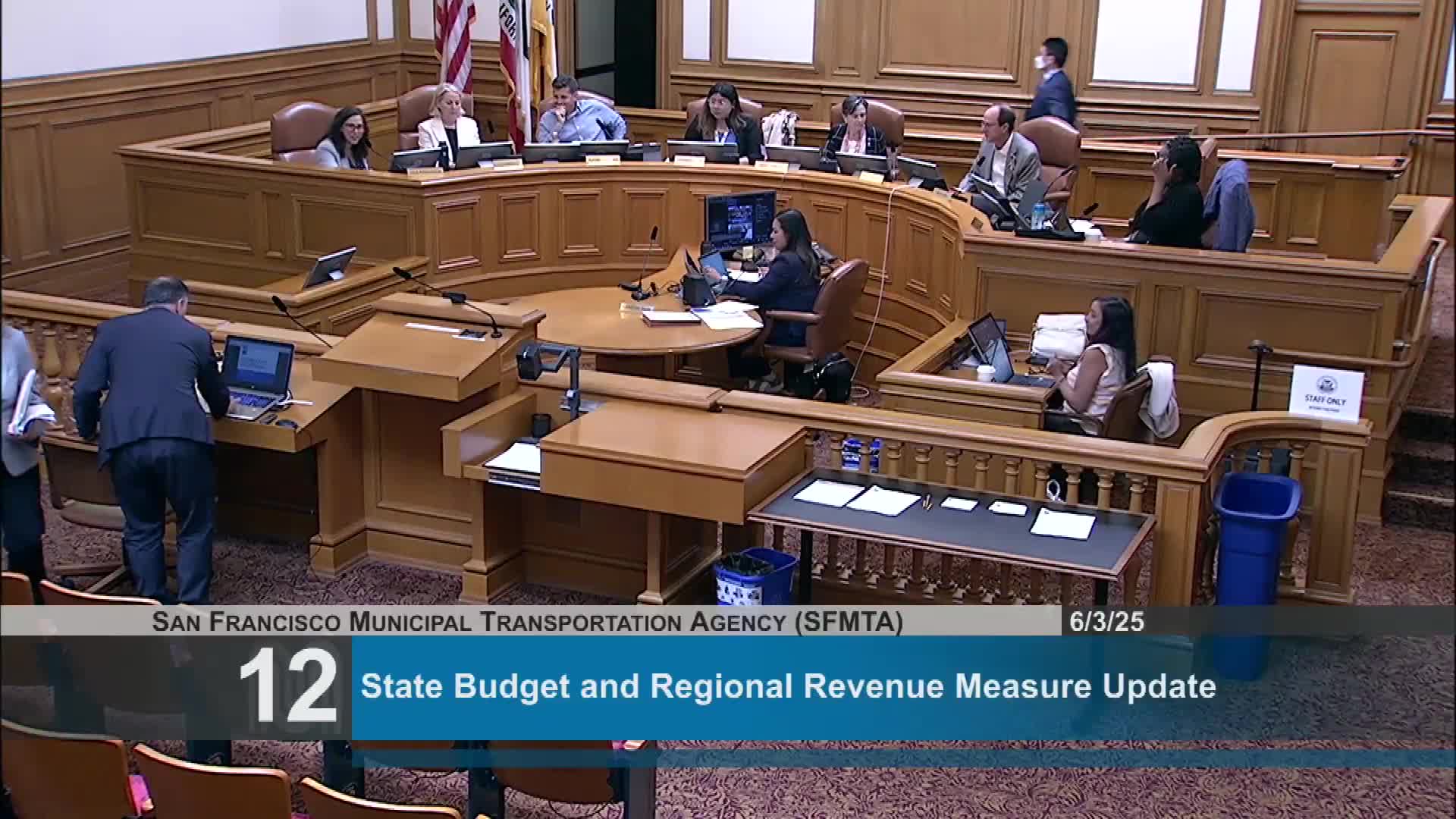
SFMTA staff briefed the board on June 3 about fiscal risks from the state budget May revise and the regional revenue proposal Senate Bill 63, saying shifts in the governor’s cap-and-invest proposal and budget reductions could jeopardize planned transit capital and operating support.
Judson True, SFMTA’s chief of staff and director of external affairs, told the board that the governor’s May revise projects a state shortfall and omitted a $2 billion transit request championed by Bay Area legislators. Staff said the May revise reallocates or delays some continuous appropriations funded by the state’s cap-and-trade program (referred to in the presentation as “cap and invest”) and has prioritized high-speed rail and Cal Fire in its proposal.
True identified programmatic exposure, including about $245 million in capital funding that had been programmed for MuniForward corridor projects and an essential train-control upgrade, and roughly $17 million a year in operating funds tied to the Low Carbon Transit Operations Program (LCTOP) that currently help support discount-fare programs. True said those operating dollars are at risk beginning in the fiscal year that starts July 1, 2026, if current cap-and-invest commitments are withdrawn.
True described SB 63 (Connect Bay Area Act) as a parallel regional effort to raise new revenues. The bill, authored in part by state Senator Scott Wiener, would create a regional district and authorize up to a half-cent sales tax for 10–15 years (with a mechanism allowing San Francisco to consider a full 1¢ option). The board was told the regional bill passed the state Senate and now moves to the Assembly with tight deadlines: a July policy-committee deadline in the Assembly, an August 11 deadline to produce a regional expenditure plan, an August 29 appropriations deadline and a final September 12 session deadline for the Legislature; the governor then has 30 days to act.
True said SFMTA and the city continue to advocate to preserve formula and discretionary funds (including TRSIP and LCTOP) and that the agency is coordinating with the Mayor’s Office, the County Transportation Authority and regional partners. He reported the agency has asked for an allocation of up to $170 million for Muni from a 1¢ San Francisco scenario in the regional measure and emphasized that the state and regional processes run on different timelines: the main state budget must be resolved by June 15, while cap-and-invest reauthorization discussions will likely continue through the summer.
Board members asked staff for more specifics on the likely dollar impact by fiscal year, what discount programs would be affected, and how the timing would affect the SFMTA budget process. Staff said they will return with detailed dollar-year breakdowns after the June 15 state budget deadline and will continue advocacy and coordination with regional partners.