Get Full Government Meeting Transcripts, Videos, & Alerts Forever!
Get email alerts on the Calcutta Docks topic
No spam. Unsubscribe anytime.
Indian River County directs attorney to research options for Calcutta docks after months of dispute
Summary
After hours of public comment and legal briefing, the Board of County Commissioners asked county attorneys to research options for the Calcutta docks at Country Club Point — including abandonment, sale or creation of a homeowners association — rather than taking immediate action.
The Indian River County Board of County Commissioners asked county attorneys to study options for resolving long-running disputes over the Calcutta docks at Country Club Point, directing staff to return with legal and practical options after public testimony and extensive debate.
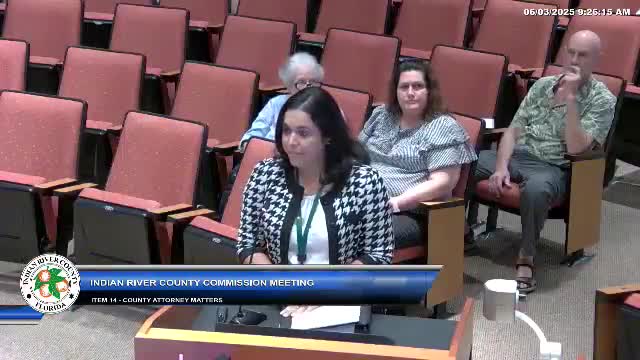
At the meeting the county’s deputy attorney, Susan Prado, told commissioners her office had found no legal “public benefit” supporting the county’s long-running practice of licensing slips at the site and presented five general options: continue renting slips at market rates; abandon the county’s interest to the homeowners association under Florida Statute 336.125; abandon the right-of-way to adjacent property owners; sell the property at fair market value under Florida Statute 125.35; or leave existing licenses as-is. Prado said any option could be challenged in court.
Why it matters: Residents said the docks raise questions about property rights, taxes, liability and county staff time. Commissioners said the county should stop operating what one called “a mini marina” while also trying to be fair to residents who have invested in docks for decades.
County counsel presented the legal background and cautioned that the county had not accepted the canals or docks for maintenance as part of a public system when the subdivision was platted. Prado advised the board that renting slips could be justified as public benefit only if the county received fair market revenue; otherwise abandonment or sale were legally safer paths. “Revenue is actually a public benefit,” Prado said during her presentation, adding that nominal or token transfers require a demonstrable public purpose.
Residents and owners had strongly divergent views. Attorney Barry Siegel, speaking for several dock users, urged abandoning county control and transferring responsibility to a homeowners association, saying the county “has been very gracious” but is not the practical manager of the docks. Other longtime residents described paying substantial sums to build or replace docks and said removing or auctioning slips would be unfair without protections for those investments.
Commissioner discussion focused on three practical routes: (1) sell the property competitively; (2) abandon the county’s interest (which would require legal steps and could include conveyance to an HOA if statutory requirements are met); or (3) require all leases to run to term and then change the program. Several commissioners said their preference was to get the county out of daily marina management; others said a sale could raise revenue for taxpayers. Several speakers suggested giving existing dock users a right of first refusal if the county elected to sell.
The board did not vote on a final remedy. Instead commissioners gave direction to the county attorney’s office to research and return with a concrete plan that would examine (at minimum): whether the county holds title or maintenance responsibility for the strip of land underlying the docks; the applicability of Florida Statute 336.125 for abandonment to a homeowners association; the requirements of Florida Statute 125.35 for a sale process; options for parcelizing property for taxation; and options to protect existing lessees or people who have invested in dock improvements. The county attorney said she would report back with legal findings and implementation steps.
Residents may still face a range of outcomes, the board noted: abandonment, sale by competitive bid, assignment to a homeowners association (if statutory formation requirements are satisfied), or continued county ownership but with revised lease terms and higher fees. Commissioners asked staff for a written memo and asked counsel to coordinate with neighborhood representatives to produce a plan for the board to consider at a future meeting.
The board’s direction means no immediate change to slip use or licenses; Prado told commissioners that licenses are legally cancellable with appropriate notice in many circumstances, but the board sought more structured legal guidance before directing staff to terminate or reassign any individual agreements.
What’s next: County attorneys were asked to return with legal research and a recommended implementation path and timeline. Several owners said they would form an association to accept accountability if that was the chosen route.