Get Full Government Meeting Transcripts, Videos, & Alerts Forever!
Get email alerts on the Electricity Rates And Generation topic
No spam. Unsubscribe anytime.
Lincoln Electric System proposes $180 million turbines, seeks 4% mid‑year rate increase to meet SPP reliability rules
Summary
Lincoln Electric System told the City Council it plans to add two aeroderivative combustion turbines at the Terry Bundy generating station at an estimated cost of $180 million, and will ask the council to amend the 2025 capital budget and approve a 4% rate increase to partially cover near‑term cash needs.
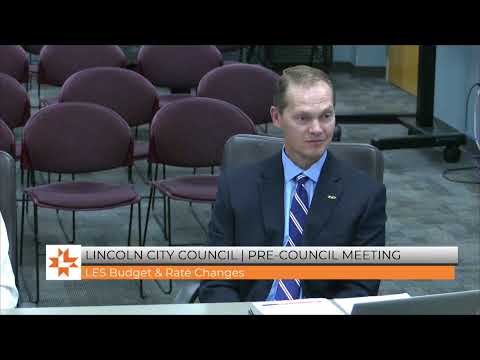
Jason Fortic, vice president of the power supply division at Lincoln Electric System, told the Lincoln City Council at a pre‑council session that LES plans to install two aeroderivative combustion turbines at the Terry Bundy generating station and will ask the council for a 2025 budget amendment and a 4% residential rate increase starting July 1 to help finance the work.
The change is driven by new resource‑adequacy requirements from the Southwest Power Pool (SPP), Fortic said. New accreditation rules, including effective load carrying capability (ELCC), performance‑based accreditation for dispatchable units and higher planning reserve margins, reduce how much of LES’s existing generation counts toward required accredited capacity, particularly in winter. “When you look at all these regulations… it's taking our generating fleet and reducing the amount of it that we get to count for accredited capacity,” Fortic said.
LES presented board materials showing a projected shortfall as early as 2031 if new capacity is not added. The utility’s analysis compared options including combustion turbines, wind, solar and battery storage and concluded that adding combustion turbines at the Terry Bundy site is the lowest‑cost path to restore accredited capacity. Fortic said the utility estimates the project at roughly $180,000,000 and that site infrastructure at Terry Bundy is already laid out to accommodate additional units.
Emily Koenig, LES chief financial officer, outlined the near‑term budget and rate implications. Koenig said LES’s 2025 budget included only a placeholder for additional generation and that recent contractor pricing shows much larger near‑term cash‑flow needs than expected — including an unanticipated potential $25,000,000 of cash outflows in 2025 tied to securing production slots and progress payments for turbines. Because of those cash calls, LES staff proposed a 4% mid‑year rate increase that Koenig said would generate about $6.5 million this year; she said the full revenue requirement to service the long‑term debt on a $180 million project would be about $14.6 million per year (roughly a 4.5% rate impact) before potential financing optimizations.
Koenig said LES acted quickly to educate its board and customers and that the utility expects the project procurement and installation to take about four to five years. “The supply chain issues are real…and every month that we wait to get into the queue are several months on the back end and probably higher cost for us,” she told the council.
LES staff said the proposal has been presented to the LES board, which approved moving forward to pursue the project and related budget and rate changes. Staff outlined the approval steps for the council: a first reading at the current meeting, a public hearing next week, and a request for final action at the council meeting identified by staff as “the 23rd.” Koenig said LES will either seek bond authority this year or return next year for financing authorization; LES already obtains council authorization to issue bonds on a regular two‑year cycle, and staff noted the current authorization (up to $300 million) expires at year‑end.
Council members asked about the project’s impact on the utility’s carbon‑reduction goal and alternatives such as additional renewables or hydro. LES staff said the turbines are expected to run relatively infrequently and that modeling indicates the additions do not, in staff’s view, prevent LES from remaining on a path to its 2040 decarbonization goal. “We don't think it prevents us from staying on the path to meet the 20 40 goal,” a staff speaker said. Staff also said hydro opportunities are scarce and that the utility pursued a small hydro purchase earlier this year that came online April 1.
LES emphasized the role of SPP as a regional reliability coordinator and the driver of the changes: SPP sets accreditation, reserve margin and market rules that load‑responsible entities must meet or face penalties if they demonstrate a persistent deficit in accredited capacity. Fortic and other LES staff framed the project as an action to keep the utility in compliance and avoid future penalties while preserving system reliability.
Next steps listed by LES staff include formal council action on the budget amendment and the rate change after the public hearing and the council’s scheduled consideration on the date staff identified. LES staff also said they will negotiate turbine contract terms and pursue financing; Koenig said LES expects to seek debt structuring and possible refinancing strategies to reduce the long‑term rate impact.
No formal council motions or votes on the budget amendment or the rate increase were recorded in the pre‑council session transcript; staff described the council process and the items that will come before the council for formal action.