Get Full Government Meeting Transcripts, Videos, & Alerts Forever!
Get email alerts on the Public Health topic
No spam. Unsubscribe anytime.
Benton County health department presents $76.7 million proposed budget, highlights new crisis‑response posts and separate health fund
Summary
Benton County health officials told the budget committee the proposed health department budget is $76,700,000, driven by new crisis‑service positions and a change to keep health dollars in a standalone health fund rather than commingling them with general fund resources.
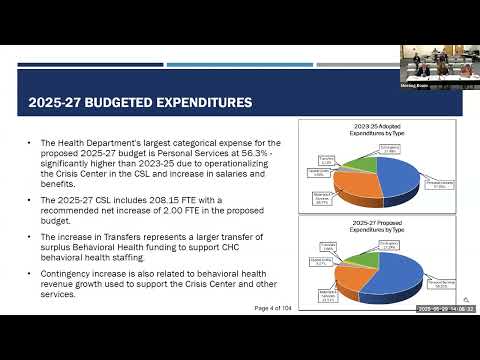
Benton County Health Department Director April Holland outlined a proposed $76,700,000 budget Wednesday that county staff said is about 33% above the adopted level and driven primarily by new crisis‑response positions and funding shifts.
Holland said the personnel increase reflects two main drivers: salary and benefit adjustments and 27 new positions that county staff expect to start being filled in July or August. "There is obviously the driver of the things I've been talking to you over the last couple days in relation to salary increases ... but the other thing is the driver here is 27 new positions," Holland said.
The presentation emphasized a move to separate health fund reporting: county staff proposed isolating dedicated health revenues into a distinct health fund rather than mixing them inside the general fund. Rick (county staff) said the change will make discretionary general‑fund dollars easier to identify. "For the first time this finding, we are actually moving to the health fund. So there will be a separate health fund, from the general fund," he said, adding that most health funding remains dedicated (70.6% cited during the presentation) and typically comes from Oregon Health Authority grants and Medicaid billing.
Officials described staff and program shifts within three primary divisions — public health, behavioral health and developmental diversity — and a shared "health business office" that supports both the health department and the Community Health Centers (CHC). Holland said the behavioral health expansion was a key reason for increased transfers into CHC and for contingency growth.
On reductions and risk, staff proposed several cuts and temporary freezes to balance the budget: management pay freezes and reductions to retirement benefits, elimination of two FTEs (described as eliminations or freezes), and conversion of some limited‑duration positions. Holland and staff warned these choices could affect capacity. "Freezing the communicable disease nurse position ... can diminish the capacity of the CD team or the immunizable disease team to respond effectively and in a timely manner to outbreaks," Holland said.
Staff also described a $1.3 million policy package included in the request and said most of the positions added are funded by dedicated grant resources, not general fund. The vacancy factor applied to current service level (CSL) staff was presented at roughly 2.6%, with a proposed budget that staff described as a modest net change after the policy package and reductions.
Commissioners asked about specifics: funding sources, the communications assessment that is underway, and the status of positions tied to federal grant timing. Commissioner Weiss asked about a communications assessment; Holland said the county contracted an outside consultant to review communications top to bottom and that the county is still uncertain about some federal grant continuations.
Staff flagged several program goals — including rehousing through the county's Flexible Housing Subsidy Pool and development of a young adult behavioral‑health hub — and said certain additions, such as some homeless‑response positions, are funded through special grants and would remain outside of the general fund.
Staff recommended several of the health department's policy option packages for funding, but noted federal and state funding uncertainties could change final decisions. The committee did not take votes on the budget during this session.
The presentation closed with staff emphasizing operational risks — workforce recruitment and retention, federal‑level uncertainty for grants, and the need to monitor communicable‑disease capacity — and with a pledge to return to the board if new revenues appear.