Get Full Government Meeting Transcripts, Videos, & Alerts Forever!
Get email alerts on the Instructional Program Equity topic
No spam. Unsubscribe anytime.
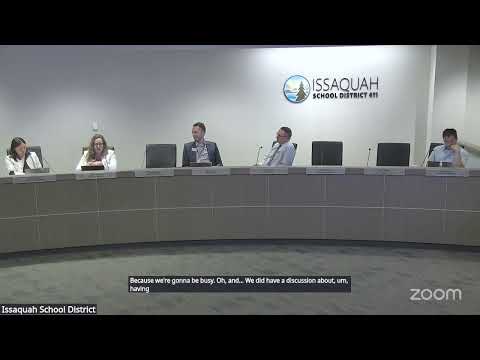
Issaquah School Board rejects emergency monitoring report for instructional program after heated debate on AP/IB equity
Summary
The Issaquah School District Board voted against accepting the emergency monitoring report for Operational Expectation 14 (instructional program) following extended discussion about whether Skyline High School students have equitable access to college-credit opportunities compared with students at Liberty and Issaquah high schools.
The Issaquah School District Board of Directors voted no on the emergency monitoring report for Operational Expectation 14, which covered the district's instructional program for the 2024'25 school year through May 29, 2025.
Board members spent more than an hour debating whether the district provides equitable access to college-credit earning opportunities across its three comprehensive high schools. Director Gallagher said Skyline students currently face an "inequitable" situation because many students there have fewer chances to earn college credits in ninth and 10th grade compared with students at Liberty and Issaquah high schools. "This is where Skyline students have half the opportunity to earn college credits. And that's not okay for me," Gallagher said.
Superintendent Dr. Dana Bailey and academic staff described recent changes intended to expand college-credit pathways: new AP and International Baccalaureate (IB) course offerings, expansion of college-in-the-high-school (CHS) sections, and additional advanced-placement pilots. The district said it has aligned some course syllabi so that certain standard-level IB (SL) classes map closely to on-grade-level curriculum and that some CHS certifications were added to give more students access to transcripted college credit.
But several board members and parents said alignment alone does not erase disparities. Director Taylor argued the board must confront legacy program differences that leave students in different attendance areas with materially different opportunities. "If we could get the same amount of chance to earn the same amount of credit and have the same chance to be competitive, that would make me happy," Taylor said.
Board members also raised concerns that some SL-IB coursework, while presented as "on grade level," is being marketed within buildings as providing college-credit opportunities that may not be accepted as credit by many selective out-of-state institutions. Director Gallagher noted that many top-tier colleges do not award college credit for IB SL scores the way they do for some AP scores and warned that families need clearer information during course selection.
After public and board discussion the motion to approve the emergency monitoring report failed on a voice vote. The board's discussion concluded with officials committing to further work on uniformity of course offerings and clearer communication to families about which courses generate college credit and how credits transfer.
Board leaders asked the administration to return with more detailed, disaggregated data on access to college-credit opportunities by school and student subgroup, and to clarify the implementation schedule for AP expansions and CHS approvals.
The board also discussed running-start, CTE dual-credit mechanics, and the difficulty of comparing AP, IB and CHS pathways because each follows distinct governance rules and acceptance policies at colleges.
Looking ahead, the superintendent said the district will continue phased implementation of AP offerings, expand common course cataloguing and provide clearer communications to families during course-selection periods to reduce confusion about credit opportunities.
Ending note: Board members agreed on the need for a longer, districtwide conversation about how to reconcile legacy program differences and how much uniformity the district should require across high schools. Several directors asked staff to return with concrete options and timelines for aligning math and English pathways—subjects directors identified as foundational for postsecondary competitiveness.