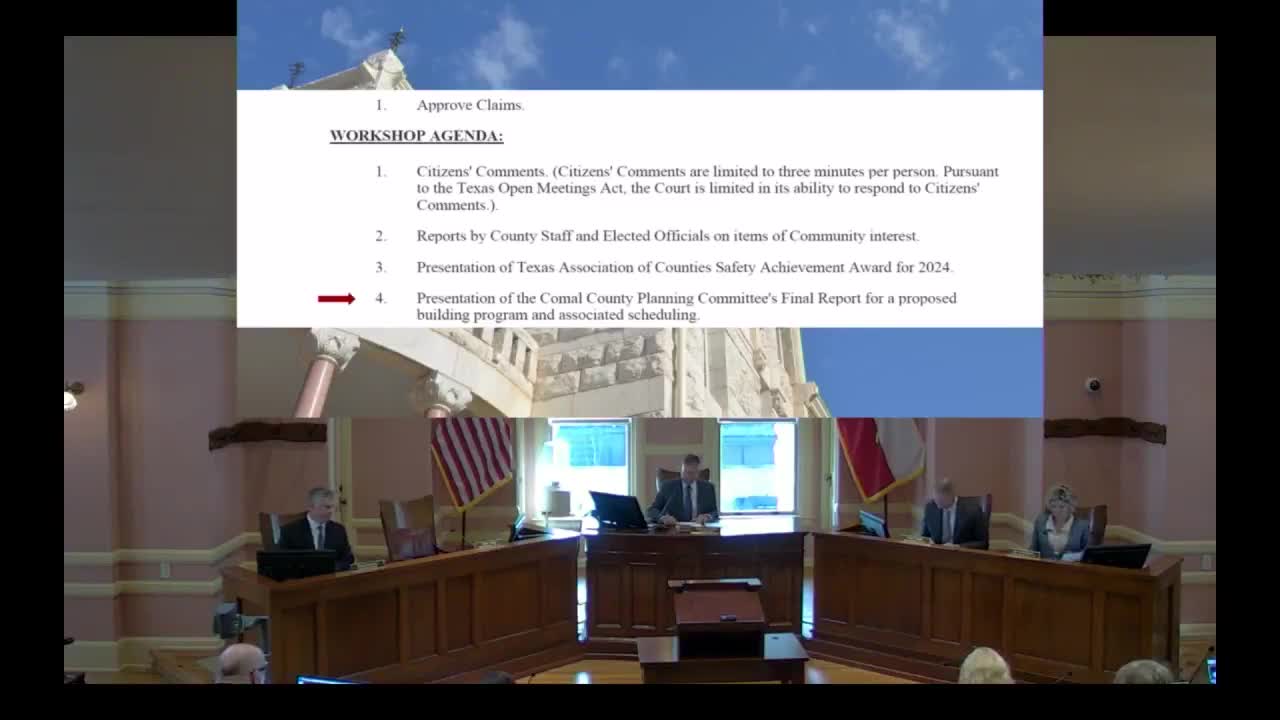
Comal County planning committee delivers 800-page facilities report recommending phased jail expansion, possible new courts building and road projects
Loading...
Summary
A county-appointed planning committee presented an 800-page final report recommending two financing scenarios that prioritize a jail expansion, several satellite office projects, and road connectors; the report estimates multi-year design and construction timelines and flags near-term jail capacity constraints.
Comal County staff presented the Planning Committee’s final report on a proposed county building program and schedule, outlining two financing scenarios that prioritize a jail expansion, several satellite office projects and road work.
The committee’s report, produced after roughly 11 months of work and several consultant studies, recommends that the county make the jail expansion its top priority. Under a scenario that includes a new courts building on the county’s 3150 property (near Loop 337 and I‑35), the court building would follow the jail expansion and trigger a series of remodels and relocations of offices. Without the courts building, the committee’s alternative scenario sequences satellite offices and road projects earlier.
Why it matters: the county’s existing jail capacity and the long lead time for large public buildings make timing and sequencing important. Presenters and commissioners stressed that these are multi‑year, multi‑million‑dollar projects that will require additional design work, financing decisions and public communication.
The committee’s work and main findings
The committee reviewed feasibility studies produced by HDR Architects and Park Hill Architects and compiled appendices and cost estimates into a package the presenter described as roughly 800 pages. The studies considered multiple solutions: (1) expanding the existing jail (HDR); (2) constructing new office buildings or annexes to house justice-of-the-peace and constable offices, tax assessor satellite services, elections storage/space and information technology (Park Hill); and (3) an HDR study of a new courts building on the county’s 3150 property that would centralize some district services and free up existing downtown space for other county uses.
Two financing/build-sequence scenarios are summarized in the report. In both, the jail expansion is the first priority. Scenario 1 sequences satellite office buildings and remodels along with road projects (West Connector and Blanco Road) and anticipates design starting in mid‑2025 and major construction activity through about the end of 2029. Scenario 2 layers in the larger courts building at 3150 after the jail expansion; that sequence pushes the overall program further out, with some elements extending toward the end of 2030 due to added complexity.
Key details and constraints cited during the presentation
- Existing jail capacity: the feasibility material cited in the report shows an existing capacity of 583 beds and projects the county will reach capacity soon if growth continues. - Proposed jail expansion sizing: the HDR material referenced an additional roughly 270–298 beds in the proposed expansion (the report text presents both figures from feasibility options). - Timing: the committee’s example schedules show design beginning mid‑2025 and projects staged through 2029–2030 depending on the scenario. - Project list (selected): jail expansion; tax assessor/IT/elections building; a State Highway 46 annex remodel; a Sattler annex; remodels of existing annexes; West Connector and Blanco Road improvements. - Cost framing: commissioners discussed a large, multi‑hundred‑million‑dollar eventual build‑out for a new courts building (one commissioner referenced roughly $300 million as a “first step” figure for the 3150 courts building), and emphasized the need to demonstrate efficient use of existing downtown buildings before pursuing that option.
Commissioner comments and committee process
Commissioners thanked committee members and consultants and urged urgency on the jail design because of near‑term capacity pressures. Commissioners discussed the tradeoff between pursuing a large new courts building versus a portfolio of smaller satellite projects to relieve pressure on tax, elections and IT functions. One commissioner noted that some design choices—such as ‘‘double‑decking’’ or larger expansions—could reduce the likelihood of needing additional expansions again within a decade.
Next steps and public transparency
The presenter said the report would be submitted to the Commissioners Court and posted on the county website. Commissioners indicated they expect to pursue design work on the jail and some satellite projects as next steps and warned that financing decisions would require separate, more detailed analysis by bond counsel and staff.
Ending
The presentation concluded with staff committing to make the report available online. No formal court action on the planning report was recorded during the meeting; the report was presented for the court’s information and will be available for future decisions.