Get Full Government Meeting Transcripts, Videos, & Alerts Forever!
Get email alerts on the Immigration Enforcement Local Policy topic
No spam. Unsubscribe anytime.
Public urges Cambridge council to tighten 'welcoming community' ordinance to limit local assistance to ICE; council pauses for review
Summary
Dozens of public commenters urged the Cambridge City Council to amend the city’s welcoming community ordinance to bar police and other city employees from assisting federal immigration enforcement; city leaders discussed the proposal but deferred further action so stakeholders can review language.
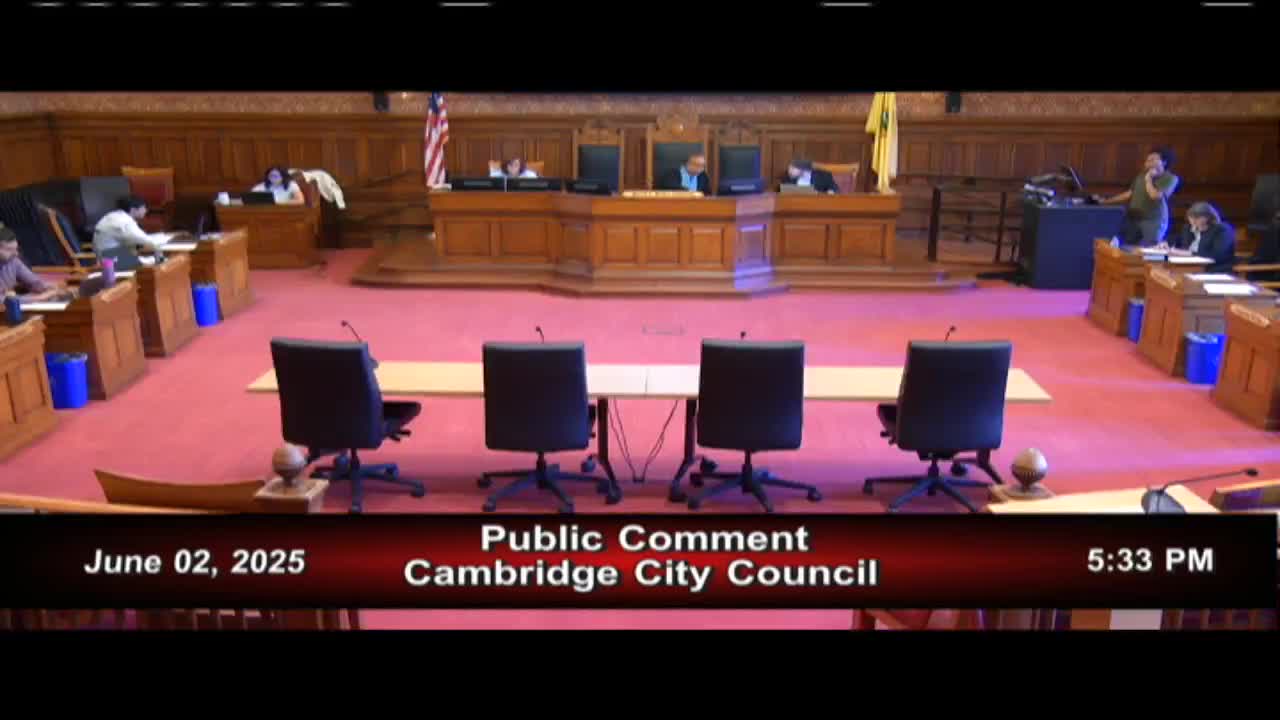
Dozens of Cambridge residents called on the City Council on June 2 to strengthen the city’s welcoming community ordinance by removing language they say allows local police to provide operational support — such as traffic or crowd control — during federal immigration enforcement actions.
Public comments clustered around a single request: remove a clause that permits Cambridge employees to provide "support services" that could be interpreted to include traffic perimeter or crowd-control assistance during a federal operation. Speakers described recent high-profile ICE actions in other Massachusetts cities and nationwide and said they fear local cooperation could enable deportations that violate due process. Several called the proposed amendment "closing a loophole" in the existing ordinance.
What speakers said David Sullivan, a North Cambridge resident, told the council the existing ordinance contains a "huge loophole" that allows local police to assist ICE with support services and crowd control and urged councilors to adopt policy order number 2 to clarify the city's stance. Other commenters, including Julia Schlossman and Kashif Hoda, recounted videos and incidents they described as alarming and urged the council to ensure that local police's role is strictly to protect public safety, not to aid immigration enforcement.
Advocates from the ACLU and local immigrant-rights groups spoke in support of the change. Laura Rotolo of the ACLU of Massachusetts told the council the change is "crucial for immigrants and for public safety" because current practice and tactical choices by federal agents — including masked agents and rapid raids — can blur lines between local and federal authorities, undermining public trust.
What councilors said and next steps Council sponsors (including Councilor Sabrina Wheeler, Councilor Nolan and Councilor Siddiqui) said they had worked with staff to craft clarifying language. During the council's later policy-order review, Councilor Sabrina Wheeler described the two primary aims: (1) make clear the sole role of city employees when federal agents are operating in Cambridge is to protect public safety and (2) empower officers to document and confirm the identities and badge numbers of federal personnel at operations so the city can track incidents.
Council procedure and delay When the policy order came before the council later in the meeting, Councilor Toner exercised a charter right at the request of the Cambridge Police Patrol Officers Association, asking that the association be allowed to review the proposed language with the city manager and police commissioner. That procedural step closed debate for the night; councilors did not vote on the ordinance change.
Why it matters Proponents said clarity will protect immigrant community members’ willingness to report crimes and access city services without fear of immigration enforcement. Opponents warn that local police must retain the ability to address public-safety needs at multi-agency operations; the police association requested time to review operational implications with staff.
Ending Councilors and staff agreed to continue working on language. Councilor sponsors said they expect to return with revised text following consultations with police and other stakeholders.