Get Full Government Meeting Transcripts, Videos, & Alerts Forever!
Get email alerts on the Strategic Planning topic
No spam. Unsubscribe anytime.
Arts Commission hears strategic-plan update; city begins talks to combine arts agencies
Summary
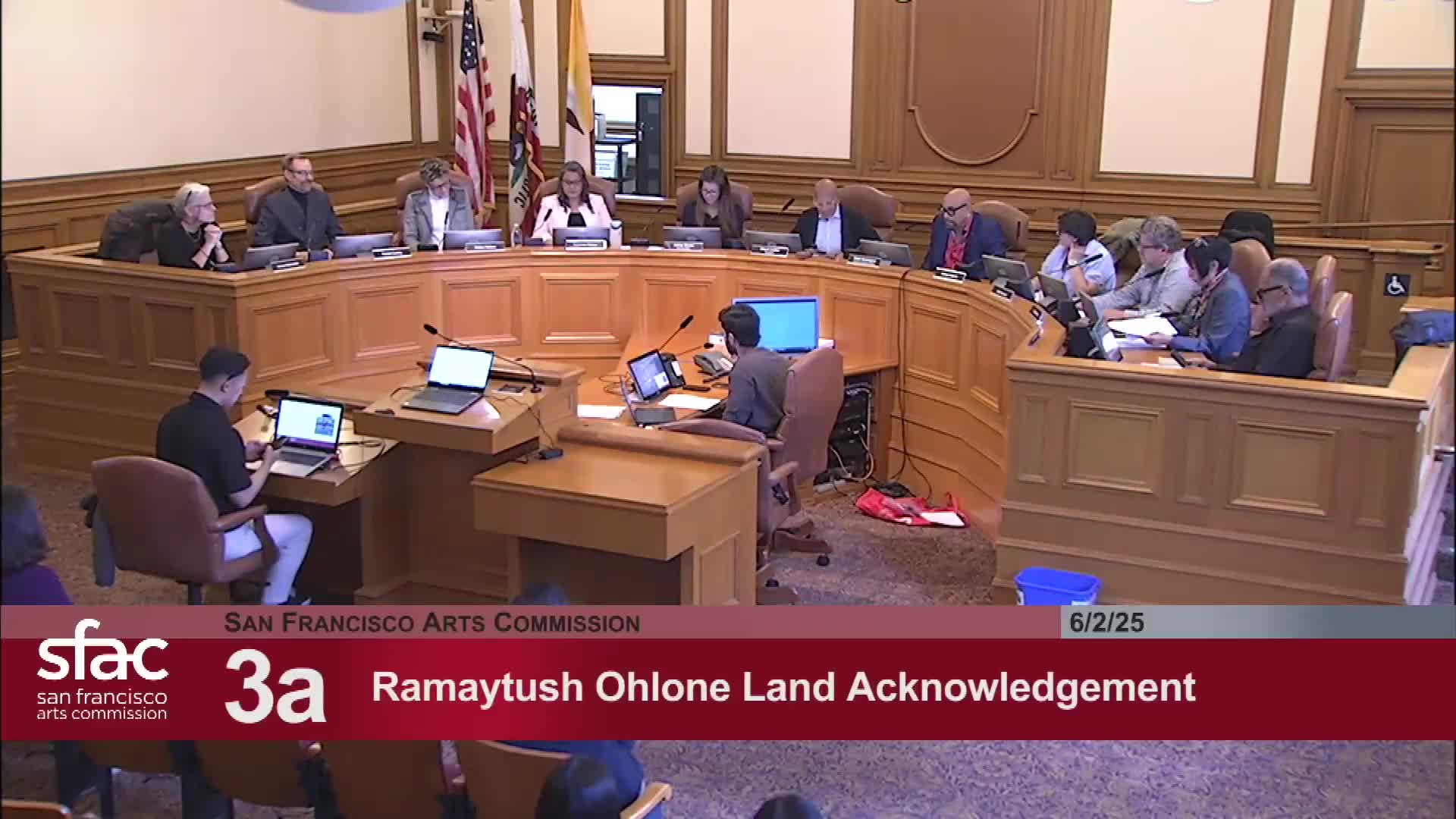
At its June 2 meeting the San Francisco Arts Commission received an update from consultants on a multi‑phase strategic planning process and heard city officials say a proposal to bring the Arts Commission, Grants for the Arts and the Film Commission into a single structure is a preliminary plan to be studied.
SAN FRANCISCO — The San Francisco Arts Commission on June 2 received an update on a multi‑phase strategic planning process and heard city officials say the mayor's office has opened a preliminary process to explore bringing the Arts Commission, Grants for the Arts and the Film Commission into a combined arts department.
Consultant Bill Blake of AMS Planning and Research told commissioners the planning process began in August and has engaged almost 1,000 people: 38 stakeholder interviews, a stakeholder survey with about 109 responses, 730 responses to a broad community survey and roughly 110 participants at open houses. "We are currently in the midst in phase 4, which is the envisioning the future part," Blake said, describing the next months as the period when governance will set high‑level goals and staff will draft objectives and strategies.
The consultants presented a fiscal and program overview of the commission, saying the commission's fiscal 2025 operating budget is about $30,000,000 and that the largest expenditure category is grantmaking, roughly $12,900,000. Lauren Frankel of AMS summarized the community engagement results, saying grantmaking surfaced as a particular strength in public feedback: "we got 730 people to respond to that survey," she said.
Ned Siegel, the city's chief of housing and economic development representing the mayor's office, told the commission the administration has put the consolidation idea into public view to invite broader discussion. "This is the beginning of a process and the end might be somewhere different than where we started," Siegel said, adding that the entertainment commission was not included in the current proposal because its permitting work may be operationally distinct from funding and advocacy functions.
Ralph Remington, director of cultural affairs, noted the commission will be one of several client stakeholders in any combined structure. "The San Francisco Arts Commission is no longer the client in this. All 3 entities are the client," Remington said, describing ongoing coordination with Grants for the Arts staff.
Commissioners asked questions about scope and timing. Commissioner Deborah Walker urged that the entertainment commission and other departments be engaged early if they have overlapping responsibilities. Several commissioners stressed transparency and the continuing role of the commission as a public, oath‑sworn body providing oversight: "The commissions are doing their work to ensure that what happens ... has been plenty of public light on it," President Collins said, urging clear public communications as the process moves forward.
Blake and Frankel described the remaining calendar for the planning effort: committee review of drafted goal language in mid‑June, staff working groups over the summer to develop objectives and tactics, a draft plan presented to the commission in early November, and a coaching/implementation support period through the second quarter of 2026.
The presentation also highlighted peer research on consolidated municipal arts departments — including Austin, Chicago and Denver — and said consultants will follow up with those cities as consolidation options are refined. The consultants and city staff repeatedly framed the current work as designing better capacity and coordination for arts funding, public art and cultural programs rather than as a process driven primarily by budget cuts.
The meeting moved to public comment after the presentation; several speakers, including artists and union representatives, expressed concern about transparency, job impacts and how grant and contracting processes would be handled during any transition.
The commission did not take a formal action on consolidation at the June 2 meeting; commissioners and staff said the presentation is an interim update and that further proposals will come back for discussion before any structural change is implemented.