Get Full Government Meeting Transcripts, Videos, & Alerts Forever!
Get email alerts on the City Budget Housing Vouchers topic
No spam. Unsubscribe anytime.
Cambridge Council approves FY26 budget, creates $5M federal stabilization fund and adds municipal vouchers amid federal funding uncertainty
Summary
The Cambridge City Council adopted a nearly $979 million general fund budget for fiscal 2026, approved a $1 million amendment to create 25 municipal supportive-housing vouchers and established a $5 million federal grant stabilization fund, while passing multiple capital loan orders for parks, schools and infrastructure.
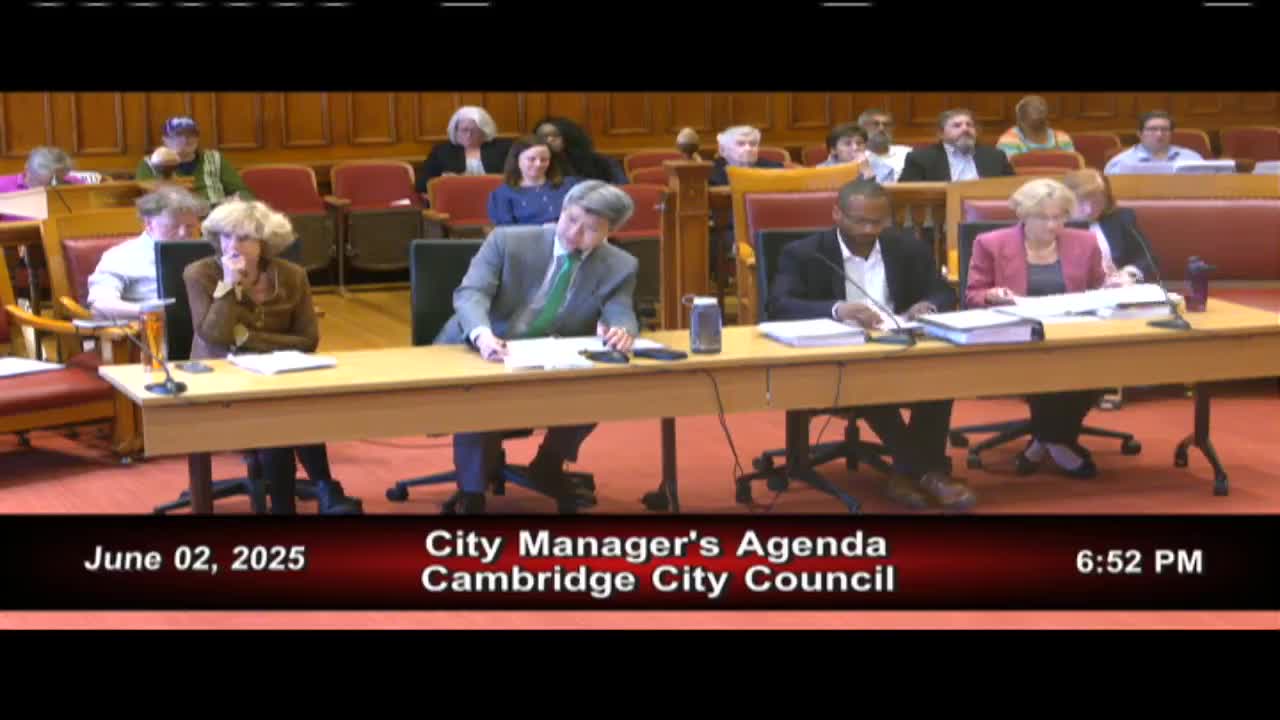
The Cambridge City Council on June 2 adopted its fiscal 2026 budgets and a package of capital loan orders after weeks of budget hearings and a lengthy public discussion about federal funding risks.
City Manager Yuan Wong and budget staff told the council the city faces an uncertain federal funding outlook — with potential cuts to Medicaid, HUD programs and other grants — and proposed two measures to reduce exposure: a new municipal supportive-housing voucher pool funded at $1,000,000, and a $5,000,000 free-cash appropriation to create a federal grant stabilization fund to backstop possible federal cuts.
The voucher proposal would create roughly 25 municipal permanent supportive-housing vouchers paired with supportive services and case management. Assistant City Manager (Simonoff) and staff said vouchers would be administered largely through the Cambridge Housing Authority’s processes and the existing coordinated-entry (CCAN) prioritization system; vouchers could be used in scattered-site units and include funds for supportive services rather than being limited to a single on-site facility. Staff told the council they expect the first of the 25 vouchers to be available by late summer, though they cautioned some vouchers tied to the Transitional Wellness Center (TWC) population would not be available in June when TWC closes.
Wong told the council the stabilization fund would be used as a contingency if federal grants to housing and social services are reduced or delayed; staff cited roughly $12 million in federal grants the city tracks across homelessness, CDBG and other programs as at risk and said the stabilization fund will be guided by criteria the council will approve before allocations are made.
Councilors and public speakers urged urgency for vouchers and clarity on timelines. Vice Mayor McGovern and Councilor Wilson pressed staff about how quickly vouchers could be issued and where people should be referred (staff said the Multi-Service Center/CCAN process is the referral path). Several neighborhood advocates and homelessness service providers asked for faster rollout and detailed implementation plans for supportive services and applicant outreach.
Votes and key outcomes - The council first placed the city manager’s communication about the voucher/stabilization proposal on file (roll call recorded as 9–0). Later the council amended the FY26 general fund budget to include the $1,000,000 for the municipal voucher initiative and referred the amended budget to unfinished business; that amendment passed on roll call (recorded 9–0 for referral). Council then adopted the general fund budget as amended: $978,578,370 (adopted 7 yes, 2 no). The water fund ($13,602,950) and public investment fund ($41,204,770) budgets were approved (each 9–0). - The council created a dedicated federal grant stabilization fund (vote 9–0) and appropriated $5,000,000 of free cash to that fund (vote 9–0).
Capital loan orders As part of its public-investment approvals, the council authorized a slate of capital loan orders (final votes and tallies as recorded at the June 2 meeting): - Ahern Field improvements — $7,500,000 (approved 9–0). - Complete Streets reconstruction — $16,500,000 (approved 9–0). - Municipal facilities improvement plan — $11,100,000 (approved 9–0). - School building upgrades — $19,986,000 (approved 9–0). - Central Square sewer project — $27,500,000 (approved 8 yes, 1 absent). - CSO (combined sewer overflow) storage tank projects — $3,000,000 (approved 8 yes, 1 absent). - Sewer reconstruction projects — $7,500,000 (approved 8 yes, 1 absent). - Water-construction projects — $15,250,000 (approved 8 yes, 1 absent). - Wilderly Playground replacement (additional authorization) — $1,600,000 (approved 9–0).
What councilors and staff said City Manager Yuan Wong summarized the uncertain federal landscape and three milestones the city is tracking: the congressional budget reconciliation process, the state budget, and the federal continuing resolution that runs through September. He said the city is monitoring court challenges and federal agency actions that could affect grant flows and warned that, if federal funding is lost, the city will need to prioritize what to backstop with local funds.
Assistant City Manager Simonoff and housing staff described the municipal voucher design as a permanent supportive-housing model: vouchers will be portable, linked to housing navigators and case management, and intended to prioritize people with long durations of homelessness. Staff said they will work with the Cambridge Housing Authority on program design and use CCAN for prioritization. They estimated some vouchers could be available by late summer for people on the coordinated-entry list, while mixed-status household planning and possible earlier allocation for certain households could be addressed in a coming report to the council.
Public commentary and council concerns Public commenters — including housing advocates and service providers — repeatedly urged faster timelines and clarity about how to reach people at imminent risk. Several speakers asked whether vouchers could be distributed sooner to people exiting the Transitional Wellness Center; staff said Bay Cove had assured bed availability and that vouchers for the TWC population would require more time to implement. Speakers also expressed concern about potential HUD changes to vouchers for mixed-status families; staff said they are planning to provide municipal vouchers as a contingency and will return with an implementation plan.
Why it matters Cambridge’s actions reflect a city-level effort to shield locally delivered social services from rapid federal policy shifts and to create a short-term local backstop for homelessness and housing programs. The $5 million stabilization fund and municipal vouchers are tactical responses intended to maintain services while legal and legislative outcomes unfold at the state and federal levels.
Ending note Councilors said they expect follow-up reports and specific allocation criteria for the stabilization fund. Staff committed to returning with implementation details and timelines in the coming weeks. For people seeking help now, staff said to contact the Multi-Service Center or the coordinated-entry access point for screening and referral.