Get Full Government Meeting Transcripts, Videos, & Alerts Forever!
Get email alerts on the Strategic Initiatives topic
No spam. Unsubscribe anytime.
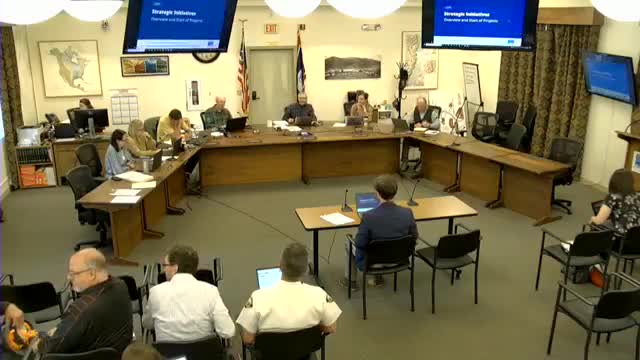
Teton County kicks off two‑year strategic‑initiatives program; eight projects, six‑month updates planned
Summary
Teton County staff presented a two‑year strategic initiatives program on June 2, outlining eight initiatives, named project leads, a shared template for objectives and key results, and a schedule of six‑month updates through December 2026.
Cal Bracken, innovation and engagement manager for Teton County, led a June 2 workshop to kick off a two‑year strategic‑initiatives process that county staff will steward through December 2026.
Why it matters: the program organizes county priorities into measurable objectives and timelines and formalizes project leads and reviewer check‑ins. The commission backed a structure of shared templates, regular updates and staff‑led project teams, with commissioners providing input as a committee of the whole.
What was presented - Scope: eight strategic initiatives with seven project leads and 25 listed collaborators. Initiatives highlighted include ecosystem stewardship and natural resources (led by Chris Neubecker, planning director), policy and organizational structure (led by Jody Pond, commissioners’ administrator), climate sustainability (led by Eric Kimball, sustainability coordinator), transportation (led by Charlotte Fry, transportation manager) and community early childhood education and care (led by Cal Bracken). - Templates and cadence: each initiative uses a shared template with objectives, how the objectives will be accomplished, and a summary of progress. Key briefing dates include a six‑month update (July 28, 2025), 12‑month update (January 2026), 18‑month update (July 2026) and a final report in December 2026. - Early framing: Bracken described a "mission‑oriented" approach and used a working example for the early‑childhood initiative — an illustrative, time‑bound concept of broad access to infant care by 2030 — explicitly presented as a discussion model rather than a board proposal.
Commissioner and staff direction - Commissioners asked for clearer, measurable key results and for project leads to sharpen templates into actionable milestones; Bracken and project leads acknowledged several templates need further specificity and said workgroups will refine key results as meetings proceed. - Commissioners said they prefer to provide input as a committee of the whole rather than through single‑member liaisons; staff and Bracken said they will accept commissioner inquiries and one‑on‑one engagement where appropriate, but the working structure will be staff‑led. - Public engagement: staff said they will develop outreach strategies to bring the initiatives to the community and consider targeted engagement for specific initiatives (for example, early childhood and conservation). Project leads will report progress on the published templates and provide periodic updates to the commission.
"This is the beginning of a living document," Bracken said, describing the "clay on the table" phase of broad idea generation that will, over time, become "meat on the bones" as projects mature and measurable key results are added.
Ending: The board requested regular updates and asked staff to proceed with the template‑driven process; Bracken said the next formal update is scheduled for late July and that project leads will continue refining objectives and key results with staff and collaborators.