Get Full Government Meeting Transcripts, Videos, & Alerts Forever!
Get email alerts on the Zoning Variance topic
No spam. Unsubscribe anytime.
Zoning board reapproves height variance for Crescent/Jefferson affordable housing, ties extension to permit timeline
Summary
The Saratoga Springs Zoning Board of Appeals reapproved an area variance allowing a proposed affordable housing building to reach 48 feet in height (8 feet over the 40-foot limit) and clarified the expiration timeline; the board found no new neighborhood changes and cited a prior negative SEQRA declaration.
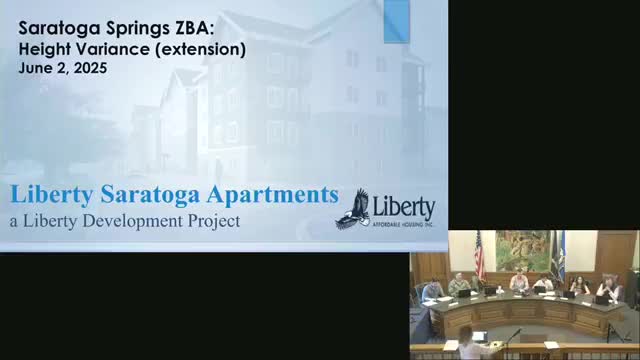
The Saratoga Springs Zoning Board of Appeals on June 2 reapproved an area variance allowing a proposed affordable housing complex at the corner of Crescent Avenue and Jefferson Street to reach a midpoint roof height of 48 feet, 8 feet higher than the 40-foot limit in the UR-4 district, and set the standard expiration tied to filing dates and local rules.
The project team told the board the taller midpoint and a half-gable roof profile were intended to make the building more consistent with Saratoga Springs architecture and to screen mechanical equipment. The applicant said the proposed design and unit count constrained the number of floors and that a lower flat roof would leave mechanical equipment exposed: "We're seeking, 48 feet. 40 feet is the allowable," the applicant representative told the board.
Board members reviewed the ZBA's prior May 18, 2023 decision and a coordinated SEQRA review for the same project that resulted in a negative declaration earlier this year. The board concluded there have been no significant changes in neighborhood circumstances since the prior approval and cited the project's 20-acre wooded buffer between the site and the nearest residential receptors as mitigation for visual impacts.
In the board's draft motion the relief was listed as: district maximum height 40 feet, proposed 48 feet, relief requested 8 feet (20%). The motion's findings mirrored the five standard variance criteria: achievability by other means, undesirable change, substantiality, adverse physical or environmental effect, and self-created difficulty. The motion noted the project remains largely forested and that wetlands on the parcel reduce buildable area.
Board members asked the applicant whether the board could tie the variance expiration to building permit issuance rather than a fixed 18-month clock; staff and other members said the 18-month limit is set by the city council and cannot be changed by the ZBA. The applicant was told they may seek administrative extensions under the rules and, because this was treated as a new application, they may be eligible for two extensions.
The board closed the public hearing and voted to approve the variance. Roll call during the meeting recorded the following votes: Christopher Lapointe — in favor; Jonah Cohen — in favor; Baker Gaston — in favor; Maxwell — in favor; Madam Denla — abstain; Bridal Daley — in favor; H Simpson — in favor. The tally announced on the record was six in favor and one abstention. The motion was entered as dated June 2, 2025.
The applicant and staff were instructed that the city council's time limits and the city's Unified Development Ordinance (UDO) govern expiration and extension procedures; the board noted the county planning board had issued a favorable advisory and that the city council had previously adopted the negative SEQRA declaration.