Get Full Government Meeting Transcripts, Videos, & Alerts Forever!
Get email alerts on the Transportation.speed Limits topic
No spam. Unsubscribe anytime.
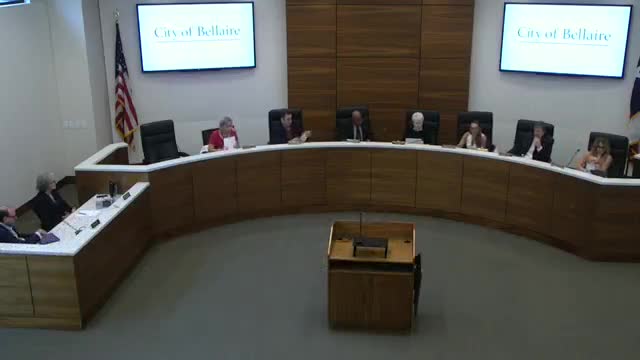
Bellaire council adopts 40 mph limit for I‑610 frontage roads after heated debate over northern segment
Summary
The Bellaire City Council voted on June 2 to amend the city code to set the speed limit on I‑610 frontage roads within Bellaire at 40 mph, following a TxDOT speed‑zone recommendation, after debate over one short northern segment where council members and residents urged caution.
The Bellaire City Council voted on June 2 to amend the city code to set the speed limit on I‑610 (the Interstate 610) frontage roads within Bellaire at 40 miles per hour, adopting a recommendation from the Texas Department of Transportation (TxDOT).
The change matters because the frontage roads carry high‑speed traffic and because some residents and council members urged caution for a short northern segment—between Westpark and Fornace Place—where recent freeway reconstructions and new ramps create merging and lane‑change conflicts. Council Member Cindy (last name not specified) proposed an amendment to keep the 5200–5900 blocks of West Loop South (the northern feeder segment) at 35 mph; that amendment failed in a 3–3 tie. The council then approved the TxDOT recommendation by majority vote; the record shows the ordinance amendment passed with all voting members recorded as in favor when the final vote was taken.
Travis Tanner, the city’s director of development services, told the council TxDOT had completed a speed‑zone study and recommended a 40 mph limit in the frontage‑road areas. Tanner said the city’s code of ordinances still listed 35 mph in some places, while signage along most frontage‑road stretches already posted 40 mph; staff recommended amending the code to align with the posted signs and TxDOT’s engineering recommendation.
Several council members and residents pushed back. Council Member Cindy said she had driven the segment and found no 40 mph signs in that particular stretch; she also said the speed study TxDOT provided dated from 1997 and that the freeway and ramps had been reconstructed twice since then. She described a short distance with merging traffic and ramps that can produce fast, unpredictable lane changes, and she said she worried a higher posted limit would encourage faster driving where lane changes and merges increase crash risk.
Other council members urged deference to the engineering study, noting that speed limits typically follow formal traffic engineering recommendations. Councilman Gordon and other members said adopting a consistent posted speed along the frontage roads would reduce confusion and align the city code with engineered signage.
Council members discussed options: asking TxDOT to reexamine the specific northern segment, hiring a city traffic engineer for a focused study, or proceeding now with the TxDOT recommendation and revisiting the segment later. The motion to keep the 5200–5900 block at 35 mph failed by a 3–3 tie; the council then approved the ordinance amendment reflecting the 40 mph recommendation by the vote recorded at the meeting.
The council and staff noted that TxDOT controls highway and frontage‑road engineering and that city action that conflicts with TxDOT recommendations can create enforcement and jurisdictional complications. Several council members said they might pursue further engineering review focused on the northern segment before making any additional changes.
The ordinance amending the city code to reflect 40 mph on the I‑610 frontage roads was approved and will be reflected in the city’s code of ordinances; the transcript did not show an ordinance number in the record and did not list individual roll‑call votes by name.