Get Full Government Meeting Transcripts, Videos, & Alerts Forever!
Get email alerts on the Lmf Scoring Priorities topic
No spam. Unsubscribe anytime.
LMF board debates scoring priorities, proposes outreach to underrepresented land trusts
Summary
Board members discussed elevating geographic distribution, first-time applicants and threat of losing public access when scoring proposals and asked staff to pursue outreach to underrepresented land trusts and counties.
Board members spent the public portion of the meeting debating qualitative priorities to guide the consensus scoring of Land for Maine’s Future (LMF) grant applications, and they asked staff to help identify underrepresented applicants and consider outreach to increase geographic diversity.
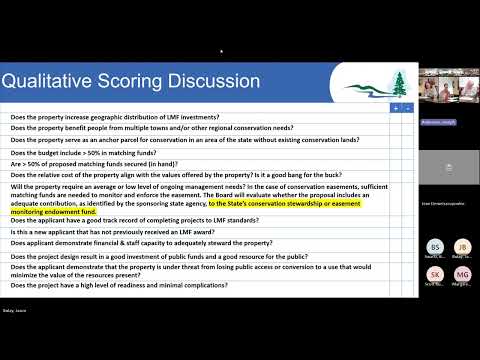
Members identified five priority considerations they wanted to elevate in this round’s decisions: whether a property increases geographic distribution of LMF investments; whether the applicant is a first‑time recipient; whether the property is under immediate threat of losing public access or being converted; environmental resilience; and the project’s benefit to people and communities.
“ If we hear from one of those applicants that we haven't heard from before, it ought to get special consideration,” said Mac Heather, a public member, urging the board to favor proposals from organizations or areas that historically have not applied for LMF funding. Multiple board members said they have observed persistent gaps in applications from several counties and suggested a future survey and coordinated outreach with statewide partners such as Maine Coast Heritage Trust to learn and reduce barriers.
Staff walked the board through the numerical scoring process used to produce a starting point for consensus: individual board scores were entered into a spreadsheet and averaged; staff scores were provided only for reference; the board then used a “grounding” approach to adopt a consensus score for each criterion unless a member objected. Staff explained how they handled out‑of‑range or blank entries when computing averages and reminded members that proposals are confidential until finalists are notified to avoid undue influence on scoring.
Board members also discussed cost‑effectiveness and the difficulty of comparing cost per acre across regions: a large acreage project in a less pressured region can score highly on acres and ecological value but cost less per acre than a small, high‑pressure parcel in southern Maine. Several members argued for balancing both approaches—protecting land ahead of rising development pressure while also supporting town‑edge parcels that provide nearby recreation and community access.
Members asked staff to flag first‑time applicants and geographic gaps during the staff presentation of projects to help the board consider those qualitative priorities during the executive session selection process. The board also agreed it would be useful in future rounds to plan outreach well before application deadlines and to consider earmarking funding for underrepresented regions when appropriate.
The board then moved into executive session to apply the consensus scores and make final project selections.