Get Full Government Meeting Transcripts, Videos, & Alerts Forever!
Get email alerts on the Middle East Conflict topic
No spam. Unsubscribe anytime.
UN official urges immediate ceasefire, steady aid and revival of two-state solution
Summary
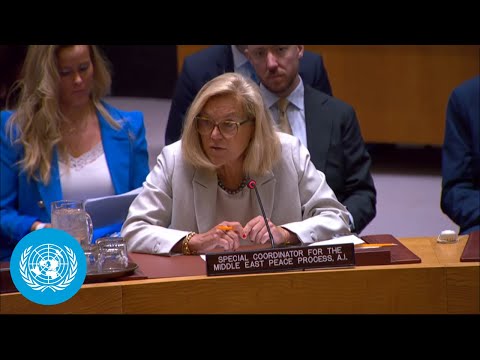
Speaking to the UN Security Council, Ms. Sigrid Kaag urged an immediate ceasefire, unconditional release of hostages, expanded humanitarian access to Gaza and a renewed, time-bound political process to restore prospects for a two-state solution.
Ms. Sigrid Kaag, a United Nations official, told the Security Council that an immediate ceasefire and the unconditional release of hostages are urgent priorities as civilians across Gaza face mounting humanitarian catastrophe. "The hostages need to be released unconditionally, and an immediate ceasefire needs to come into effect," Kaag said.
Kaag told council members that the Israeli hostages and their families have suffered profoundly since the Oct. 7 attacks and highlighted the May 12 release of Eden Alexander as "a welcome but too brief moment of relief." She said limited humanitarian access approved by Israeli authorities on May 18 had allowed some aid to enter Gaza, but described deliveries as "comparable to a lifeboat after the ship has sunk." "Aid cannot be negotiable, and there can be no question of forced displacement," Kaag said.
The UN official urged the Security Council to move from declarations to concrete decisions and to support a political process that would end the occupation and realize a two-state solution. Kaag called the two-state outcome essential and warned that settlement expansion, land seizures and settler violence in the West Bank risk making the arrangement "physically impossible." She urged international support for a reformed and empowered Palestinian government capable of governing both Gaza and the West Bank, while also recognising Israel's legitimate security concerns.
Kaag highlighted that since the collapse of the ceasefire in March civilians in Gaza have been "confined to ever shrinking spaces, and deprived of life saving relief," and warned the population is facing "the risk of famine." She reiterated that the United Nations, including UNRWA, will continue to provide humanitarian assistance "based on the principles of impartiality and neutrality" and said agreements on post‑war security and governance should not be delayed.
Pointing to an upcoming high‑level international conference in June co‑chaired by France and the Kingdom of Saudi Arabia, Kaag said the meeting must do more than issue rhetoric: it should "launch a path towards ending the occupation and realizing the two‑state solution based on international law, UN resolutions, and previous agreements." She also called on Palestinian leadership to address internal divisions and pursue reforms to preserve the Palestinian Authority's viability and legitimacy.
Kaag closed by urging international alignment and a time‑bound political process accompanied by safeguards, and by reiterating the demand for the unconditional return of hostages and remains to families. "Statehood is a right. It is not a reward. Let us not be remembered as the generation that let the two‑state solution disappear," she said.