Get Full Government Meeting Transcripts, Videos, & Alerts Forever!
Get email alerts on the Ems Budget topic
No spam. Unsubscribe anytime.
Lawrence–Douglas County fire-medical outlines 2026 budget options that would cut staff and shift costs between city and county
Summary
Acting Fire Chief Joe Hardy told Douglas County commissioners at a work session that Lawrence'Douglas County Fire Medical (LDCFM) must reconcile rising emergency call volume with a city request to reduce its 2026 contribution by roughly $1.5 million to $1.9 million.
Acting Fire Chief Joe Hardy told Douglas County commissioners at a work session that Lawrence'Douglas County Fire Medical (LDCFM) must reconcile rising emergency call volume with a city request to reduce its contribution by roughly $1.5 million to $1.9 million for the 2026 budget.
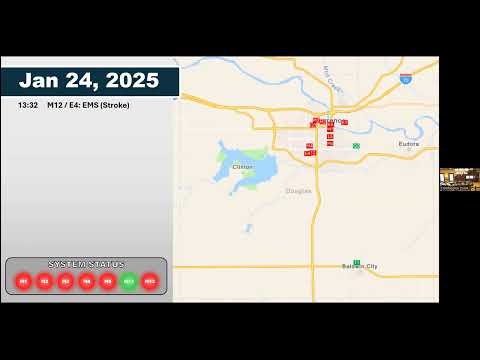
The presentation summarized how LDCFM assigns resources to specific call types, showed recent case studies in which the system reached "status 0" (no ambulances or fire apparatus available) and outlined four budget options that trade staff, service levels and the shared-cost percentage between the city of Lawrence and Douglas County.
Why it matters: LDCFM said call volume has grown substantially over recent years, pushing travel times and resource exhaustion higher in several demand zones. Several of the budget scenarios presented would reduce staffed apparatus or supervisory positions and eliminate multiple full-time-equivalent (FTE) positions, changes LDCFM's leadership warned would make it harder to meet critical tasks on high-acuity calls.
Hardy said the department dispatches units based on "call type" and the critical tasks associated with that call; those tasks do not change even if fewer personnel or different apparatus respond. "Our response times are getting longer, much longer in some areas," Hardy said, citing multi-minute travel-time increases in several county demand zones.
The presentation included three on-the-record case studies from earlier in 2025 in which routine daytime and overnight demand rapidly consumed available ambulances and apparatus. In one January example, a structure fire plus multiple medical calls left the system temporarily without any available fire trucks or ambulances; LDCFM said only a prevention lieutenant in a staff vehicle happened to be on scene and stopped additional property damage. The department described similar episodes in April and May in which routine calls and transfers left the system at or near exhaustion.
Budget options and likely impacts
- Baseline/Green option (initial proposal presented to the city): Using the existing shared-cost methodology (the city pays roughly 64% of shared expenses and the county 36%), the city's target reduction could be met but would require changes to deployments that LDCFM said would increase the county's contribution under that methodology. That option, as presented April 1, showed a possible $2.6 million total reduction to the LDCFM operating budget and a reduction of about 18 FTEs under one scenario; Hardy singled out the elimination of three battalion chief positions (total budget impact cited: $633,000) as a particularly serious operational risk because it would remove a dedicated safety officer and double remaining chiefs' workloads.
- Modified Green / 24-hour ambulance retained: After follow-up discussions, LDCFM developed a variant that keeps an ambulance on 24/7 rather than converting a 24-hour apparatus to a 40-hour schedule. That change reduces but does not eliminate staffing cuts; Hardy said it would produce a net reduction of 14 FTEs and change the shared-expense ratio modestly so the city still meets its target while the county's reduction is smaller than in the earlier scenario.
- Gray option (minimize EMS reductions): This option keeps the six battalion chiefs, the training lieutenant and all seven ambulances fully staffed while still eliminating Engine 5 and converting Ladder 5 to a different staffing posture, and eliminating the prevention lieutenant. Using a shared-expense ratio LDCFM labeled in the presentation (about 61.75%), that scenario would let the city meet its target and would require an initial county contribution of about $183,000 over current levels and a net reduction of about 10 FTEs.
- Expansion ("rainbow") option: If the county agreed to fund an added expansion ambulance, LDCFM said the shared-expense ratio would shift to roughly 59.54%, which would require an additional roughly $1.1 million from the county but would reduce net FTE losses (presented impact: reduction of 2 FTEs in that scenario). Hardy said adding an expansion ambulance is the most direct way to address growing demand but acknowledged it requires additional county funding.
Specific operational changes described by LDCFM and their likely effects
- Reducing three battalion chiefs: would remove the dedicated safety officer function on major incidents and reduce command capacity for simultaneous high-acuity events.
- Shutting down Engine 5 and up-staffing Ladder 5: would reduce available ALS (advanced life support) response units and increase reliance on mutual aid; Engine 5 currently provides ALS staffing that "stops the clock" for response-time metrics.
- Eliminating the prevention lieutenant: would reduce inspections, plan review and community risk reduction work and remove a local responder who in one case prevented greater property damage.
- Removing a training lieutenant: LDCFM said it would lower EMS training hours and slow updates to protocols; the training lieutenant supports both city and rural first-responders.
- Converting a 24-hour ambulance to a 40-hour ambulance: would eliminate four FTEs and leave an ambulance staffed for less than 25% of the week, LDCFM warned this would increase the frequency of status-0 events.
Numbers LDCFM gave the commission
- Current operating budget (approx.): $29,000,000. - LDCFM reported it runs roughly 18,000 calls a year and performs about 1,000'1,100 transfers annually; roughly 700',800 of those transfers are nonemergency. - Under the department's 2025 deployment, 25 personnel were assigned to fire apparatus and 14 to ambulances each day (39 total). Using that staffing, the city's share of shared expenses is about 64% and the county's about 36%.
Commissioners' questions and context
Commissioners pressed LDCFM staff on mutual aid, the practicality of outside nonemergency transport vendors, the department's mobile integrated health pilot and the possible effects of new large venues (University of Kansas's convention center) on call volume. LDCFM said mutual-aid agreements for fire apparatus are used frequently but that ambulance mutual aid is harder to deploy fast enough because units often are already committed; Johnson County was named as a typical mutual-aid source.
Hardy and other staff said mobile integrated health and partnering for nonemergency transfers can reduce some transports but would not, by themselves, return the system to 2017 service levels. Commissioners asked for a three- to five-year forecast; the department said it did not have a single consolidated forecast but can produce one and already maintains station-optimization analytics.
No decisions or votes
The meeting was a work session and explicitly informational: Commissioner Reid opened the session noting that no public comment would be taken and no action would be taken during this work session. County staff and LDCFM presented options and received direction and questions; no formal motions or votes were recorded.
Next steps
County staff said they must prepare a proposed balanced 2026 budget that reconciles county priorities, the shared governance arrangement and a flat mill levy unless the commission directs otherwise. LDCFM said it will provide additional cost comparisons (for example, the cost difference between a 24/7 medic and a 40-hour-week medic and longer-term forecasts requested by commissioners) and that further governance discussions with the city will be necessary to finalize operating commitments for 2026.