Get Full Government Meeting Transcripts, Videos, & Alerts Forever!
Get email alerts on the Clinical Use Cases topic
No spam. Unsubscribe anytime.
Hospitals and vendors point to early efficiency and outcome gains from AI pilots—clinical caution remains
Summary
Health‑system executives and vendors described early clinical and operational results from pilot AI projects — faster documentation, faster imaging‑to‑treatment times, and predictive models — while acknowledging limitations and the need for careful validation and human oversight.
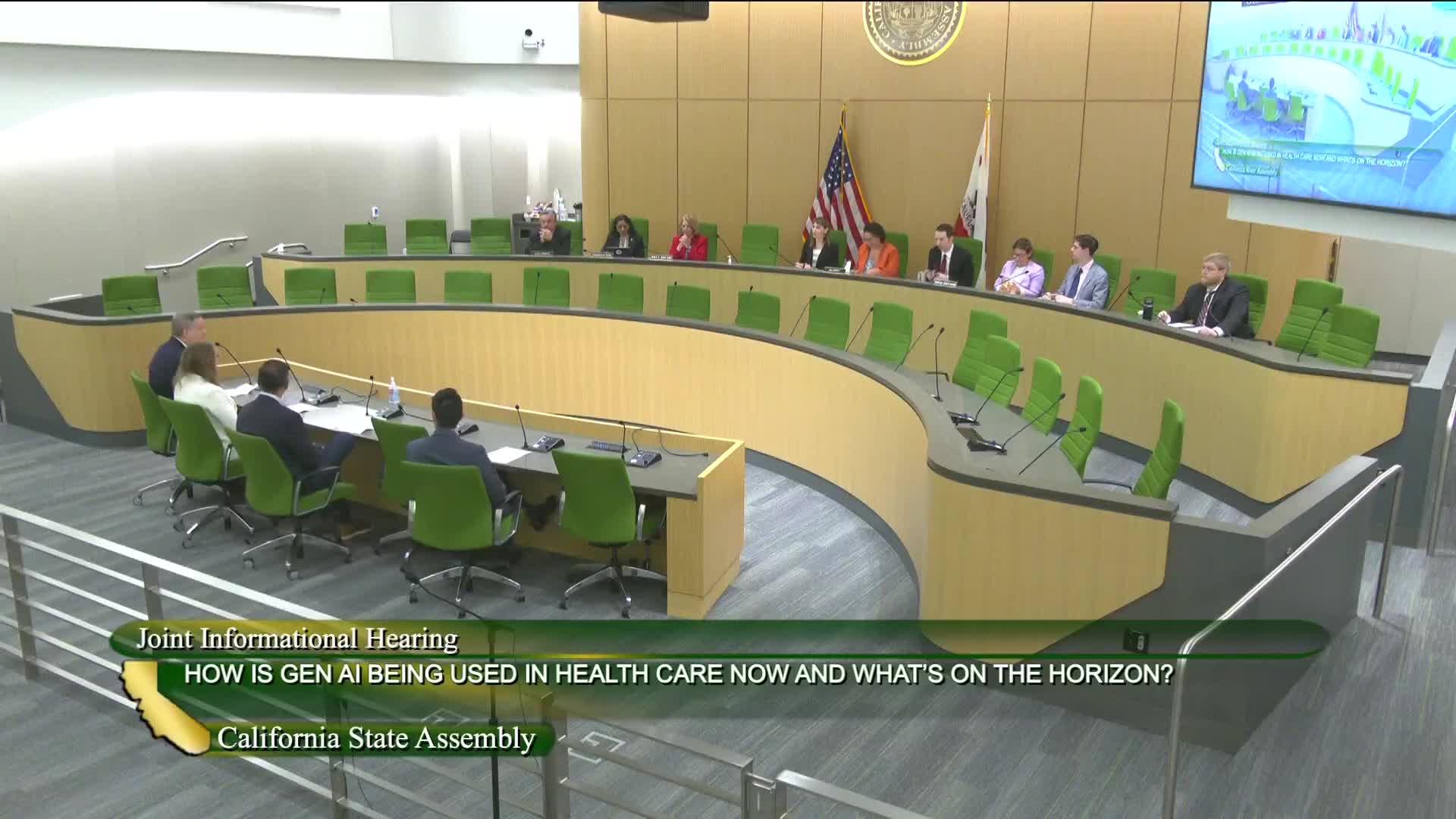
Several health‑system leaders and vendors told the Joint Informational Hearing about concrete use cases and near‑term outcomes from AI pilots in hospitals and clinics.
Cedars‑Sinai’s Craig Kwiatkowski highlighted use cases spanning administrative documentation, nursing documentation via mobile devices, imaging triage and maternal‑fetal decision support. He said an imaging workflow that ranks pulmonary embolism scans and notifies a response team produced roughly a 40 percent reduction in time to mechanical thrombectomy and related reductions in ICU and overall length of stay.
Dr. Daniel Yang of Kaiser Permanente described enterprise deployment of an ambient‑scribe product across clinicians and noted patient feedback that clinicians were more present in visits once freed from keyboard work. Yang also described a deployed predictive inpatient deterioration model that Kaiser evaluated and estimated prevented roughly 500 deaths per year in Northern California, based on local impact analysis.
Vendors and entrepreneurs urged starting with administrative and structured problems—prior authorization, coding and document summarization—where outcomes are measurable and ROI accrues quickly. Fawad Bhatt of Penguin AI said prior‑authorization automation can cut decision times from days to hours in sample deployments.
Panelists stressed that clinical uses pose higher risk and require drug‑development‑style validation, local evaluation and human‑in‑the‑loop safeguards. Multiple presenters noted that imperfect performance still can compare favorably against current practice (for example, notes written by exhausted clinicians), but that measurement and monitoring are essential.
The hearing showcased both promising early results and the limits of existing evidence: some pilots have operational metrics and preliminary outcome estimates, but independent peer‑reviewed studies were not presented for each claim. Lawmakers asked for follow‑up materials and data to evaluate the generalizability of the reported benefits.