Get Full Government Meeting Transcripts, Videos, & Alerts Forever!
Get email alerts on the Marine Debris Shoreline Cleanup topic
No spam. Unsubscribe anytime.
Volunteer removes tons of trash from Virginia Key, warns permits and state preemption limit local fixes
Summary
Volunteer Andrew Tasso told a local shoreline committee he has removed about 30,000 pounds of marine debris from South Florida over eight years and 3,200 pounds from Virginia Key this year, but his city permit lapsed and Florida preemption on local plastics rules hampers broader solutions.
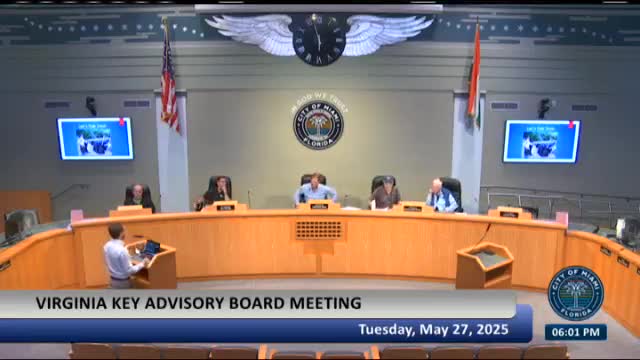
Andrew Tasso, a Key Biscayne resident and volunteer cleaner, told a local shoreline committee on May 27 that he has removed roughly 30,000 pounds of trash from South Florida’s coastal ecosystems over the past eight years and about 3,200 pounds from Virginia Key between February and April of this year. "I've removed 3,200 pounds of trash. That's more than a ton and a half of trash," Tasso said during his presentation.
Tasso said much of the debris consists of Styrofoam, plastic, derelict lobster and crab trap line, and vehicle tires, including an estimated 38 tires and a 220-pound tractor-trailer tire at one dump site. He described multiple sources for the waste: land-based litter washed to the bay during storms, weekend boaters and cruise lines, and illegal beach camping that leaves tents and barbecues. "Everything that we create as a species winds up in the ocean, that winds up in the mangrove," he said.
The presentation focused on two immediate problems: recurring accumulation of trash and limits on volunteer cleanup work because of permitting. Tasso said he had a city permit that allowed him to work on North Pointe in Virginia Key from February through April, but the permit expired and he was told it could not be renewed until October. "I was given the permit back in February... Unfortunately, my permit expired, and I was told that it can't be renewed until October," Tasso said. He described the permitting process for city-managed areas as involving multiple sign-offs because of overlapping jurisdictions, naming the Bill Sadowski Critical Wildlife Area and Florida Fish and Wildlife (FWC) among the stakeholders that needed to sign off.
Committee members and residents asked about recontamination, enforcement and whether the city or county had adequate staff to maintain shorelines. Tasso said shoreline areas near high public use are repeatedly re-cleaned: "If it's along the coastline... I have cleaned up the same areas dozens of times and removed hundreds and hundreds and hundreds of pounds from the same stretch." He contrasted that with interior mangrove areas, which remain cleaner unless a large storm surge moves debris inland.
On enforcement, Tasso said he calls marine patrol, Florida Fish and Wildlife or city police when he finds people trespassing or illegal camping, but that patrols are limited. He described enforcement as useful when it results in tickets that create a deterrent memory: "Once you build that memory in people's heads of, 'oh, if I go to this area, I'm gonna get a ticket, then they'll... be less likely to go there and trash it.'"
Tasso urged systemic fixes in addition to volunteer cleanup. He said cultural stewardship and top-down policy changes are needed, and he pointed to Florida’s preemption laws as a barrier to local restrictions on single-use plastics: "In the state of Florida... you have the preemption laws that don't allow for plastic bag bans," he said, arguing that municipalities therefore lack one tool for reducing plastic at the source.
He also described counting and documenting trash as part of a public-education strategy. He said his cleanup work and social-media posts, along with partnerships (he cited Miami Waterkeeper, the Virginia Key Mountain Bike Club and several volunteer groups), help raise public awareness and encourage action. Committee members in the meeting offered to connect Tasso with an assistant city attorney present to help with permitting and introductions to relevant staff.
The meeting had limited official business: organizers noted at the start they lacked a full quorum, and the group moved to adjourn after the presentation. A member moved to adjourn and "Roger" seconded; the meeting was then adjourned by voice without a recorded roll-call vote.
Tasso asked the committee to consider ways to support continued volunteer work in sensitive mangrove areas and to clarify permitting and enforcement pathways so volunteers can operate safely and effectively. He also suggested producing documentation of recurring trash types and locations to give agencies actionable data.
Ending: Committee members thanked Tasso for the presentation and for his work removing debris from Virginia Key and other local sites. Several attendees asked for his social-media handles and contact information to follow his work and coordinate future cleanups. "You can find me on Instagram. You can find me on Twitter. It's, at Andrew Otazo, o-t-a-z-o," he said.