Get Full Government Meeting Transcripts, Videos, & Alerts Forever!
Get email alerts on the Board Budget topic
No spam. Unsubscribe anytime.
OHA trustees review $17.2 million biennial board budget, debate CIP projects, paid family leave and board counsel
Summary
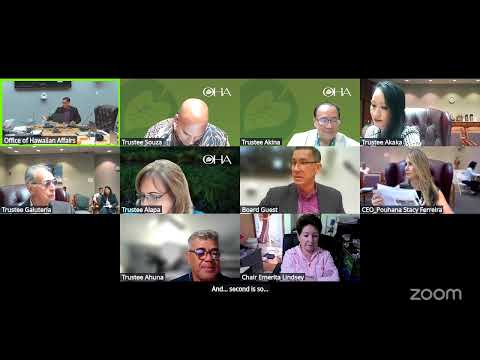
Trustees of the Office of Hawaiian Affairs heard a budget briefing May 27 that proposed a $17.2 million biennium board budget, new capital and programmatic projects across the islands, a paid family-leave insurance policy, and funding for a full-time board counsel. Trustees pressed for more administrative due diligence before committing funds.
Chair Kahele, chair of the Office of Hawaiian Affairs Board of Trustees, presented the board office'''s proposed biennial budget May 27, asking trustees to consider a $17.2 million request that would fund personnel, travel, programs and a slate of capital and program projects across the state.
The budget presentation proposed a $9.1 million personnel and fringe package for the board office, trustee salaries of roughly $2.9 million across the biennium, about $589,000 for trustee travel across both years, and $7.3 million in programmatic and capital project requests. Chair Kahele described the package as "a transformational budget for the board of trustees," designed to support trustee priorities and the board'''s Mauna E Maoliola strategic outcomes.
Why it matters: the board-level budget would commit OHA trust resources to locally driven capital improvement projects and new program spending in addition to routine board operations, a shift trustees said could let OHA use its funds to match external grants and private philanthropy but also requires tighter administrative vetting before final approvals.
Major budget figures and proposals
- Top-line: $17.2 million requested for the board office for fiscal years 2026 and 2027 (biennium). Chair Kahele identified personnel as the largest single category at $9.1 million.
- Trustee compensation and staff: Trustee salaries were estimated at $1.4 million in FY26 and $1.5 million in FY27 (about $2.9 million total). Trustee office staff and board-suite personnel were estimated at about $5.8 million across the biennium. The presentation also included funding for a possible full-time board counsel, with salary and fringe estimated at about $3.71 million for the biennium (a half-year in FY26 plus FY27).
- Travel: The trustees''' travel allotment is approximately $589,000 for the biennium (about $294,000 per fiscal year), covering required neighbor-island site visits and national or international conferences trustees attend.
- Programs and CIP: The board office proposed $7.3 million in capital improvement and program requests across the biennium (about $3.7 million in FY26 and $3.6 million in FY27). Examples presented included: - Kawananakoa Hall and gymnasium renovation (Hilo): $10.5 million total renovation cost described as a three-way cost-share (state CIP $3.5 million, county of Hawaii $3.5 million match, OHA $3.5 million). The gym sits on Department of Hawaiian Home Lands (DHHL) trust land and is run by the county. - OHA Washington, D.C. congressional fellowship: a proposed one-for-one match with a Native Hawaiian organization to fund up to six fellows beginning January 2026; the package cited $210,000 from OHA matched with $210,000 from an NHO for a total of $420,000, estimating about $70,000 per fellow for stipend and housing. - Ulua'''i Learning Center expansion (Kapolei): $250,000 in FY26 and $125,000 in FY27 (total $375,000) for a covered pavilion and related expansion to serve elementary and middle school students. - Kaua'''i heiau and ki'''i work: a multi-part proposal that included acquisition and transport of sacred carvings (ki'''i) and initial due diligence/first-tranche funding. The presentation described an $11,050,000 figure for a set of related actions (including a $50,000 allocation for purchase/transportation of a ki'''i and a proposed $500,000 commitment each fiscal year to advance stewardship/transfers), with stewardship proposed to be transferred to local nonprofit custodians. - Aha O'''pio revival and youth civic program: a proposal to restore the historic program to bring roughly 50 high-school students to O'''ahu for an immersive civic education experience; the board office requested $200,000 annually (estimate) for the program. - Statewide home repairs and renovations program: $1.5 million for home repair grants targeted to Native Hawaiian beneficiaries who cannot access traditional lending (e.g., DHHL homestead residents who are income- or credit-limited). - JABSOM (Department of Native Hawaiian Health) partnerships: a workforce development proposal seeking about $1,750,000 total across the biennium ($877,000 noted in the presentation for specific student/fellow supports) to expand medical and behavioral health training pipelines for Kanaka Maoli at the John A. Burns School of Medicine. - Avayai'''ulu and language/cultural initiatives: a request to support revitalization projects; OHA staff described a proposed $250,000 per fiscal year support commitment in the presentation. - Post-baccalaureate higher-education scholarships: $250,000 per fiscal year (total $500,000) to support 8'''10 recent graduates pursuing advanced degrees. - Hawaiian registry program expansion: a proposed increase from previous budget estimates to $75,000 per fiscal year to grow OHA'''s Hawaiian registry.
Trustee debate: due diligence, process and partnerships
Trustees generally expressed support for many of the community projects but repeatedly pressed for more administrative vetting and due diligence before allocating funds. Trustee Morita Hula Lindsay said she was "not comfortable about somebody just coming to the board at a B&F meeting and asking for that kind of money," and asked that administration and any ad hoc review panels supply background information so trustees can make fully informed decisions.
Trustee Galutaria urged increased funding for the Hawaiian registry and framed the registry as a data resource for policymaking: "Data is king when making policy," she said, arguing the registry enables demographic analysis and program targeting. Other trustees highlighted the value of leveraging outside partners: Chair Kahele and others described one-for-one matches from Native Hawaiian organizations (NHOs) and private donors as an important part of reducing net OHA expenditures on some projects.
Two board proposals drew particular discussion:
- Board legal counsel: The presentation included funding to transition from the current part-time contract board counsel to a full-time board counsel, estimated at about $3.71 million for the biennium (salary and fringe, including a half-year in FY26). Trustees discussed whether some legal work could be handled by the state Attorney General'''s office and cited past conflicts that led OHA to obtain separate counsel. Trustees noted a bylaws amendment would be required to add a full-time board counsel, and the board would follow a multi-step hiring process if it chooses to proceed.
- Paid family leave for OHA staff: The budget presentation proposed an insurance-funded paid family-leave benefit estimated at $188,000 per fiscal year ($376,000 total across the biennium) to provide up to 12 weeks of fully paid family leave (retroactive to Jan. 1, 2025). Chair Kahele and multiple trustees described the benefit as a tool to recruit and retain staff and to differentiate OHA as an employer of choice. Trustees asked administration to provide actuarial detail and HR vetting; staff said they had begun work with an insurance broker and would present deeper analysis in follow-up meetings.
Administrative and next steps
CEO Stacy Ferreira and staff flagged that many project proposals would undergo additional administrative review and, where appropriate, competitive procurement or memoranda of understanding with partner agencies or nonprofits. Staff noted carryover funds of roughly $5 million (discussed in the presentation) could be applied to capital projects if trustees chose that route. Several trustees requested more granular backup materials, page references in the packet, and additional financial analyses before final adoption.
Votes at a glance
The meeting concluded with a motion to adjourn and a roll call; trustees recorded an "Aye" vote during that final call. No trustees voted during the meeting to adopt any budget line items; the committee scheduled further hearings and a June 17 Budget & Finance meeting for follow-up.
Ending
Chair Kahele and committee staff said they would incorporate trustee input, pursue additional vetting and partner outreach over the next two weeks, and present a revised budget and supplemental materials at follow-up committee meetings in June. Trustees emphasized the need for clear due-diligence packages and administrative recommendations before any final board-level funding decisions.
(Quotes and attributions drawn from the committee hearing transcript; direct quotations are from speakers listed below.)