Get Full Government Meeting Transcripts, Videos, & Alerts Forever!
Get email alerts on the Gaza Humanitarian Crisis topic
No spam. Unsubscribe anytime.
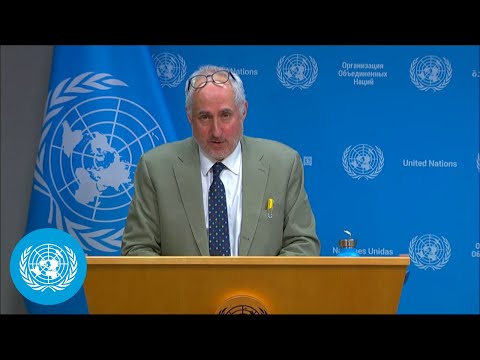
U.N. spokesperson: Gaza aid deliveries hampered; videos from distribution sites "heartbreaking"
Summary
The U.N. spokesperson said humanitarian operations in Gaza remain severely constrained, with videos from distribution sites described as "heartbreaking," fuel shortages in the south, and trucks cleared at Kerem Shalom still at the loading dock.
The U.N. spokesperson said Friday that aid deliveries to Gaza are being hampered by security and coordination challenges, describing recently released footage from a distribution site as “heartbreaking.”
The spokesperson said the U.N. and partners have a “detailed principled operationally sound plan supported by member states” to move aid at scale and that a “meaningful scale up of humanitarian operations is essential to stave off famine and meet the needs of all civilians wherever they are.”
U.N. humanitarian partners reported continued bombardment across the Gaza Strip and severe impacts on civilians. The Ministry of Health, the spokesperson said, reported “dozens of people killed and over a 50 injured just in the past 24 hours.” The briefing cited a strike on a school shelter in Adaraj in eastern Gaza that reportedly killed 36 people, including women and children; many bodies were described as severely burned.
The spokesperson said recent Israeli displacement orders cover roughly 55 square kilometers (the speaker corrected units) and affect more than 60 neighborhoods — “over 40% of the Gaza Strip,” overlapping prior orders. Since renewed hostilities in March, partners estimate more than 632,000 people have been forced to flee again and many internally displaced people are living outdoors, exposed to heat and lacking food.
Fuel shortages are acute, the spokesperson said: some 200,000 liters of fuel are required per week across Gaza to sustain water and sanitation operations. Northern Gaza has secured enough fuel for about two weeks, but no fuel was available in the south at the time of the briefing, and only one-third of required weekly supplies was received the prior week.
On access and logistics, the spokesperson and a U.N. staff member identified as Deji said roughly 100 trucks had been cleared at the Karim (Kerem) Shalom crossing and were at the loading dock after crossing into Israel; as of the briefing the U.N. had no confirmation those consignments had reached warehouses inside Gaza. “We’re still trying, we’re desperately trying to deliver aid based on our system that has worked,” the spokesperson said. Deji said U.N. teams were attempting to pick up supplies from the Palestinian side of Karim Shalom but noted the process “demands coordination with the Israeli forces” and safety assessments for routes.
Journalists pressed the U.N. on why other groups appeared able to distribute aid more quickly. The spokesperson said the U.N. applies “principles of independence, impartiality” and had reviewed the plan of other actors; the U.N. concluded that the other group’s parameters did not match those principles and therefore the U.N. was not participating in those distributions.
The spokesperson repeated calls for all crossing points to open for humanitarian and commercial goods and said U.N. partners “stand ready to deliver at scale.” The briefing emphasized that international humanitarian law must be respected and that civilians, including those displaced and those who remain, must be protected.
The briefing closed with pleas for increased flexible funding, unimpeded access, and clarification of logistics so aid can move from crossings to warehouses and then to civilians in need.