Get Full Government Meeting Transcripts, Videos, & Alerts Forever!
Get email alerts on the Police Accountability topic
No spam. Unsubscribe anytime.
Caroline County commissioners advance police-accountability ordinance after technical amendments
Summary
After a two-hour discussion and a briefing from the Maryland Police Training and Standards Commission, Caroline County commissioners amended legislative bill 2025-006 to clarify procedures for the Police Accountability Board (PAB) and Administrative Charging Committee (ACC) and voted to move the draft to third reading for public review.
Caroline County commissioners on May 27 advanced a local ordinance establishing a Police Accountability Board and Administrative Charging Committee, adopting multiple technical amendments after a state training official told the panel that local governments must fill in gaps left by the state statute.
The move came after Wayne Silver, executive director of the Maryland Police Training and Standards Commission, briefed the commissioners on how counties across Maryland have implemented the Police Accountability Act and the ACC process. Commissioners then debated changes to legislative bill 2025-006 and approved several amendments; the board voted to send a redrafted ordinance to a third reading and make the revised version available for public review.
Why it matters: The ordinance would create a new chapter (Chapter 20) in the Caroline County Code defining the PAB, the ACC, and trial boards, including membership, training, meeting standards, and record-keeping. Commissioners said the local ordinance must provide procedural detail the state regulation left unspecified so ACCs and trial boards can operate consistently and fairly.
Silver told the commissioners the state commission’s reading of the statute is that ACCs do not themselves have subpoena authority. "What our interpretation of the law is ... is that it is the law enforcement agency that would issue the subpoena if it was necessary," he said, adding that in practice the ACC should work with the law enforcement agency to request missing investigative material rather than try to compel an officer directly.
Commissioners discussed a range of amendments raised by the county’s ACC, the local PAB and chiefs and sheriff representatives. Key changes adopted included inserting the state statute definition of "police misconduct" directly into the county ordinance (drawing on Public Safety Article §3-101); requiring ACC rules of procedure to be submitted to the county commissioners for approval; and changing residency language so board members must reside in Caroline County at the time of appointment rather than for three prior years.
The commissioners also removed a clause that explicitly mimicked statutory language about ACCs "requesting the issuance of subpoenas"; the board replaced that phrasing with more circumscribed language directing ACCs to request additional information from the law-enforcement agency and permitting the agency to use legally available means to obtain that material. Commissioners said they wanted the ordinance to reflect practical limits on local subpoena powers and to encourage cooperation between ACCs and law-enforcement agencies.
Other adopted amendments addressed member eligibility and conflicts: the ordinance now defines an "immediate family" list for disqualification, limits service by members whose law-enforcement family members serve under the jurisdiction of Caroline County, and preserves existing local members while restricting future appointments from local chapters of police fraternal organizations. Commissioners also added a provision allowing PAB members to attend meetings remotely.
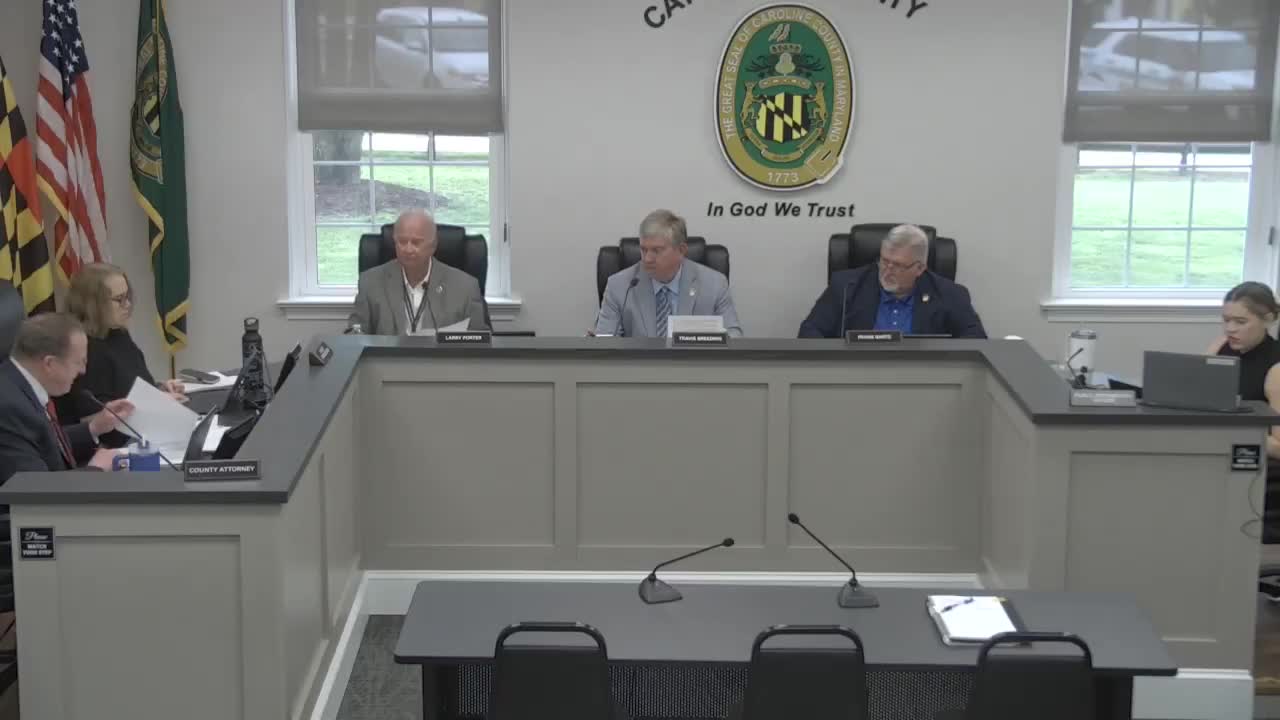
Commissioner Stuart Barrell presided over the public hearing and the amendment process; after each motion the board voted verbally ("aye") to adopt changes. After the amendment package was completed, the board voted to move the ordinance to a third reading and to make the redrafted bill available for public review before final action.
The state training director cautioned that ACCs fall into two patterns: larger, busier ACCs that risk treating reviews as a paperwork exercise, and smaller ACCs that hear too few cases and risk forgetting training. He recommended clear, written local procedures, an initial jurisdiction check for each case, and regular refresher training. "The process is working," he said, "however, discipline comes a lot slower than it used to."
The commissioners did not close public comment on the topic—several written submissions from the PAB, ACC and law-enforcement leadership had been distributed to the board and were discussed during the hearing. The board closed the public hearing on the bill and approved the motion to advance the ordinance for another reading.
The next step: Commissioners directed staff to produce a redrafted ordinance incorporating the amendments and to post it for public review prior to a third reading.