Illinois posts Adult Redeploy NOFO offering $1.5M for local prison-diversion programs
May 25, 2025 | Criminal Justice Information Authority, Illinois, C, Boards and Commissions, Executive, Illinois
This article was created by AI summarizing key points discussed. AI makes mistakes, so for full details and context, please refer to the video of the full meeting. Please report any errors so we can fix them. Report an error »
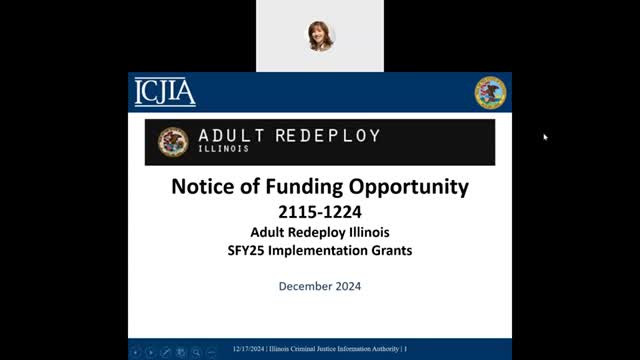
The NOFO, posted Dec. 17, 2024, awards grants ranging from $50,000 to $1,000,000 with an estimated 1 to 5 grants to be funded for the period April 16, 2025, through April 15, 2026. "The application due date is 5PM on 01/17/2025," Dyer said during a program webinar describing eligibility, application requirements and the review process.
The NOFO is intended to fund local plans that establish or expand alternatives to incarceration for people with probation-eligible offenses. The program is administered by the Illinois Criminal Justice Information Authority (ICJIA) and was created by the Crime Reduction Act of February 2009. Dyer said Adult Redeploy Illinois (ARI) uses performance incentive funding and justice-reinvestment principles and currently supports 26 sites covering 45 counties and more than 50 diversion programs.
Applicants and eligibility
Only county units of government or judicial circuits may apply directly; other local governments and nonprofit or private agencies may serve as subawardees or subcontractors. Applications must include a completed local plan (the program narrative), a logic model, letters of support and a budget with narrative. Required letters of support must include the chief judge or presiding criminal court judge, the state's attorney, the public defender and the director of probation or court services.
Target population and performance requirement
Dyer explained that ARI-funded programs must focus on people with probation-eligible offenses who are "prison bound" — meaning a proxy assessment of moderate to high risk to reoffend — and that applicants must set a reduction goal equal to 25% fewer commitments to the Illinois Department of Corrections from the defined target population. Progress is measured by diversions or enrollments in lieu of incarceration. Dyer said the ARI Oversight Board may require corrective action plans and can assess a penalty if a grantee does not meet its reduction goal; the penalty is currently estimated at half the marginal cost of imprisonment.
Funding, allowable costs and cost-effectiveness
Available funds total $1,500,000. Grants may be used for personnel, training, travel, program supplies, treatment services (behavioral health, substance-use disorder and mental-health services), wraparound supports such as transportation and housing, incentives, data collection and evaluation, and — rarely and only for government agencies — vehicles. Applicants must show the program is cost-effective compared with incarceration; Dyer cited a figure for the cost per person in prison of $49,300 and asked applicants to calculate cost per person served for their proposal.
Application process and technical details
All applications must be submitted through Amplifund (the state's grant management system) via the Illinois Grants Accountability and Transparency Act (GATA) portal. Dyer warned that Amplifund times out after 20 minutes of inactivity and advised applicants to save frequently. The NOFO posts supporting documents on the ARI grants web page, including county-level eligibility tables, Excel templates for the budget and a logic-model template.
Scoring and review timeline
Applications will be screened by ARI and ICJIA staff, then scored by an expert panel on a 100-point scale; the minimum score for funding consideration is 70. Site Selection and Monitoring, a working committee of the ARI Oversight Board, will prepare funding recommendations for the Oversight Board to approve at its February 2025 meeting. Dyer said the NOFO’s question-and-answer period closes Jan. 9, 2025; responses will be posted weekly on the ARI/GATA pages.
Reporting and evaluation
Awarded sites must submit quarterly progress reports and upload required data elements electronically; grantees must participate in external evaluations. Dyer said corrective action plans are available if a grantee risks failing to meet its reduction goal, but the Oversight Board retains authority to impose penalties under the Crime Reduction Act.
Contact and next steps
Dyer identified Stacy Woods as the ARI program manager and contact for the NOFO; questions must be submitted to the CJA email address provided on the ARI website. Dyer closed by reiterating the application deadline and the required components: the uniform grant application, program narrative (local plan), letters of support, logic model, implementation and performance plan, and a 12-month budget and budget narrative.
The webinar recording and application resources, including county eligibility tables, templates and prior ARI materials, are available on the ICJIA website's ARI grants page.
Don't Miss a Word: See the Full Meeting!
Go beyond summaries. Unlock every video, transcript, and key insight with a Founder Membership.
30-day money-back guarantee
Sponsors
Proudly supported by sponsors who keep Illinois articles free in 2025

